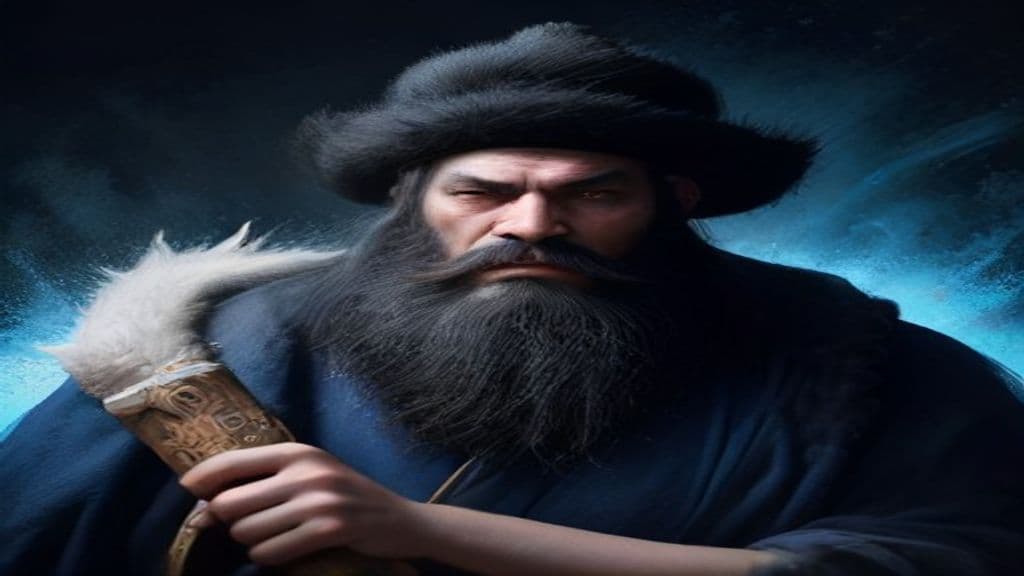
In Tang-era accounts preserved in later anthologies and narrative inscriptions, Emperor Xuanzong dreamed of a confrontation between a small thief-ghost (named Xuhao) and a larger wrathful figure who seized and punished the smaller spirit. The larger figure identified himself as Zhong Kui, described as a failed imperial examination candidate who died shamed and thereafter devoted himself to hunting harmful spirits; the emperor honored him and commissioned a likeness (a painting attributed in tradition to Wu Daozi). Sources also stress that Zhong Kui's ultimate origins remain unresolved and are the cumulative product of folk practice, ritual, and literary-artistic creation across centuries.
Sources describe Zhong Kui as a large, fearsome man with a big black beard, bulging eyes, and a wrathful expression. Tang-era narrative detail adds hair dishevelled, beard bristling, clad in a blue robe and battered cap in certain accounts; one sleeve stripped and legs bound in hide appear in some dream-inscription variants. A painting attributed in tradition to the master Wu Daozi provided a vivid likeness that influenced later iconography.
Narrative and ritual sources portray Zhong Kui as locating, seizing, punishing, and subduing petty and harmful spirit-beings (for example, the dream-account in which he seizes the thief-ghost Xuhao, gouges out and devours its eyes). He is depicted as an incorruptible champion of justice who rids the world of certain evil ghosts on behalf of the living, and later summaries attribute to him command over vast numbers of subordinate demons (a modern summary notes he can command '80,000 demons' as part of hagiographic accretion). His invocation and depiction are credited with therapeutic/exorcistic effects in ritual contexts (e.g., resolving the emperor's malarial fever in the dream-narrative and functioning in Nuo exorcistic rites).
Weaknesses
None recorded.
Wards
- symbolZhong Kui portrait/painting
- ritualImperial bestowal of Zhong Kui portrait at year's end
- ritualInvocation in New-Year Nuo rites (除夕鍾馗驅儺文)
Azure Dragon (Qīnglóng)
The Azure Dragon (青龙 / 青龍 Qīnglóng) is one of the Four Symbols of Chinese constellations and a principal astral/territorial guardian associated with the eastern quarter of the sky and the season of spring. It functions as a cosmological and civic protective emblem appearing in temple iconography, tomb murals, and syncretic links to named Dragon Kings.
Chen Jinggu (陳靖姑)
Chen Jinggu is a historical‑legendary Taoist woman venerated as a protective goddess of women, pregnancy, childbirth, children, and coastal communities in Fujian and Taiwan. Remembered as a Lushan‑school priestess who used ritual power to end a drought and vanquish a white snake, she was later honored in temples and mediumship and is incorporated into modern maritime devotional calendars.
Da Siming
Da Siming (大司命) is a deified official-title in Chinese religious-cultural frameworks representing an office that administers and ‘‘makes fine adjustments to human fate.’’ The figure appears in textual and religious contexts as part of a bureaucratic cosmology of cosmic administration and is often presented as one half of a dyadic pair with Shao Siming.
Daode Tianzun
Daode Tianzun (道德天尊, 'Heavenly Venerable of the Way and its Virtue') is one of the highest deities in Taoist cosmology, a member of the Three Pure Ones and the transcendent personification of the Dao (Way) and De (virtue). Closely identified with Laozi and commonly titled Taishang Laojun, he functions as a supreme heavenly teacher, object of worship, and ruler of the Taiqing (Great Pure Heaven).
Dragon (Long)
Long (龍, "dragon") is a pervasive cultural and artistic motif that appears in Taoist sacred-geographical contexts, Chinese literature, and modern exhibitions; the provided sources treat it as part of the broader mythic imagery present around Taoist sites and ritual scenes rather than as a single, consistently described doctrinal entity.
Eight Immortals (八仙; Bā Xiān)
The Eight Immortals are a group of legendary xian (immortals) in Chinese mythology and popular Taoist-related religion, portrayed as once-human figures who attained transcendence. They function as exemplars of Taoist immortality, patrons of varied social roles, and popular auspicious figures in art, ritual cults, qigong, and martial arts.
Fengbo
Fengbo (also written Feng Bo) is identified in modern English-language reference catalogs as a Taoist deity of the wind. Available supplied sources provide only this categorical identification and do not supply further traditional narrative, iconography, ritual, or functional detail.
Golden‑Nosed White‑Haired Mouse Spirit
A cultivated mouse spirit (金鼻白毛老鼠精, Jīnbí Báimáo Lǎoshǔ Jīng) appearing in the 16th‑century novel Journey to the West. She cultivated at Vulture Peak, stole and consumed the Buddha's fragrant flowers and candles, disguises herself to deceive humans, kills several monks, and attempts to force Tang Sanzang into marriage to obtain his yang and attain the rank of Taiyi Golden Immorta (太乙金仙) before being exposed and captured by heavenly officers.
Guan Gong (Guan Yu / Guan Di)
Guan Gong is the honorific cult form of the historical late Eastern Han general Guan Yu (courtesy name Yunchang), a prominent follower of Liu Bei whose memory was transformed through literature and popular religion into a widely venerated 'Warrior Saint' figure with temples, images, and cultural presence across China and overseas Chinese communities.
Gui (wandering ghost)
Gui (鬼), often rendered 'wandering ghost' or you hun ye gui (wandering spirits), are human-derived spirits in Chinese/Taoist popular religion that remain unsettled after death—commonly through violent or unhappy death or neglect by descendants—and are addressed through ancestor rites, Ghost Festival observances, and specialist ritual interventions.
Hun and Po
Hun (魂) and po (魄) are complementary soul-aspects in classical Chinese thought: hun is the more ethereal, yang-associated component that departs the body after death, while po is the more corporeal, yin-associated component tied to physiological and lunar-linked functions and which remains with the corpse.
Little Crown Prince Zhang
Little Crown Prince Zhang (小张太子, Xiǎozhāng Tàizǐ) is a literary character from the 16th-century novel Journey to the West who, in regional popular religion of the lower Yangtze, was later syncretized with a local flood-protecting tutelary figure worshipped as the 'Sizhou Zhang Great Sage' (泗州张大圣). He appears in narratives as a martial Buddhist disciple and in ritual contexts as a protector invoked in rites addressing water calamities.
Community Record
- [1]Zhong Kui - Wikipedia. Wikipedia: Zhong Kuiwiki
- [2]Wikidata: Zhong Kui. Wikidata: Q1092708other
- [3]Qi che xin ji shu xin pei zhi (archive entry). Archive holdings cited in research notesother
- [4]Er tong wen xueling jun jia zuo. 2, Tong hua juan (archive entry). Archive holdings cited in research notesother
- [5]Shui hu chuan / 2, Song jiang shang liang shan (archive entry). Archive holdings cited in research notesother