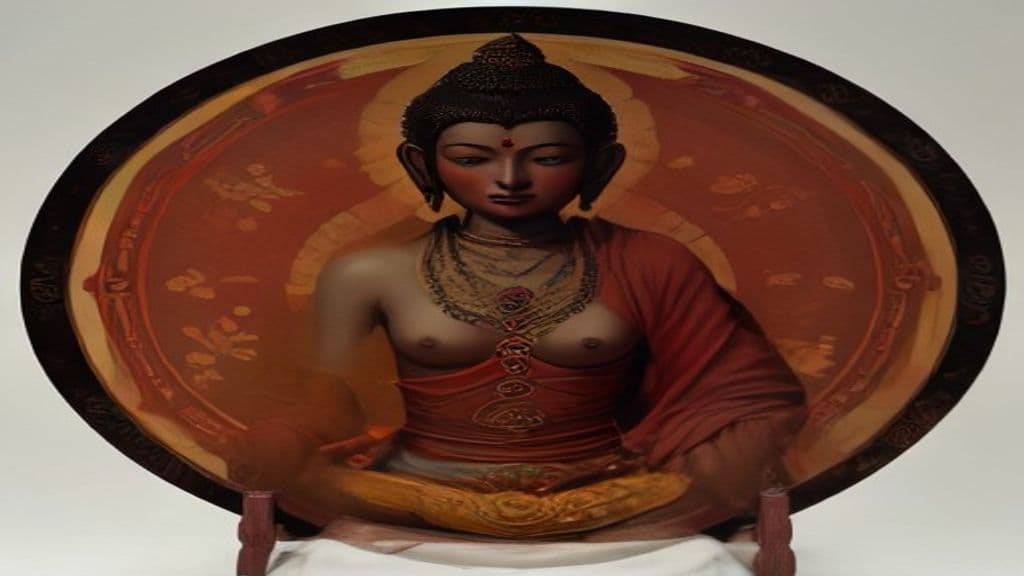
Mahayana textual tradition: Samantabhadra appears in the Avataṃsaka (Flower Adornment) cycle, including the Gandavyūha episode, as a bodhisattva exemplar whose practices and vows are narrated and who is invoked in the sutra literature (see Gandavyūha folios and the Flower Adornment Sutra, Chapter 40 'Practices and Vows of Samantabhadra Bodhisattva'). Tibetan doctrinal usage: in Tibetan Vajrayāna and Dzogchen texts the name Samantabhadra (Tibetan: Kuntu Zangpo) is applied to an Adi‑Buddha or primordial ground principle; this is a doctrinal identification rather than a biographical continuation of the Mahāyāna bodhisattva. Jain tradition: independently, a historical Digambara monk named Samantabhadra lived in the early centuries of the common era and authored Jain works including the Ratnakaranda Gaurav; this is a distinct person who shares the Sanskrit name but occupies a separate sectarian and textual context.
Iconographic and material culture sources show regional variations rather than a single canonical physical description. In East Asian carved and painted representations Samantabhadra is often shown as an adorned bodhisattva, wearing a golden diadem and embroidered robes and sometimes seated upon a richly caparisoned elephant (examples include carved snuff bottles and wood sculptures). Manuscript folios from Gandavyūha cycles depict Samantabhadra in narrative scenes — e.g., 'Samantabhadra purifies the path to enlightenment' and 'Samantabhadra spinning clouds of things' — but the primary sutra texts do not supply a standardized corporeal specification; Tibetan doctrinal treatments that identify Samantabhadra with primordial ground focus on metaphysical status rather than bodily form.
As a Mahāyāna bodhisattva Samantabhadra functions as the patron and exemplar of practice, meditation, vows, and the transfer of merit; Chapter 40 of the Flower Adornment Sutra collects his 'Practices and Vows,' and Gandavyūha narratives and folios depict him performing purificatory and cosmically significant acts (e.g., purifying the path to enlightenment). In Tibetan Vajrayāna/Dzogchen contexts the name denotes an Adi‑Buddha or primordial suchness — a metaphysical ground or source rather than an acting agent described in mundane terms. In Jain tradition the historical Samantabhadra appears as an author and teacher (e.g., Ratnakaranda Gaurav) rather than as a miraculous or adversarial supernatural being. The supplied sources emphasize exemplary, doctrinal, and ritual roles (vows, merit transfer, contemplative invocation) rather than combative or malevolent powers.
Weaknesses
- otherNo traditional weaknesses recorded
Wards
- otherNo traditional warding techniques; Samantabhadra is venerated rather than warded against
Akshobhya
Akshobhya is a transcendent buddha of Mahāyāna and Vajrayāna Buddhism, one of the Five Wisdom (Dhyāni) Buddhas. He personifies 'mirror knowledge' (ādarśa-jñāna), is conventionally placed in the East, and is lord of the eastern Pure Land Abhirati; in esoteric texts he is associated with the eastern Vajra division and invoked in mantra/mandala ritual contexts.
Amida Nyorai
Amida Nyorai (Amitābha / Amitāyus) is a principal Mahayana Buddha venerated across East Asia as the embodiment of Infinite Light and Infinite Life who presides over a Western Pure Land and is invoked as the savior who receives the dying into rebirth there.
Amitābha
Amitābha is a central celestial Buddha of Mahayana Buddhism who presides over the western Pure Land called Sukhāvatī. Devotional practices invoking his 'measureless' light and life (nianfo/nembutsu) are presented in Pure Land traditions as a path by which beings may be reborn in his buddhafield and quickly attain Buddhahood.
Amoghasiddhi
Amoghasiddhi is one of the Five Tathāgatas (Five Wisdom Buddhas) in Mahayana and Vajrayana/Esoteric Buddhism, representing the Karma family and the quality of "unfailing accomplishment". He functions as an archetypal, protective, and contemplative buddha-body within tantric mandalas, presiding over the northern quarter and invoked in mantras and ritual iconography.
Anantacāritra
Anantacāritra (Sanskrit: अनन्तचारित्र) is a bodhisattva figure in the Lotus Sūtra, identified as one of the four great perfected bodhisattvas who attend Gautama Buddha. The name is glossed as "Boundless Practice" and, in Tiantai commentary, is read as representing eternity.
Aparajita (Wisdom King)
Aparajita is named in secondary sources as a member of the broad class of East Asian Buddhist 'wisdom kings'—wrathful protective emanations associated with Buddhas and bodhisattvas. The supplied materials do not provide a focused, primary textual profile for an individual Aparajita; most attestations address the wisdom-king category and the protective powers of dharani/mantra (notably the Shurangama Mantra).
Arhat
An arhat (Sanskrit: arhat; Pāli: arahant) is in Buddhist traditions a human practitioner who has gained insight into the true nature of existence, attained nirvāṇa, and been liberated from the cycle of rebirth. The status and valuation of arhatship vary by school: some traditions equate it with full liberation, while others treat it as distinct from or inferior to the bodhisattva/buddha ideal.
Avalokiteśvara
A central Mahāyāna and Vajrayāna bodhisattva who embodies great compassion (mahākaruṇā), Avalokiteśvara hears the cries of sentient beings and manifests in many forms to relieve suffering. Venerated across South, Central, and East Asia, the figure functions devotionally (mantra and sutra recitation) and iconographically in multiple gendered and regional guises.
Bhagavatī
Bhagavatī is an honorific Sanskrit epithet applied to revered female divinities in Hinduism and Mahayana Buddhism rather than a single individualized spirit. The title functions as a respectful form of address for goddesses such as Sarasvati, Lakshmi, Parvati and certain Buddhist female deities (e.g., Cundā) and is the feminine counterpart to Bhagavān.
Bhaisajyaguru
Bhaisajyaguru (Bhaiṣajya‑guru; Medicine Buddha) is a Mahāyāna buddha associated with healing, medicine, and a pure land called Vaiḍūryanirbhāsa (Pure Lapis Lazuli). He functions as a therapeutic savior whose remedies operate through the "medicine of his teachings," vows, devotional practice, and radiance associated with lapis‑lazuli light.
Bhaiṣajyarāja (Medicine King Bodhisattva)
Bhaiṣajyarāja (Sanskrit: Bhaiṣajyarāja; Chinese: 藥王 Yào Wáng) is a Mahāyāna bodhisattva associated with healing, medicine, and supreme self‑offering. He appears in the Lotus Sūtra and in visualization/contemplation sutras and is often connected ritually and iconographically with the Medicine Buddha (Bhaiṣajyaguru) and with the paired bodhisattva Bhaiṣajyasamudgata.
Bhaiṣajyasamudgata
A Mahāyāna bodhisattva associated with the therapeutic activity of the Buddha and invoked in visualization (Guan) sūtras. He is named alongside the Medicine King (Bhaiṣajyarāja) and is the co-subject of a dedicated contemplation sūtra used in meditative-healing practice.
Community Record
- [1]Samantabhadra. Wikipedia: Samantabhadra (disambiguation and overview)wiki
- [2]Samantabhadra (Bodhisattva). Wikipedia: Samantabhadra (Bodhisattva) articlewiki
- [3]Wikidata: Samantabhadra. Wikidata entry for Samantabhadrawiki
- [4]Folio 348 from a Gandavyuha-sutra (Scripture of the Supreme Array). Cleveland Museum/Archive folio: 'Bodhisattva Samantabhadra purifies the path to enlightenment'literary
- [5]Leaf from Gandavyuha: Samantabhadra spinning clouds of things (folio 22). Cleveland Museum/Archive folio: 'Samantabhadra spinning clouds of things'literary
- [6]The Flower Adornment Sutra with Commentary, Chapter 40 (new edition). City of Ten Thousand Buddhas: 'Practices and Vows of Samantabhadra Bodhisattva', FAS Chapter 40literary
- [7]The Flower Adornment Sutra with Commentary, Chapter 40 (continuation). City of Ten Thousand Buddhas: FAS Chapter 40 commentarial materialliterary
- [8]The Questions of Samantabhadra. Etymological and interpretive gloss: 'samanta' and 'bhadra' and fuller conceptual glossother
- [9]Examining Samantabhadra by Jakuko Mo Ferrell. Contemporary Dharma talk noting liturgical invocation and chanting practicesother
- [10]Ratnakaranda Gaurav by Samantabhadra (translation/archive). Archive: Jain text attributed to the historical Digambara monk Samantabhadraliterary
- [11]Vision of Samantabhadra - The Dzokchen Anthology of Rindzin Godem. Dzogchen anthology discussing Samantabhadra as primordial ground/Adi‑Buddhaacademic
- [12]E. T. NADA: THE SUNYATAYANA OF SAMANTABHADRA. Essay on Samantabhadra and suchness in Tibetan doctrinal contextsother
- [13]Antique Chinese Carved Samantabhadra Pu Hien on Elephant Snuff Bottle. Museum object description noting diadem, robes, and elephant associationother
- [14]Antique Chinese Carved Samantabhadra Buddha On Elephant. Museum object description of carved Samantabhadra on elephantother
- [15]Samantabhadra (Bodhisattva) - Wikipedia. Wikipedia, 'Samantabhadra (Bodhisattva)'wiki
- [16]Bodhisattva Samantabhadra purifies the path to enlightenment, with Manjushri, folio (Gandavyuha-sutra). Cleveland Museum / Archive folio description (Gandavyūha-sūtra illumination)other
- [17]Caparisoned Elephant (Liao gilt bronze). Cleveland Museum object caption documenting the six-tusked elephant as Samantabhadra's throne/vehicleother
- [18]Dharanis and mantras (Dharanisamgraha citation as in secondary sources). Discussion and citations of Samantabhadra mantras/dhāraṇīs (examples transcribed in secondary sources)other