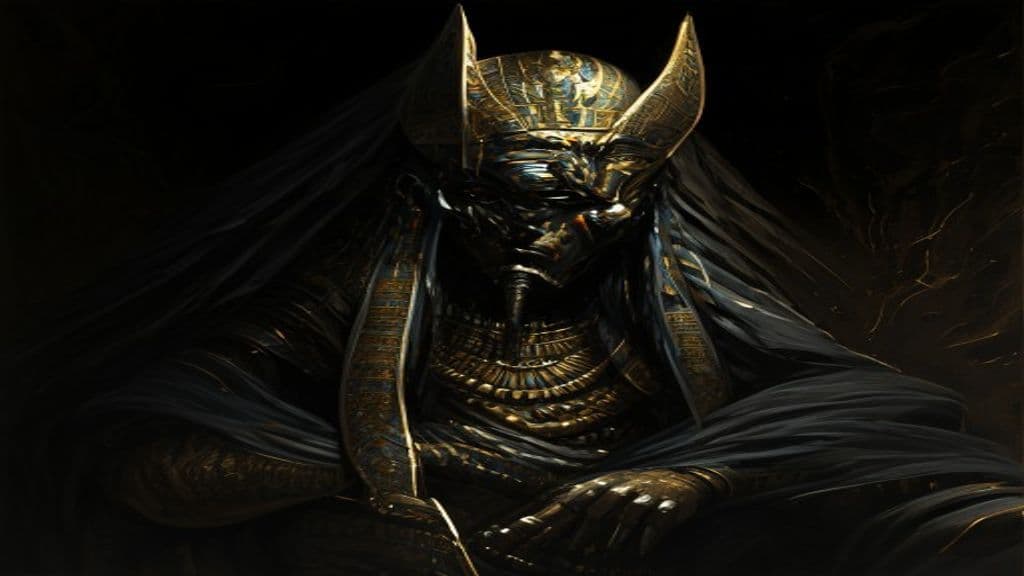
Adim appears in Egypt after the Great Flood, and his actions reflect the post-catastrophic worldview of ancient Egyptian mythology.
Adim has problem-solving skills and can take initiative. He consults with his father's ghost for guidance on how to distill drinking water from saltwater.
Adhene
A class of Manx fairies (Cloan ny moyrn) described in Isle of Man tradition as a social people of beings said to be "fallen angels cast from heaven but too good for hell," who interact with human livelihoods and families, sometimes benevolent but often mischievous.
Adi (asura)
Adi is attested in modern reference works as the name of an Asura who 'appears in the Matsya Purāṇa.' Beyond this single-line citation in secondary sources, no descriptive material about the figure is provided in the supplied research notes.
Adi Shakti
Adi Shakti (also Adi Parashakti, Mahadevi, Adya Shakti) is the primordial feminine power in Hindu/Shakta theology, regarded as the ultimate reality (Para Brahman) and the source from which all goddesses and gods manifest. She is both an impersonal cosmic principle (Mulaprakriti) and a focus of devotional invocation in temples, mantras, and pilgrimage sites such as Shakti Peethas.
Adi Vinayaka
Adi Vinayaka (Ādi Vināyaka; also called Nara Mukha Vinayaka) is a named iconographic and devotional form of the Hindu god Ganesha portraying the deity with a human head, described in sources as the form before the episode of decapitation by Shiva. It is rarely worshipped and appears in a small number of South Indian shrines and in devotional/musical repertoires.
Adikia
Adikia (Ancient Greek: Ἀδικία) is the personification and embodiment of injustice and wrongdoing in ancient Greek religious and visual culture, typically portrayed as the opposite and vanquished counterpart of the goddess Dike (Justice). She appears chiefly in archaic vase-paintings and emblematic visual programs where Justice punishes or restrains her.
Adils
Adils (Old Norse Aðils; also Eadgils, Adillus, Athisl, Adhel) is a semi‑legendary sixth‑century Swedish king attested in Old Norse saga material and later medieval traditions. He appears in saga episodes as a storied royal figure involved in warfare, court acts, and marriage suits rather than as a supernatural being.
Aditi
Aditi is a major Vedic goddess in Hindu tradition who personifies the boundless, infinite cosmic principle and functions as the maternal matrix from which many celestial deities (the Ādityas and other groups) are born. In the Vedic hymns she is invoked as a protective liberator who guards petitioners, provides wealth and safety, and frees devotees from hindrances such as sin and sickness.
Adjassou-Linguetor
Adjassou-Linguetor is a loa in Haitian Vodou associated with spring water. The limited cited sources describe her as having protruding eyes and a bad temper; beyond these points, the available documentation (Wikipedia and Wikidata) is minimal.
Adlet
A category of non-human peoples in Inuit narrative tradition (also rendered Erqigdlet/Irqigdlit) that functions both as a mythic ancestor-race and as dog‑legged antagonists; the term can denote inland native American peoples or half‑canine humanoids depending on regional usage.
Admete (Admeta)
Admete (Ancient Greek: Ἀδμήτη) is a mortal princess of the house of Eurystheus in the Heraclean cycle and, in alternate local tradition, a priestess of Hera associated with the transfer and purification of a cult image to Samos. She functions in surviving accounts as a named requester whose wish prompts one of Heracles' labors and as the human custodian of a sacred image in a Samian foundation story.
Admeto (Admetus)
Admeto is the legendary King of Thessaly from classical myth as transmitted into European opera (notably Handel's Admeto, HWV 22). Portrayed as a mortal tragic protagonist, his fate in the narrative is determined by divine oracular decree and by the actions of other mythic figures (Alceste, Apollo, Hercules) rather than by any innate supernatural power.
Admetus
Admetus is a mortal king of Pherae in Thessaly in the Greek tragic tradition (notably Euripides' Alcestis). His life becomes the subject of a divine bargain in which Apollo intervenes to delay his appointed death, a bargain that requires another to die in his stead — most famously his wife Alcestis.
Community Record
- [1]