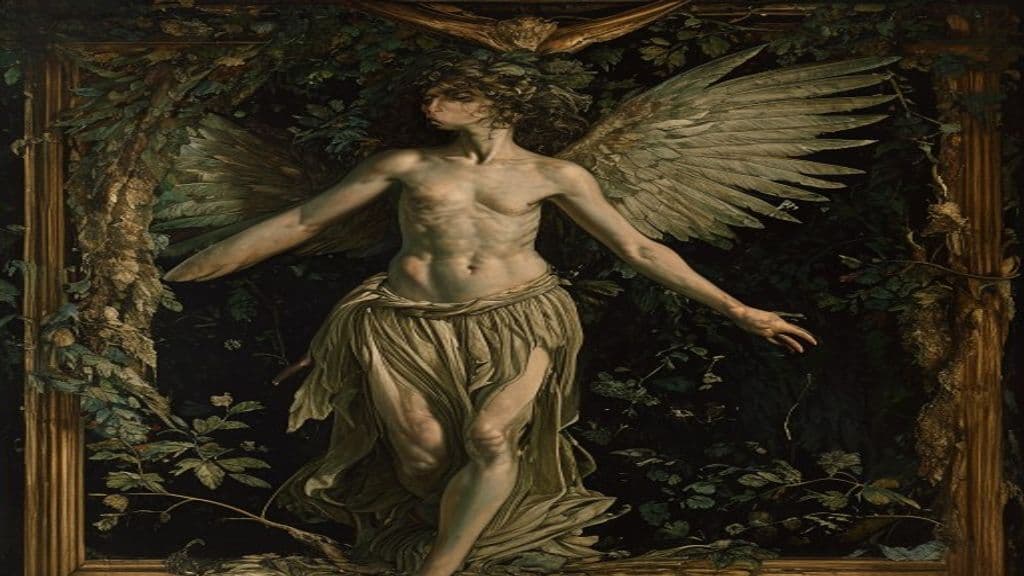
Two main narrative strands are attested in the sources. In the Theban/Homeric strand (alluded to in Homer’s Odyssey and scholiastic tradition) Aëdon, daughter of Pandareus and wife within the Theban royal milieu, is grieving after one night when she unknowingly slays her own son Itylus (Itys) with a knife; thereafter she is transformed into the nightingale whose song is described as continual wailing for the child. In a separate western Asia Minor tradition preserved by Antoninus Liberalis (attributing the tale to Boios) Aëdon appears as the wife of Polytechnus of Colophon and her story is woven into a different set of domestic rivalries and tragic errors; in these regional variants gods are named as agents effecting the metamorphosis in particular versions (Homeric material and later scholiasts vary in naming Zeus or, in other variants noted by scholiasts and mythographers, Aphrodite as involved). The narratives function etiologically: the human figure Aëdon is transformed and fixed into the natural sign of the nightingale’s lament.
As a mortal Aëdon is identified by family and social ties (daughter of Pandareus; in different local versions wife of Zethus or of Polytechnus) but the supplied sources give no detailed physical description of her human body. After transformation she is described simply as the nightingale: Homeric wording depicts the bird "perched amid the thick leafage... pouring forth her rich voice in wailing for her child," without further morphological detail.
The primary attributed characteristic after metamorphosis is the nightingale's continuous, plaintive song — interpreted as Aëdon's perpetual mourning for her slain son. Prior to transformation, narrative actions (intent to kill a rival child, a mistaken killing of her own child, or a fit of madness and jealousy) are the causal behaviors that lead to metamorphosis. Sources record that a deity effects or permits the change in some variants (Homeric and scholiastic tradition supply differing attributions such as Zeus in the Homeric context and Aphrodite in other scholiastic variants), but the supplied materials present the transformation as narrative consequence rather than as an ongoing active agency by Aëdon herself.
Azrael
Azrael is the canonical angel of death in Islamic tradition and appears earlier in apocryphal Christian literature; portrayed as a high‑ranking, God‑ordained psychopomp who removes and transports souls, keeps a register of human fates, and acts only under divine command. In some extra‑Quranic and exegetical accounts he is depicted with vast, awe‑inspiring physical attributes and in a few apocryphal Christian texts he is associated with punitive afterlife functions.
Azukiarai
Azukiarai is a Japanese folkloric phenomenon — a yokai-associated auditory apparition characterized by the uncanny sound of azuki (red) beans being washed or ground near water. In stories the sound can lure listeners toward rivers or ponds; accounts vary between treating it as an unseen spirit, a grotesque short humanlike yokai, or the misattributed noise of trickster animals such as tanuki or weasels.
Azukibabaa
Azukibabaa (あずきばばあ, "bean hag") is a Japanese yōkai represented as an old-woman figure whose presence is signaled by the sound of azuki beans being handled (azukiarai). Found in regional folk narratives around Kantō and nearby prefectures, she lures or unnerves night travelers and in some localities is said to scoop up or swallow passersby.
Azukihakari
Azukihakari (小豆はかり) is an Edo-period Japanese household yōkai described as an auditory-only phenomenon that produces the sound of red beans being sown or measured inside a house. The tale records audible disturbances and minor physical effects (debris falling) but no visible apparition or harmful actions.
Azumi-no-isora
Azumi-no-isora (阿曇磯良) is a Shinto kami of the seashore and the ancestral deity of the Azumi people. He is attested in late legends as a lesser sea deity who acted as a navigator in a story involving the loan of the tide jewels to Empress Jingū and is worshiped at several coastal shrines.
Azure Dragon (Qīnglóng)
The Azure Dragon (青龙 / 青龍 Qīnglóng) is one of the Four Symbols of Chinese constellations and a principal astral/territorial guardian associated with the eastern quarter of the sky and the season of spring. It functions as a cosmological and civic protective emblem appearing in temple iconography, tomb murals, and syncretic links to named Dragon Kings.
Aëtos
Aëtos (Greek: Ἀετός, 'eagle') is an earth-born youth in Greek myth who is transformed into the eagle that becomes the sacred bird and emblem of Zeus. In surviving accounts he functions etiologically as the origin/personification of Zeus's eagle and appears in narrations of Zeus's youth, the Gigantomachy, the torment of Prometheus, and the rescue by Heracles.
Añjanā
Añjanā (Sanskrit: अञ्जना; also Anjani, Anjali) is a semi-divine figure of the Ramayana cycle, described as an apsara reborn among the vanaras and the mother of the hero Hanuman. She figures both in pan-Indian epic narratives (as wife of Kesari and devotee of Vayu) and in regional cultic practice (notably a temple tradition in Himachal Pradesh) and is adapted in Javanese wayang as Dewi Anjani.
Aśvatthāmā (Ashvatthama)
Aśvatthāmā is a major human warrior-character in the Indian epic Mahābhārata, son of the teacher Drona and close ally of the Kaurava leader Duryodhana. In postwar narrative episodes he is depicted committing a nocturnal slaughter of sleeping rivals and attempting to use the cosmic weapon Brahmāstra, after which the sage Vyasa admonishes and curses him in the dramatic retellings cited.
Ašratum
Ašratum is an ancient Mesopotamian goddess name attested in sources as of Amorite origin and regarded in those sources as the wife/consort of the god Amurru (Sumerian Martu). Her name is treated in scholarship as a cognate of the Ugaritic Athirat / Hebrew Asherah name-family, though the supplied sources note that cognate names did not necessarily occupy identical roles across different pantheons.
Aštabi
Aštabi is an ancient Near Eastern deity attested in Eblaite, Hurrian, Ugaritic, and Hittite contexts. In later Hurrian and Hittite sources he functions as a war god and participant in divine assemblies and mythic combat; in the earliest Eblaite documents his precise original character is unresolved though he had named cult centers and cultic statues.
Ašur (Ashur)
Ašur (also Ashur, Ashshur, Aššur) was the national god of the ancient Assyrians and served as the principal divine figure around which Assyrian identity and state religion were organized until the society's gradual conversion to Christianity in late antiquity.
Community Record
- [1]Aëdon — Wikipedia. Wikipedia contributors, 'Aëdon', Wikipedia, The Free Encyclopediawiki
- [2]Aëdon — Wikidata entry Q368853. Wikidata entry Q368853, 'Aëdon'other
- [3]Antoninus Liberalis (summary of Boios tradition) — as cited in modern summaries. Antoninus Liberalis, as summarized in modern secondary sources cited on Aëdon (Boios/Colophon tradition)literary