
In the epic‑framed accounts recorded in the available sources, Añjanā is an apsara named Punjikastala who, through a curse (attributed to Brihaspati in one account), is born on earth as a vanara princess. She marries Kesari, a mighty vanara (son of Brihaspati), and, after intense prayer with her husband to Vayu (the wind god), they receive the boon of a son — Hanuman. In Javanese wayang retellings she appears as Dewi Anjani, daughter of Resi Gotama and Dewi Indradi, whose narrative includes lake episodes, transformations of companions into animal forms, penance ordered by Resi Gotama, union with Hyang Pawana (Batara Bayu), and the birth of Maruti; such episodes rework the origin motifs in a Southeast Asian performance context. The Himachal Pradesh tradition localizes her further as a goddess who once stayed at Masrer near Dharamshala and is venerated as a family deity there.
The provided sources do not supply a standardized, detailed physical description of Añjanā. Narrative accounts identify her as an apsara reborn among the vanaras and as the wife of Kesari, but they do not give measurements, colours, or consistent bodily attributes. In Javanese wayang she appears as Dewi Anjani within the visual and performative conventions of wayang, but specific canonical bodily descriptions are not recorded in the available material.
Sources attribute to Añjanā a semi‑divine status (apsara origin) and narrative capacities that include receiving divine boons through devotion (she and Kesari obtain Vayu's blessing resulting in Hanuman's birth). Regional stories as recorded for Himachal Pradesh ascribe to her the capacity for punitive supernatural action in a local legend (turning a villager to stone for revealing her identity) and a remedial cultic role (believers worship her after scorpion bite because her vahana is said to be a scorpion). The Javanese account attributes to her the narrative fate of transformation and redemption via penance and divine forgiveness within that tradition's cosmology. The sources do not document other consistent powers such as possession, widespread shapechanging, or universal magical formulae.
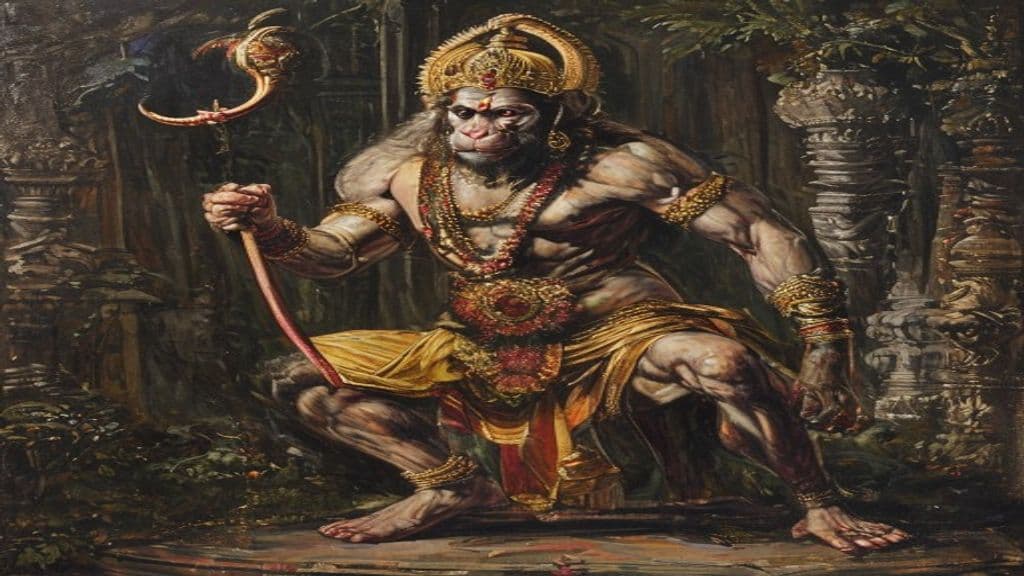
Hanuman
Hanuman is a divine vanara (monkey‑like being) in Hindu literature, foremost companion and devoted servant (Rama-dūta) of Lord Rama in the Ramayana. Revered in later Bhakti traditions, he is worshipped as a protector and exemplar of devotion, strength, and service.

Apsara
Celestial dancers and water nymphs of Hindu cosmology — beautiful semi-divine beings who dance at the court of Indra and, by his command, descend to earth to distract sages from excessive asceticism.
Kusha
Kusha (Sanskrit: कुश, IAST: Kuśa) is the elder of the twin sons of Rama and Sita in the Hindu epic the Ramayana. Presented in canonical Uttara Kāṇḍa material as a human prince raised at Valmiki's ashram, he functions as an heir and founder-king who preserves dynastic continuity and helps transmit the Ramayana as a cultural text; a small number of later or regional variants give alternate birth legends or expanded territorial claims.
Kuśadhvaja
Kuśadhvaja is a human royal figure in the Ramayana tradition, described as the younger brother of King Janaka of Mithila, husband of Chandrabhaga, and father of Mandavi and Shrutakirti. He is named as King of Samkasya after Janaka defeats Sudhanvan and appears in the narrative context of the Sita–Rama marriage.
Lakshmana
Lakshmana is the younger half-brother and devoted attendant of Rama in the Ramayana tradition. Portrayed as an ideal companion and protector during Rama’s fourteen-year exile and the war with Ravana, the Puranas also describe him as an incarnation (avatara) of the serpent Shesha, linking him to the divine order surrounding Vishnu.
Nila
Nila (Sanskrit: नील, Nīla; also spelled Neela) is a vanara chieftain in the Ramayana epic, described as commander‑in‑chief of the vanara army under Sugriva who leads troops in the war against Ravana and participates in the search for Sita and the building of the Rama Setu in some traditions.
Azumi-no-isora
Azumi-no-isora (阿曇磯良) is a Shinto kami of the seashore and the ancestral deity of the Azumi people. He is attested in late legends as a lesser sea deity who acted as a navigator in a story involving the loan of the tide jewels to Empress Jingū and is worshiped at several coastal shrines.
Azure Dragon (Qīnglóng)
The Azure Dragon (青龙 / 青龍 Qīnglóng) is one of the Four Symbols of Chinese constellations and a principal astral/territorial guardian associated with the eastern quarter of the sky and the season of spring. It functions as a cosmological and civic protective emblem appearing in temple iconography, tomb murals, and syncretic links to named Dragon Kings.
Aëdon
Aëdon is a mythic woman in ancient Greek tradition who, after killing (or attempting to kill) a child in a tragic episode of jealousy or madness, is transformed into the nightingale; the bird's plaintive song is presented as her eternal mourning for the lost child.
Aëtos
Aëtos (Greek: Ἀετός, 'eagle') is an earth-born youth in Greek myth who is transformed into the eagle that becomes the sacred bird and emblem of Zeus. In surviving accounts he functions etiologically as the origin/personification of Zeus's eagle and appears in narrations of Zeus's youth, the Gigantomachy, the torment of Prometheus, and the rescue by Heracles.
Aśvatthāmā (Ashvatthama)
Aśvatthāmā is a major human warrior-character in the Indian epic Mahābhārata, son of the teacher Drona and close ally of the Kaurava leader Duryodhana. In postwar narrative episodes he is depicted committing a nocturnal slaughter of sleeping rivals and attempting to use the cosmic weapon Brahmāstra, after which the sage Vyasa admonishes and curses him in the dramatic retellings cited.
Ašratum
Ašratum is an ancient Mesopotamian goddess name attested in sources as of Amorite origin and regarded in those sources as the wife/consort of the god Amurru (Sumerian Martu). Her name is treated in scholarship as a cognate of the Ugaritic Athirat / Hebrew Asherah name-family, though the supplied sources note that cognate names did not necessarily occupy identical roles across different pantheons.
Aštabi
Aštabi is an ancient Near Eastern deity attested in Eblaite, Hurrian, Ugaritic, and Hittite contexts. In later Hurrian and Hittite sources he functions as a war god and participant in divine assemblies and mythic combat; in the earliest Eblaite documents his precise original character is unresolved though he had named cult centers and cultic statues.
Ašur (Ashur)
Ašur (also Ashur, Ashshur, Aššur) was the national god of the ancient Assyrians and served as the principal divine figure around which Assyrian identity and state religion were organized until the society's gradual conversion to Christianity in late antiquity.
Community Record
- [1]Añjanā — Wikipedia. Wikipedia entry 'Añjanā' (accessed via provided research notes)wiki
- [2]Anjana — Wikidata. Wikidata item for Anjana (referenced in provided research notes)other