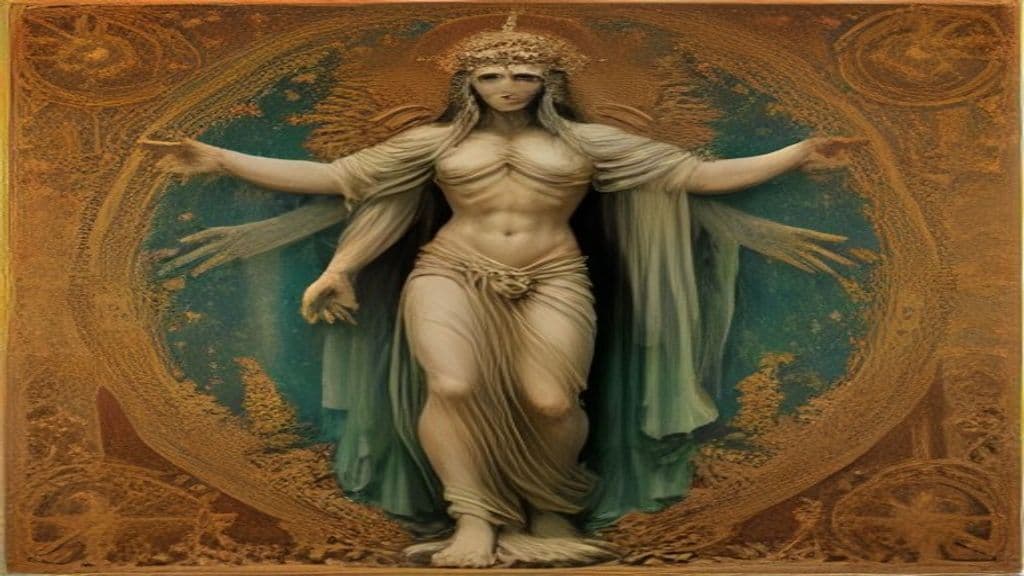
In the main surviving tradition Aethlius is presented as the first ruler of the land later called Elis and is named as a son of Zeus and Protogeneia (daughter of Deucalion); he is the father of Endymion. Variant genealogies appear in other accounts: some make him a son of Aeolus (or equate Aeolus with Zeus in naming), and summaries of Eusebius report a tradition in which Aethlius staged contests (modelled on the Idaean Dactyls' 'Olympics') to challenge his sons. These variants are given across the surviving summaries of Pausanias, later compilations, and modern reference entries.
No ancient source in the supplied materials provides a physical or iconographic description of Aethlius. He is attested only as a genealogical and royal figure in literary/foundation contexts rather than as a described visual type.
Sources do not attribute supernatural powers to Aethlius. He is reported to have led Aeolians from Thessaly to found Elis and to have been the first ruler there (founder-king activity). In a tradition reported via Eusebius he is said to have used a competitive ritual (likened to the Idaean Dactyls' contests) to challenge his sons, an element used to connect his name with the origin of the term for contestants ('athletes'), but no miraculous abilities are recorded in the provided material.
Aeson
Aeson (Ancient Greek: Αἴσων) is a legendary mortal king of Iolcus in Thessaly in Greek myth, best known as the father of the hero Jason. His fate—imprisonment by his half-brother Pelias and either suicide or a miraculous restoration performed by Medea—provides the dynastic and moral background for the Argonautic cycle.
Aesyle
No evidence in the provided sources describes a mythological entity named Aesyle. The available records referencing the label 'Aesyle' point instead to taxonomic database entries (a genus of insects) and unrelated media, with no mythic details present.
Aeternitas
Aeternitas is the Roman divine personification of eternity, cultivated as an abstract virtue in the official Imperial cult and invoked especially to express the perpetual duration of imperial rule (Aeternitas Imperii). She appears on coinage and in temple cult from the 1st through the 3rd centuries AD and is treated in later intellectual tradition as the Latin term for divine duration.
Aethalides
Aethalides is a personal name borne by two distinct figures in ancient Greek myth: one listed among the Argonauts as a son of Hermes and Eupolemeia, and another named among the Tyrrhenian sailors who attempted to deceive Dionysus and was transformed into a dolphin. The sources treat Aethalides as named human mythic personages appearing in separate narrative contexts rather than as a class of supernatural being.
Aether
Aether is the personified bright upper sky in ancient Greek myth and a primordial cosmic principle. Treated both as the luminous upper atmosphere and as a divine being, Aether appears in multiple cosmogonic genealogies (notably Hesiodic and Orphic traditions) as an early-born element that helps constitute the ordered cosmos.
Aethiolas
Aethiolas (Aithiolas) is a figure from Greek mytho-historical tradition described as a Spartan prince, commonly listed as a son of King Menelaus and in some accounts son of Helen or of an unnamed concubine. He and his brother Nicostratus are recorded in secondary sources as receiving cult worship from the Lacedaemonians.
Aethon
Aethon (Ancient Greek aithōn) is an epithet meaning 'burning', 'blazing' or 'shining' used across classical Greek literature to describe animals (especially horses), some other animals, and occasionally humans. In the provided sources it functions as a descriptive name applied in poetry and myth rather than as a single, individuated supernatural being; the term is also reused in modern taxonomy and cultural titles.
Aethra
Aethra (Ancient Greek: Αἴθρα, romanized Aithra, lit. 'bright sky') is a name borne by multiple women in Greek myth, most prominently a princess of Troezen who is mother of the hero Theseus. In some traditions an Aethra is also listed among Oceanids, indicating a separate, water‑nymph identity in certain genealogies.
Aetna (corporate name)
The supplied sources refer to 'Aetna' as Aetna Inc., an American managed health care company whose name derives from Mount Etna (Latin Aetna). The provided materials contain no attested folkloric or mythological entity named Aetna.
Aetnaeus
An epithet associated with gods and mythical beings connected to Mount Etna. (Note: - Power tier: Primordial (due to association with major gods like Zeus) - Weaknesses: Needs to be filled - Wards: Needs to be filled - Sensory cues: Needs to be filled - The summary should be revised )
Aetolus
Aetolus (Ancient Greek: Αἰτωλός, Aitolos) is a figure in Greek legendary genealogy described as a son of Endymion and an eponymous ancestor of the region called Aetolia. He appears in traditions that explain regional origins and sequences of local kingship, notably in genealogies connected with Elis and the foundation/ethnogenesis of Aetolia.
Aex
Aex (also rendered Aix) is a name attested in fragmentary Greek mythic traditions with at least three different identifications: a nurse of the infant Zeus later said (in a Hyginus-derived summary) to have been changed into a constellation; an Arcadian epimelid or 'nanny-goat' nymph said to have borne the goat-associated son Aegipan; and a goatish primeval figure called Gorgô Aix ('Terrible Goat') described in a source-summary as slain by Zeus at the start of the Titanomachy. These attestations are brief and inconsistent across sources.
Community Record
- [1]Pausanias, Description of Greece (summary in Archive #3). Pausanias, Description of Greece (summary as provided in Archive #3)literary
- [2]Aethlius — Wikipedia. Wikipedia entry 'Aethlius' (summary and cited traditions, including notes on name etymology and variant parentages)wiki
- [3]Who's Who in Classical Mythology (entry summary). Who's Who in Classical Mythology (entry for Aethlius, summary excerpt in Archive #4)other
- [4]Myths UVic — Aethlius entry. UVic myths page entry for Aethlius (genealogical listing)other