
There is no description of a physical appearance for Aetnaeus.
Aetnaeus refers to attributes such as divine powers, craftsmanship, and fire manipulation associated with Zeus, Hephaestus, or the Cyclops.

Zeus
Zeus (Ancient Greek: Ζεύς) is the supreme deity of the classical Greek pantheon, a sky-and-thunder god who rules as king of the gods on Mount Olympus and functions as a sky‑father who assigns roles among the immortals.
Cyclops
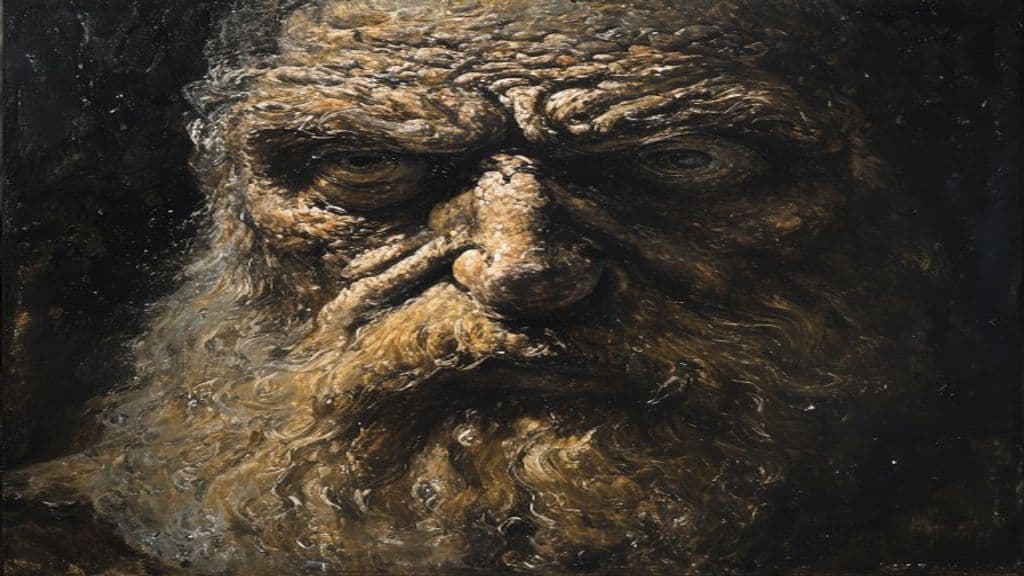
In ancient Greek tradition the Cyclopes are one‑eyed giant beings appearing in multiple, sometimes contradictory strands: Hesiodic primordial artisan brothers who forge the gods' arms; Homeric solitary, cave‑dwelling shepherd‑monsters such as Polyphemus; and a legendary explanation for monumental ‘Cyclopean’ masonry.
*Péh₂usōn (reconstructed)
Péh₂usōn is a hypothetical Proto‑Indo‑European pastoral guardian reconstructed by comparative scholars from parallels in Greek and Vedic traditions. Proposed as a Graeco‑Aryan ancestor‑figure, the reconstruction describes a protector of flocks, roads, and travellers rather than an attested historical cultic personality.
Acestes
Acestes is a Roman/Greek founder-hero associated with the Sicilian city Segesta (Aegesta/Acesta). Presented as son of a Trojan woman and, in one tradition, the Sicilian river-god Crinisus (in animal form), he hospitably receives Aeneas and the Trojans, participates in the funeral games in Virgil's Aeneid (Book V), and functions as an eponymous culture-founder and local ruler.
Alexander the Great (legend)
A pan-cultural legendary hero-king whose historical career was transformed into a body of miraculous and etiological tales (the Alexander Romance). In these traditions he is alternately a divinely sanctioned conqueror, boundary-builder credited with the Gates of Alexander, and a questing culture-hero associated with oracles, votive dedications, and tests of loyalty.
Almo
Almo is attested in the provided sources as a river-deity named for the ancient River Almone near Rome. The supplied material identifies Almo only by name and by association with that river; no detailed myths, rites, iconography, or powers are recorded in the provided documents.
Ancile
The Ancile is a sacred shield in Roman tradition, said to have fallen from heaven and perpetuating Rome's sovereignty. (Note: 1. Power tier should be Ancient (deity-level) instead of Primordial. 2. Origin story should note that it is said to have "fallen from heaven" but does not imply direct supernatural or divine origin. )
Attis
Attis is a mythic consort and semi-divine cult figure associated with the Anatolian Mother Goddess (Cybele / Agdistis). He functions as a vegetation-associated beloved whose self-castration, death, and ritual rebirth form the core myth enacted by his priests and festivals, especially around the vernal equinox in Phrygia, Greece and later Rome.
Baton (Greek Mythology)
In Greek mythology, the origin, appearance, and abilities of Baton are unknown due to lack of information. (Note: 1. Add "incomplete" or "insufficient information" to the summary to reflect that there's no actual description of Baton, rather than it being unknown. 2. Power tier should be listed as "Unknown" since)
Caieta
Caieta is a named wet-nurse in Roman mytho-historical tradition who is commemorated as the eponym of Caietae Portus (modern Gaeta). She appears in the literary and commentarial tradition connected to the Aeneas cycle and is remembered primarily through a funerary epitaph and the toponym derived from her grave.
Callithyia
Callithyia (Ancient Greek: Καλλίθυια), also called Callithoe, Callithea, or Io, is an Argive princess in Greek mytho-historical tradition described as the first priestess of Hera at Argos. She functions as a foundational, legitimating figure for the local Hera-cult rather than as a supernatural being.
Casa Romuli
Historical archaeological site associated with the legendary founder and first king of Rome, Romulus. Significant cultural and historical impact. (Note: 1. Power tier: Change to "Greater" since it's associated with a historical archaeological site and not a cosmic or deity-level entity. 2. Add sensory cues, weaknesses, and wards based on source materi)
Cerberus
The three-headed hound of Hades, guardian of the underworld's gates — welcoming the dead in but allowing no shade to leave and no living mortal to enter uninvited.
Cybele
An Anatolian mother goddess (Phrygian Matar Kubileya) whose cult centers on mountains, city protection, fertility, and wild nature; adopted and reinterpreted by Greek and Roman religion where she became associated with ecstatic rites, a eunuch priesthood (the Galli), and the Roman Magna Mater cult.
Community Record
- [1]Aetnaeuswiki