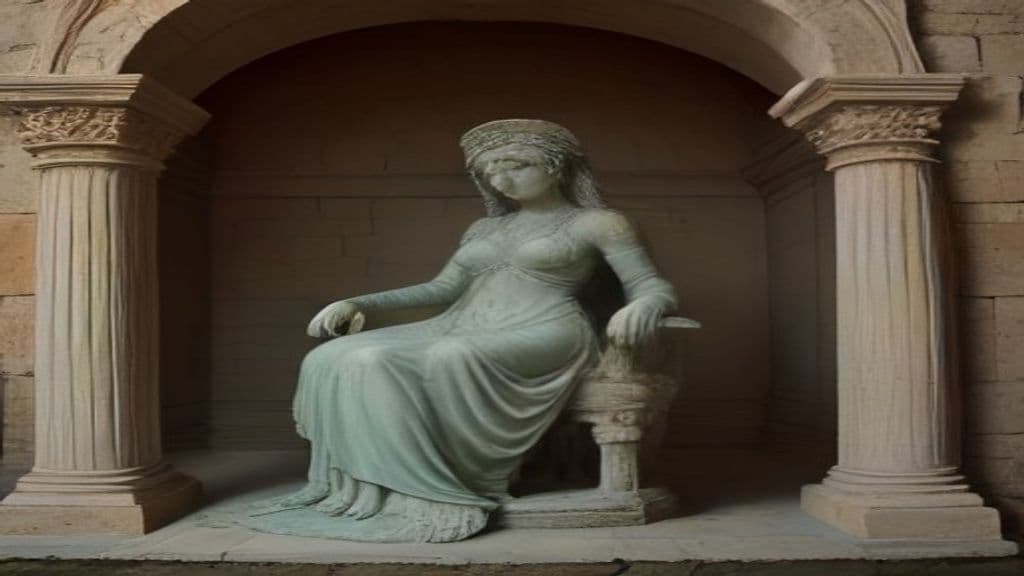
In Roman literary tradition Caieta is presented as a wet-nurse attached to the household of figures in the Trojan-to-Italian genealogical cycle. Vergil locates her grave on the bay at Gaeta, and the port (Caietae Portus) is said to take its name from her tomb. Ovid records a funerary epitaph commemorating her, and the fourth-century commentator Servius records that there was disagreement in sources over whether she was the wet-nurse of Aeneas, or alternatively Creusa or Ascanius. The surviving attestations therefore present Caieta as a named household figure whose burial becomes a local toponym and a point of literary commemoration.
Surviving sources provide no physical description of Caieta. Ancient texts and later summaries identify her only by social role (wet-nurse) and by the location of her tomb on the shore called Caietae Portus; they do not record details of age, dress, or iconography. No further depiction or sustained visual tradition is attested in the supplied materials, and later uses of the name in modern contexts do not supply ancient iconographic evidence.
The cited literary and commentarial materials do not attribute supernatural powers, magical functions, or active behaviors to Caieta. Her role in the tradition is commemorative and toponymic: she is remembered as a nurse within a household network and as the eponym of a place where she was buried. Ancient commentators discuss her identity and connection to named mythic figures, but do not ascribe agency beyond her social role and memorial significance.
Weaknesses
- otherNone attested in sources
Wards
- otherNone attested in sources
Acestes
Acestes is a Roman/Greek founder-hero associated with the Sicilian city Segesta (Aegesta/Acesta). Presented as son of a Trojan woman and, in one tradition, the Sicilian river-god Crinisus (in animal form), he hospitably receives Aeneas and the Trojans, participates in the funeral games in Virgil's Aeneid (Book V), and functions as an eponymous culture-founder and local ruler.
Aetnaeus
An epithet associated with gods and mythical beings connected to Mount Etna. (Note: - Power tier: Primordial (due to association with major gods like Zeus) - Weaknesses: Needs to be filled - Wards: Needs to be filled - Sensory cues: Needs to be filled - The summary should be revised )
Almo
Almo is attested in the provided sources as a river-deity named for the ancient River Almone near Rome. The supplied material identifies Almo only by name and by association with that river; no detailed myths, rites, iconography, or powers are recorded in the provided documents.
Ancile
The Ancile is a sacred shield in Roman tradition, said to have fallen from heaven and perpetuating Rome's sovereignty. (Note: 1. Power tier should be Ancient (deity-level) instead of Primordial. 2. Origin story should note that it is said to have "fallen from heaven" but does not imply direct supernatural or divine origin. )
Attis
Attis is a mythic consort and semi-divine cult figure associated with the Anatolian Mother Goddess (Cybele / Agdistis). He functions as a vegetation-associated beloved whose self-castration, death, and ritual rebirth form the core myth enacted by his priests and festivals, especially around the vernal equinox in Phrygia, Greece and later Rome.
Casa Romuli
Historical archaeological site associated with the legendary founder and first king of Rome, Romulus. Significant cultural and historical impact. (Note: 1. Power tier: Change to "Greater" since it's associated with a historical archaeological site and not a cosmic or deity-level entity. 2. Add sensory cues, weaknesses, and wards based on source materi)
Cerberus
The three-headed hound of Hades, guardian of the underworld's gates — welcoming the dead in but allowing no shade to leave and no living mortal to enter uninvited.
Cybele
An Anatolian mother goddess (Phrygian Matar Kubileya) whose cult centers on mountains, city protection, fertility, and wild nature; adopted and reinterpreted by Greek and Roman religion where she became associated with ecstatic rites, a eunuch priesthood (the Galli), and the Roman Magna Mater cult.
Erinyes
The three avenging Furies of Greek myth — Alecto, Megaera, and Tisiphone — who pursued and tormented those guilty of crimes against blood kin, especially murder of family members.
Goddess
A goddess is a female deity — a sacred female divine figure found across many polytheistic and religious traditions. The term functions as a classificatory label for diverse culturally specific female divinities and metaphysical female principles, ranging from local patronesses to supreme cosmic realities.
Hercules
Hercules (Latin: Hercules) is the Roman reception of the Greek divine hero Heracles: a semi-divine, divinized heroic figure son of Jupiter and the mortal Alcmena who was widely venerated across Italy. Represented in cult, votive art, and literature, he functions as a protector and martial champion whose identity was adapted through Etruscan and local Italic contexts.
Hirpi Sorani
Infernal fire god in ancient Etruscan and Roman pantheon, associated with volcanic fires and solar forces. (Note: 1. Power tier should be Ancient (deity-level) instead of Primordial. 2. No physical description is provided in the source material; delete or rephrase "Appearance" section accordingly. 3. Since specif)
Community Record
- [1]Caieta — Wikipedia. Wikipedia, entry 'Caieta' (accessed sources summarized Vergil, Ovid, Servius)wiki
- [2]Wikidata: Caieta. Wikidata item Q3649829 for Caieta (name and identifiers)other
- [3]Gaeta (Caietae Portus) — RomeArtLover. Summary of local toponymy and ancient identifications linking the bay of Gaeta to the name Caietaother