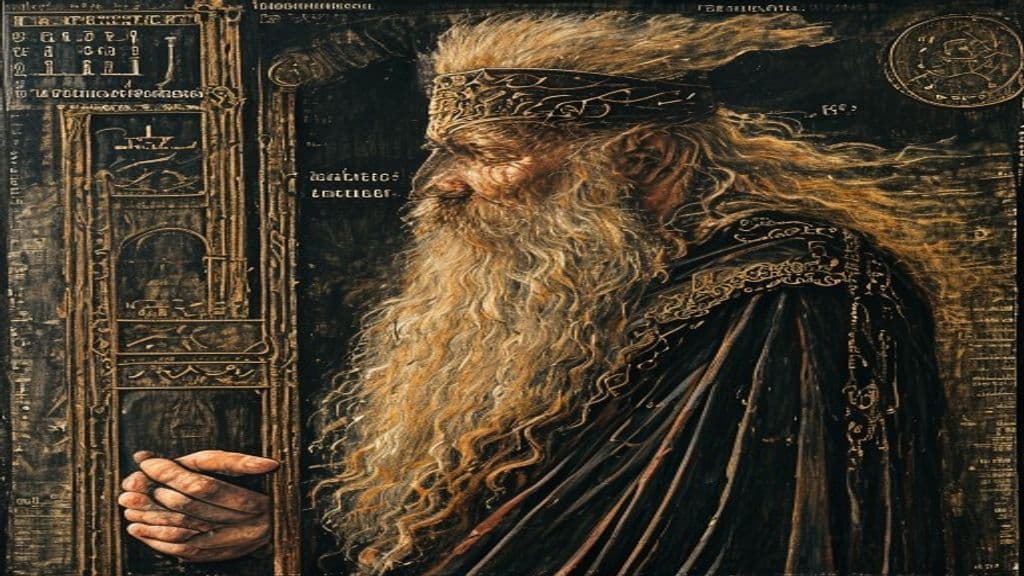
In surviving early Irish genealogical material Aimend is presented as the daughter of Óengus Bolg, king of the Dáirine or Corcu Loígde. She marries Conall Corc, the traditional founder of the Eóganachta dynasties; through that marriage she is cited as the ancestress of the 'inner circle' septs of Eóganacht Chaisil, Eóganacht Glendamnach, and Eóganacht Áine, who established the kingship of Cashel. Scholarly commentary on these genealogies suggests that details of her placement and name imply she may once have been a goddess whose cultic or mythic functions were later reshaped into a genealogical role (Byrne; Thomas Charles-Edwards as cited in the source summary).
No detailed physical description of Aimend survives in the cited genealogical material. The record is primarily genealogical and etymological rather than narrative or descriptive. The name Aimend is analyzed as deriving from Proto‑Celtic *aidu‑mandā, literally 'burning stain,' a phrase that has been interpreted as possibly denoting 'sunburn' or a mark related to heat/light; this etymology suggests poetic or symbolic associations (radiance, marks of the sun) but does not supply concrete visual detail in the sources.
The surviving texts provide no direct accounts of supernatural powers, deeds, or behaviors for Aimend; her function in the material is genealogical as wife and ancestress. Scholarly suggestions that she 'may have originally been a goddess' indicate a hypothesis that earlier cultic or mythic functions once attached to her have been lost or transformed in later genealogical redaction. Those proposals are inferential: they point to possible former sacral roles but the cited source does not record any specific rituals, powers, or actions attributable to her.
Weaknesses
- othernone recorded in sources
Wards
- othernone recorded in sources
Aidos
Aidos (Ancient Greek: Αἰδώς) is the personification of shame, modesty, and reverent restraint in classical Greek thought. Treated variously as an ethical feeling, a moral force, and occasionally as a goddess with local cults, Aidos embodies the inner reverence that restrains wrongdoing and governs social propriety.
Aigamuxa
Aigamuxa are legendary humanoid man‑eaters from Khoikhoi‑recorded traditions of southern Africa, described in the available sources as desert‑dwelling predators—especially of Kalahari dunes—notable for having their eyes located on their feet and for needing to invert their bodies to see.
Aigosages
Aigosages (Greek Αἰγοσάγες, Latin-alphabet Aegosages) were a Gallic/Galatian tribal group recorded in Hellenistic sources as a recruited mercenary body active c. 218–216 BC. Recruited in Thrace by Attalus I of Pergamon, they were transported across the Hellespont, settled on its shores, conducted raids in the Troad, besieged Ilium, and were annihilated by Prusias I of Bithynia.
Ailill
Ailill (variants Ailell, Oilioll) is an Old Irish male personal name prominent in Irish legendary and early medieval sources. It was borne by numerous kings, druidic figures, and clerics across mytho-historical and historical traditions and is said in the cited material to mean something like "beauty."
Ailill Angubae
Ailill Angubae is a human figure in the Irish tale The Wooing of Étaín, presented as the brother of High King Eochaid Feidlech who falls desperately in love with his brother's wife, Étaín. His unrequited passion leads to a wasting illness and a failed rendezvous when the Tuatha Dé Danann figure Midir casts him into an enchanted sleep.
Aim
Aim is a name attested in modern online demon-name compilations and repurposed in digital gaming contexts; the only detailed attestation in the provided corpus is a single modern occult-list entry that presents Aim as a ducal-ranked demon commanding 26 legions and associated with specific summoning correspondences. There are no corroborated traditional folkloric or ethnographic sources in the supplied material.
Aindri (Indrani / Shachi / Paulomi)
Aindri (commonly rendered in sources as Indrani, also called Shachi or Paulomi) is a Hindu goddess presented as the queen-consort of Indra. She is depicted in the available material as a courtly queen associated with beauty, pride and kindness who also appears in at least one account as an active martial participant in the devas' battles with asuras.
Aino
Aino is a human female figure in Finnish oral tradition as assembled in the Kalevala; originally appearing in folk poems as “the only daughter” or “the only sister,” she was given the proper name Aino by Elias Lönnrot when he compiled and edited the oral material into the national epic. Her story concerns family pressure, courtship by Väinämöinen, refusal, and a tragic drowning that functions as a moral and social episode within the Kalevala narrative.
Ainur
The Ainur are the immortal spiritual intelligences created by Eru Ilúvatar before the physical Creation in J. R. R. Tolkien's legendarium. Through the Music of the Ainur (Ainulindalë) their themes were given being as the universe (Eä); some of the Ainur entered that world and became its guardians, the Valar and the Maiar.
Aion
Aion is a Hellenistic divine personification of cyclical, ritual, and eternal time, often depicted within the zodiacal circle and associated in syncretic contexts with cosmic renewal and the perpetuity of the cosmos or imperial order.
Aipaloovik
Aipaloovik is an Inuit sea-associated supernatural being described in available sources as an evil or dangerous water deity linked to death and hazard for fishermen. The figure is described as the opposite of the being Anguta; beyond this brief characterization the cited sources provide no detailed myths, appearance, or ritual corpus.
Air Wave
Air Wave is a fictional costumed superhero identity from DC Comics, a human mantle borne by several members of the Jordan family (Lawrence 'Larry' Jordan, Helen Jordan, Harold Jordan) and later a separate individual listed as Harold Levey. The persona centers on radio- and signal-themed equipment and, in later incarnations, metahuman energy-transmutation powers used in genre superhero narratives from the Golden Age onward.
Community Record
- [1]Aimend — Wikipedia. Wikipedia contributors. 'Aimend.' Wikipedia, The Free Encyclopedia.wiki