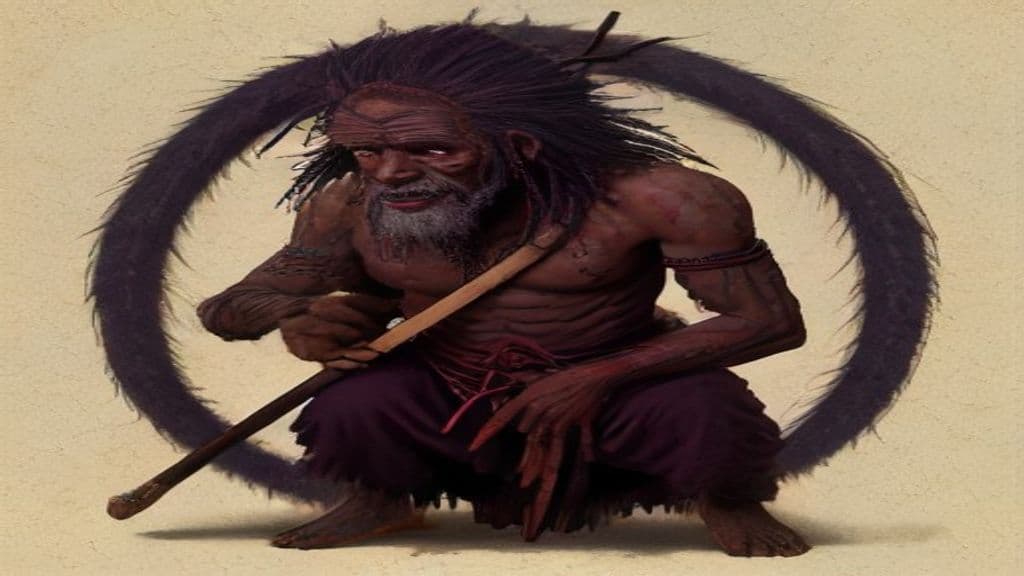
The term Ajogun (Yoruba) is etymologized in the sources as formed from the agent prefix a- + the verb jẹ ('to eat' or 'to consume') + the noun ogun ('war'), literally meaning 'the ones that feed on war.' In the Yoruba cosmological framing recorded in the sources, Ajogun are a recognized category of hostile spiritual agents that occupy the opposing pole to the benevolent Oriṣa and are described as being 'at war with mankind.' The sources present them as a class that includes named spirits with specific domains and record that they can be 'self-inflicted' when a person breaks taboos or refuses to heed the advice of Ifá divination. Iku (Death) is described in the sources as the head of the Ajogun.
The provided sources give folkloric descriptions specifically for Iku (Death), counted among and described as head of the Ajogun: in folktales Iku is sometimes depicted either as a young warrior or a haggard old man carrying a heavy club said to kill victims simply by touching them. Other named Ajogun (Arun, Ẹgba, Epe, Eṣe, Ẹwọn, Ofo, Ọran) are listed by association with domains of misfortune (disease, paralysis, curses, wounds, imprisonment, loss, conflict) in the sources but are not given distinct physical descriptions in the supplied material.
Sources describe Ajogun as malevolent spiritual forces that regularly interfere with mortal lives and cause a range of misfortunes. The sources list named Ajogun with associated domains: Iku (death) who causes death and who in tales can kill by touch; Arun (disease and illness); Ẹgba (paralysis and infirmity); Epe (curses); Eṣe (wounds and affliction); Ẹwọn (imprisonment/captivity); Ofo (loss and destruction of property); and Ọran (conflict and trouble). The sources also state that Ajogun may afflict those who break taboos or refuse Ifá's advice and that divinities such as Ọrunmila/Ifá and Eṣu interact with or intercede regarding Ajogun (for example, an Odu Ifa narrative records Ọrunmila outwitting Iku).
Weaknesses
- conditionobservance of taboos and heeding Ifá divination
Wards
- ritualsacrifices and prayers via Eṣu (intercession)
- conditioncompliance with Ifá/Ọrunmila counsel
Egungun (ancestral masquerade spirits)
Egungun refers both to Yoruba masked, costumed masquerades and to the collective force of departed ancestors who manifest through those masquerades. In performance the layered costumes are treated as a dwelling for ancestor presence; egungun appear periodically—especially at annual festivals—to remember the dead, bless the community, and mediate between the living and the otherworld.
Gelede (Gẹlẹdẹ)
Gelede is a Yoruba public masquerade spectacle and the ritual institution that honors and manages the spiritual power of 'Mothers' (senior women, female ancestors and deities). As a multi-media performance of carved and painted headdresses, masks, dance and music, Gelede functions to celebrate fertility and motherhood, educate the community, and placate potentially dangerous female powers.
Obalufon Alayemore
Obalufon Alayemore (Ọbalùfọ̀n II, Alayemore) is a historical Ooni of Ile Ife who was deified after death and is venerated in the Yoruba religious-cultural corpus as an oríṣa and patron of art, weaving, and bronze/brass casting. He appears in royal succession lists as the third Ooni of Ife and is associated with material-culture representations such as brass heads and masks.
Obatala
Obatala is a high-ranking primordial orisha in the Yoruba religious framework, widely described as the sculptor of humankind who molds human bodies and is regarded as father of humanity and owner of all heads. He is associated with wisdom, coolness of thought, and senior or royal status among the orisha; some traditions connect him to the founding of Ife.
Odùduwà
Divine king and Oriṣa in the Yoruba religion, progenitor of the Ife Empire. (Note: - Power tier is uncertain; source material does not provide clear information on Odùduwà's abilities or power level. - Appearance should be included for completeness. - Abilities need to be rewritten,)
Orisha
Orisha (Òrìṣà) are named divine or supernatural figures in Yoruba religious thought and its Afro‑diasporic continuations (for example, Candomblé and Cuban Yoruba associations). They function as central agents of worship, ritual engagement, and divinatory communication in Yoruba communal and individual religious life.
Oriṣa (Orisha / Orixá)
Oriṣa (Yoruba: òrìṣà; Portuguese: orixá; Spanish variants: orisha, oricha, orichá) are the class of divine spirits or deities central to the Yoruba religion of West Africa and to Yoruba-derived religious systems in the Atlantic diaspora (notably Lucumí/Santería in Cuba and Candomblé in Brazil). They function as active sacred presences and intermediaries in communal and individual religious life; in diaspora settings they were often syncretized with Catholic saints as a strategy of continuity under colonial Christian rule.
Oshun
Oshun (Ọṣun, Ochún, Oxúm) is a major orisha and Irunmole in the Yoruba religious corpus and its diasporic traditions, associated with freshwater (rivers), love, fertility, femininity, divination, prosperity and beauty. She is honored at the Osun-Osogbo Sacred Grove and in festivals and ritual forms across Yorubaland and Afro‑Atlantic religions such as Candomblé and Regla de Ocha/Santería.
Sopona (Ṣọ̀pọ̀na, Shapona)
Sopona is the Yoruba orisha associated with smallpox and related illnesses; the deity is understood to be capable of causing outbreaks through divine displeasure and—in traditions that identify him with Ọbaluaye/Obaluaiye—exists within a wider power to both afflict and remove pestilence. Beliefs about Sopona traveled with Yoruba peoples to the Americas and were syncretized in Orisha-based religions (e.g., as Babalú-Ayé).
Yemọja
Yemọja is a major water deity (orisha) in the Yoruba religion, venerated as a maternal patron of rivers—particularly the Ogun River in Nigeria—and, in Afro-Cuban and Brazilian Orisha traditions, of the ocean. She is depicted as a protective mother figure associated with fertility, healing, wealth symbolism (cowrie shells), and both nurturing and potentially destructive aspects of water.
Èṣù
Èṣù is a central orìṣà in the Yoruba religious system associated with trickery, chance, crossroads, judgement, duality, and languages. Described as a primordial divinity who descended from Ìkọ̀lé Ọ̀run, he functions as an intermediary who enforces natural and divine laws and governs liminal spaces and communication.
Ògún
Ògún (also Ogum, Gu, Egu) is a major West African and diaspora deity (orisha/vodun) associated with iron, metalworking, hunting, war and the crafts that use iron. In Yoruba cosmology he is described in some traditions as an Irunmọlẹ (primordial orisha) who cleared a path for other orisha and functions as patron and protector for blacksmiths, hunters, warriors, drivers and related occupations.
Community Record
- [1]Ajogun — Wikipedia. Wikipedia contributors, 'Ajogun,' Wikipedia, The Free Encyclopedia.wiki
- [2]Ajogun — Wikidata. Wikidata entry Q138545562, 'Ajogun'.wiki
- [3]Otitọ si awọn Werewolf Emperor (archive item mentioning name Ajogun). Archive item referencing the name 'Ajogun' in a modern context.other
- [4]Hennepin Technical College Student Appointed to MNSCU Board (archive item mentioning name Ajogun). Archive item referencing the name 'Ajogun' used as a personal name.other