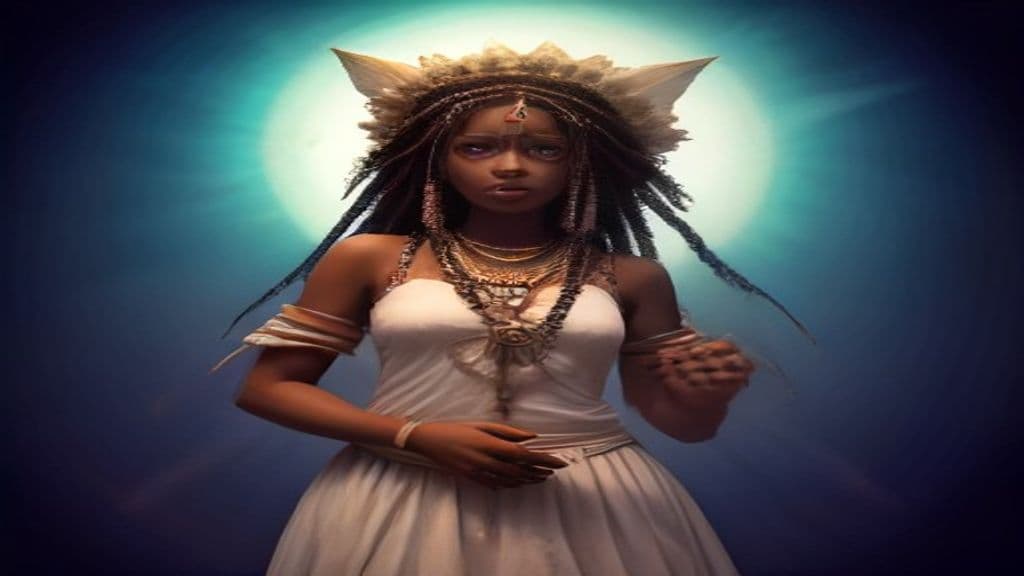
The concept of Oriṣa arises within Yoruba cosmology as a class of divine or intermediary spirits who interact with human communities and religious practice. Within that cosmological framework Oriṣa are long-established sacred agents whose worship and cultic roles have formed a core part of Yoruba religious identity. During the transatlantic slave era and colonial period, followers of Yoruba-derived practices carried devotion to these spirits to the Americas; in places such as Cuba the Lucumí tradition adapted by syncretizing particular Oriṣa with Catholic saints so that the worship of these deities could be maintained beneath prevailing colonial Christian institutions. This trajectory—origination within Yoruba religious systems and adaptive continuity in diaspora contexts—is the principal historical narrative supported by the provided sources.
There is no single, uniform physical appearance for Oriṣa as a class; the sources emphasize that Oriṣa constitute a category of divine spirits rather than a monomorphic being. Individual Oriṣa possess distinct iconography and attributes within Yoruba and diaspora ritual arts, but such specific visual identities are not detailed in the provided materials. In Lucumí/Santería and related syncretic contexts, Oriṣa are frequently represented or paralleled by images of Catholic saints (a deliberate adaptation that allowed continued veneration under colonial conditions). Modern popular-culture appropriations of the term (for example, a video‑game character named “Orisa” or literary works titled “The Orisa”) are separate fictional uses and do not document traditional ritual appearance.
The sourced material presents Oriṣa as divine/intermediary spirits centrally involved in religious life and ritual: they are venerated, petitioned, and serve as patrons or protectors in human communities. Individual Oriṣa may have specific functions—one named example in the sources, Orisa Oluwa, is described as a town protector god—indicating that protective and guardianship roles are among the functional capacities ascribed to members of the class. In diaspora settings Oriṣa continued to mediate social and spiritual needs through syncretic worship practices, functioning as enduring focal points for devotion, communal identity, and ritual action. The provided sources do not enumerate a universal catalog of supernatural powers (such as possession dynamics, miracles, or elemental domains) for the entire class; such attributes are treated as particular to individual Oriṣa within local traditions.
Ajogun
Ajogun are a class of malevolent spiritual forces in the Yoruba religious worldview that regularly interfere with human lives, responsible for death, disease, curses, loss, conflict and related misfortunes. They are described as the polar opposite of the benevolent Oriṣa, led by Iku (Death), and can be warded off or appeased through intercession by Eṣu and by observing Ifá divinatory counsel.
Cowrie-Shell Divination
A set of practices using cowrie shells for divination and guidance in West African and Afro-American traditions. (Note: - Power tier: Minor Spirit is unlikely, given the widespread use of cowrie shells across various cultures for significant spiritual practices; consider Greater or Ancient. - Appearance: Add that cowri)
Egungun (ancestral masquerade spirits)
Egungun refers both to Yoruba masked, costumed masquerades and to the collective force of departed ancestors who manifest through those masquerades. In performance the layered costumes are treated as a dwelling for ancestor presence; egungun appear periodically—especially at annual festivals—to remember the dead, bless the community, and mediate between the living and the otherworld.
Esu (Eshu, Elegbara)
Esu (also attested as Eshu, Elegbara, Elegua/Elegguá, Exu) is a named Orisha — a deity — in the Yoruba traditional religious system and its diasporic continuations. The provided source identifies Esu principally as an Orisha associated with roads and notes the figure's presence across Ifa/Orisha practice and several Afro-diasporic religions.
Gelede (Gẹlẹdẹ)
Gelede is a Yoruba public masquerade spectacle and the ritual institution that honors and manages the spiritual power of 'Mothers' (senior women, female ancestors and deities). As a multi-media performance of carved and painted headdresses, masks, dance and music, Gelede functions to celebrate fertility and motherhood, educate the community, and placate potentially dangerous female powers.
Obalufon Alayemore
Obalufon Alayemore (Ọbalùfọ̀n II, Alayemore) is a historical Ooni of Ile Ife who was deified after death and is venerated in the Yoruba religious-cultural corpus as an oríṣa and patron of art, weaving, and bronze/brass casting. He appears in royal succession lists as the third Ooni of Ife and is associated with material-culture representations such as brass heads and masks.
Obatala
Obatala is a high-ranking primordial orisha in the Yoruba religious framework, widely described as the sculptor of humankind who molds human bodies and is regarded as father of humanity and owner of all heads. He is associated with wisdom, coolness of thought, and senior or royal status among the orisha; some traditions connect him to the founding of Ife.
Odùduwà
Divine king and Oriṣa in the Yoruba religion, progenitor of the Ife Empire. (Note: - Power tier is uncertain; source material does not provide clear information on Odùduwà's abilities or power level. - Appearance should be included for completeness. - Abilities need to be rewritten,)
Orisha
Orisha (Òrìṣà) are named divine or supernatural figures in Yoruba religious thought and its Afro‑diasporic continuations (for example, Candomblé and Cuban Yoruba associations). They function as central agents of worship, ritual engagement, and divinatory communication in Yoruba communal and individual religious life.
Oshun
Oshun (Ọṣun, Ochún, Oxúm) is a major orisha and Irunmole in the Yoruba religious corpus and its diasporic traditions, associated with freshwater (rivers), love, fertility, femininity, divination, prosperity and beauty. She is honored at the Osun-Osogbo Sacred Grove and in festivals and ritual forms across Yorubaland and Afro‑Atlantic religions such as Candomblé and Regla de Ocha/Santería.
Sopona (Ṣọ̀pọ̀na, Shapona)
Sopona is the Yoruba orisha associated with smallpox and related illnesses; the deity is understood to be capable of causing outbreaks through divine displeasure and—in traditions that identify him with Ọbaluaye/Obaluaiye—exists within a wider power to both afflict and remove pestilence. Beliefs about Sopona traveled with Yoruba peoples to the Americas and were syncretized in Orisha-based religions (e.g., as Babalú-Ayé).
Yemọja
Yemọja is a major water deity (orisha) in the Yoruba religion, venerated as a maternal patron of rivers—particularly the Ogun River in Nigeria—and, in Afro-Cuban and Brazilian Orisha traditions, of the ocean. She is depicted as a protective mother figure associated with fertility, healing, wealth symbolism (cowrie shells), and both nurturing and potentially destructive aspects of water.
Community Record
- [1]Orisha. Wikipedia: 'Orishas are divine spirits that play a key role in the Yoruba religion...'wiki
- [2]Orisa Oluwa. Wikipedia: 'Orisa Oluwa is a deity of Yoruba mythology, considered a town protector god.'wiki
- [3]Chief Awodele Ifayemi (audio). Archive.org audio resource referencing Orisa and Ifa (source material in Portuguese/English archive collection).other
- [4]Orisa devotion: sources for religious education. Blog compilation referencing resources for Orisa devotional education and study.other
- [5]Orisa (Overwatch) (not traditional). Wikipedia entry noting a modern fictional character named 'Orisa' (distinct from traditional Oriṣa).wiki