
In the provided sources Alpheus is attested primarily as a river god in Greek mythology: a divine personification associated with a particular river (a potamos) within ancient Greek religious categories. The supplied excerpts do not supply a narrative genealogy, specific mythic episodes, or a fuller myth cycle for this figure; they identify Alpheus as a landscape-associated deity rather than giving detailed origin myths. Separately, the name appears as Alphaeus in New Testament genealogical contexts and is used in modern contexts (fictional characters and a crustacean genus), indicating onomastic continuity and reuse across traditions.
The excerpts supplied do not include any consistent or specific iconographic or physical description of Alpheus as a supernatural being. The principal attestation labels Alpheus as a river god (potamos), which in Greek art and literature is a category that may be represented anthropomorphically, but no such representations or descriptions are provided in the quoted material. Other occurrences of the lexeme in the sources refer to human individuals, fictional characters, or a biological genus and do not contribute a unified appearance for a mythic Alpheus.
The sources characterize Alpheus primarily as the personification and divine embodiment of the river bearing his name. While no list of explicit supernatural feats or habitual behaviors is given in the supplied material, his classification as a potamos implies his identity is bound to the river's flow and presence: he functions as the localized divine force of that watercourse and participates in the wider network of local gods within Greek mythology. The provided texts do not attribute specific miraculous acts, contests, or narrated deeds to Alpheus.

Ares
Ares (Ancient Greek: Ἄρης) is the ancient Greek Olympian god of war who personifies the physical violence, valor, and bloodlust of combat. Worshiped irregularly across Greece and Asia Minor, he was both honored and ritually restrained by communities that sought to direct his martial power toward protection rather than wanton destruction.

Artemis
Artemis is an ancient Greek goddess of hunting, the wilderness and wild animals, transitions (especially childbirth and puberty), vegetation, and chastity. Twin sister of Apollo and daughter of Zeus and Leto, she functions as a protector of young children and maidens while also capable of inflicting disease or punishment for transgressions against her sacred laws.
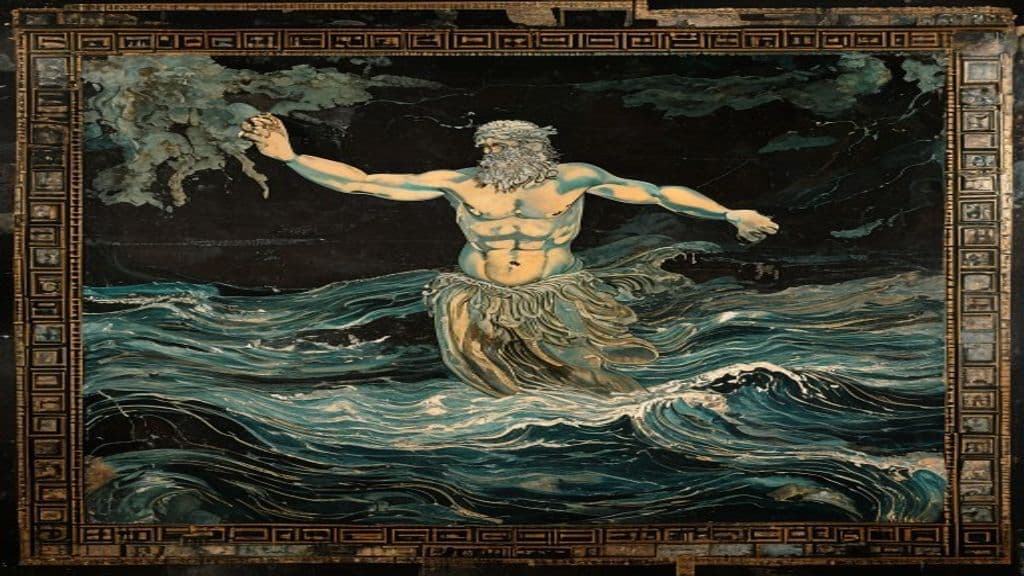
Oceanus
Oceanus (Greek: Ὠκεανός) is a primordial Titan in ancient Greek cosmology who personifies the great river that encircles the world and is named as father of the river gods (potamoi) and the Oceanids. He functions as a cosmological boundary-stream and genealogical progenitor in multiple Greek traditions and appears in literary theogonies and Greco-Roman art.

Tethys
Tethys is attested in the provided materials primarily as a Titaness of Greek mythic tradition who in a modern children's retelling is presented as an elderly storyteller and mediator among gods. The name is also widely reused in scientific and cultural contexts (a Saturnian moon, a gastropod genus, the ancient Tethys Ocean, and various institutions), usages which are naming transfers rather than continuations of the mythic figure.
Aceso
Aceso (Ancient Greek: Ἀκεσώ, Akesó) is an ancient Greek goddess who personifies the process of healing and convalescence. She is attested as a daughter of Asclepius and Epione and was worshipped in healing centers such as Athens and Epidauros, appearing in sculptural reliefs alongside her family.
Achelous
Achelous is the personified river-divinity of the Achelous River in ancient Greek religion and mythology. Regarded among the potamoi (river-gods), he is portrayed as a shape-changing elemental deity associated with springs, naiads, and the production of abundance (the horn/cornucopia motif); he appears in myths chiefly as suitor to Deianeira and as Heracles' opponent.
Acis and Galatea
A pair of lovers from ancient Greek myth: Galatea is a Nereid (sea-nymph) traditionally counted among the daughters of Nereus and Doris; Acis is a mortal youth in classical accounts who, in Ovid's poetic version, is killed by the Cyclops Polyphemus and transformed by Galatea into a river-spirit, explaining a Sicilian stream.
Actaeon
A mortal hunter of Greek myth who, in multiple traditions, is transformed into a stag and torn apart by his own hounds after transgressing the goddess Artemis. He functions as a mythic exemplar about proper deference to divine boundaries and, in some locales, became the focus of cultic rites and memorials.
Actia
Actia (Ancient Greek: Ἄκτια) is attested in the supplied sources not as a supernatural being but as (a) the ancient festival and epithet of Apollo Actius associated with Actium and Nicopolis, and (b) a modern taxonomic and commercial name (genus of flies; company and product names). No folkloric or mythic entity named Actia is documented in the provided materials.
Adikia
Adikia (Ancient Greek: Ἀδικία) is the personification and embodiment of injustice and wrongdoing in ancient Greek religious and visual culture, typically portrayed as the opposite and vanquished counterpart of the goddess Dike (Justice). She appears chiefly in archaic vase-paintings and emblematic visual programs where Justice punishes or restrains her.
Adonis
Adonis is a mythic mortal youth in ancient Greek tradition, beloved by goddesses (notably Aphrodite and Persephone) whose death and seasonal return are the focus of the women’s midsummer festival Adonia. The cultic practices—planting short-lived 'gardens of Adonis' on rooftops, ritual lamentation, and casting an effigy and withered plants into the sea—symbolically link him to vegetation cycles and Near Eastern dying-and-regenerating god traditions.
Adrasteia
Adrasteia is an ancient Anatolian/Greek goddess associated with mountain-mother cults and later identified with the Greek notion of inescapable fate and retributive necessity. She appears in Phrygian contexts as a mountain goddess connected to Cybele, in Cretan myth as a nurse of the infant Zeus, and by the fifth century BC is often equated or associated with Nemesis and other personifications of necessity.
Adrestia (Adrasteia)
Adrasteia (also Adrestia and multiple orthographic variants) is a figure in classical Greek tradition whose roles shift from a Phrygian mountain/mother-goddess probably associated with Cybele, to a Cretan nymph entrusted with nursing the infant Zeus, and by the fifth century BC identified with Nemesis as a deity/personification of divine retribution and balance.
Aeacus
Aeacus is a mythic king of the island of Aegina in Greek tradition, famed for his justice and piety. After death he is accorded a permanent office in Hades as one of the three judges of the dead alongside Minos and Rhadamanthus, and he is the eponymous ancestor of the Aeacidae.
Aegina
Aegina is an eponymous nymph of Greek mythology who personifies the island of Aegina in the Saronic Gulf. She is remembered primarily as the mother of the hero-king Aeacus and as the island’s mythical ancestress, anchoring local civic identity and cultic landscape.
Aesculapius (Asclepius)
Aesculapius (Greek Asclepius) is the classical divine-hero of medicine and healing in ancient Greek religion and later Roman cult. He functioned as the patron and legitimating divine figure for temples, attendants (therapeutae), and organized healing practices; his emblem, the rod of Asclepius (a snake-entwined staff), endures as a symbol of medicine.
Community Record
- [1]Alpheus (deity) — Wikipedia. Wikipedia contributors, 'Alpheus (deity)', Wikipedia, The Free Encyclopediawiki
- [2]Alpheus (deity) — alternate Wikipedia page. Wikipedia contributors, 'Alpheus (deity)', Wikipedia, The Free Encyclopediawiki
- [3]In Honour of Zeus - Olympia (site discussion of altars and sanctuaries). Rome Art Lover, 'In Honour of Zeus - Olympia'other
- [4]Changing Paintings: 23 Arethusa, Lyncus and the magpies – The Eclectic Light Company. Eclectic Light Company, 'Changing Paintings: 23 Arethusa, Lyncus and the magpies'other
- [5]Alpheus — Wikipedia. Wikipedia, 'Alpheus' (entry listing Alpheus/Alphaeus as a river god and other uses)wiki
- [6]Alpheus (Wikidata Q1757004). Wikidata entry for Alpheus (genus of crustaceans)other
- [7]Archive: Tesla Font (5843116). Archive.org item included among provided materials (font/file) referenced in research notesother
- [8]LP0064 - The Cretan Bull - Daedalus, Cephalus, & Megacles, from Tzetzes' Chiliades. Archive: LP0064 - The Cretan Bull - Daedalus, Cephalus, & Megacles, from Tzetzes' Chiliades (provided as contextual material; no direct additional details on Alpheus in the supplied excerpt).other
- [9]LP0005 The Labors of Hercules. Archive: LP0005 The Labors of Hercules (provided as contextual material; no direct additional details on Alpheus in the supplied excerpt).other
- [10]A Dreamer Lost in a Dream. Archive: A Dreamer Lost in a Dream (provided as contextual material; no direct additional details on Alpheus in the supplied excerpt).other