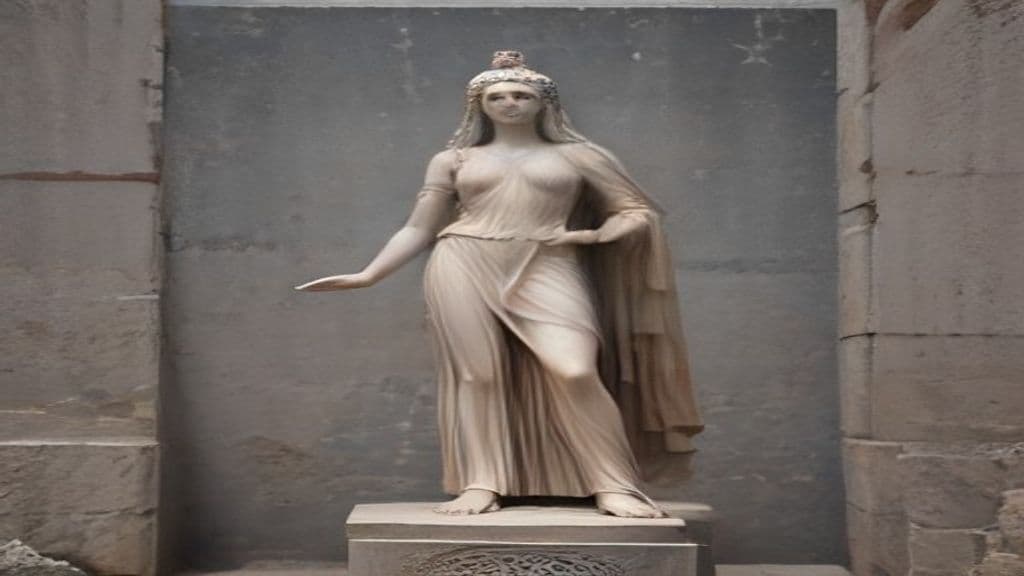
In early fragments and local tradition Adrasteia appears as a mountain-mother figure in Phrygia, described in the Phoronis as a mountain goddess served by the Idaean Dactyls. In later Greek myth she appears as a Cretan nymph, entrusted by Rhea to nurse and hide the infant Zeus from Cronus. Over time literary tradition identifies or associates her with other divine personifications of necessity and retribution, most prominently Nemesis, and with mother-goddess figures such as Cybele and Rhea.
The cited sources do not preserve a sustained iconographic description. Pausanias records seeing a statue of Adrasteia in a temple of Apollo, Artemis, and Leto at Cirrha, indicating she was represented in sanctuaries, and earlier fragments frame her as a 'mountain goddess' whose cult imagery would be consistent with mountain-mother motifs; no detailed physical attributes are preserved in the provided material.
Adrasteia personifies inevitability and pressing necessity: she represents the inescapability of punishment and enforces or symbolizes necessary retribution. In mythic narrative she also performs nurturing protective acts (notably nursing the infant Zeus in Cretan tradition). Cultic evidence shows she received public worship and temple support, linking her function to civic acknowledgement of cosmic and moral order. Later literary sources explicitly identify or equate her with Nemesis and associate her with other personifications of necessity such as Ananke and with mother-goddess figures like Cybele and Rhea.
Weaknesses
- otherSources do not record specific vulnerabilities or weaknesses for Adrasteia
Wards
- ritualPublic cultic worship and temple maintenance (attested practice)
- otherNo specific apotropaic formulas or private wards are preserved in the cited sources

Rhea
Rhea is a principal mother goddess of the Titans in ancient Greek religion and mythology, daughter of Gaia and Uranus, sister and consort of Cronus, and mother of major Olympian deities. In Roman reception she is identified with the Magna Mater (the Great Mother), reflecting continuity of her maternal and cultic role across Greek and Roman traditions.
Nemesis
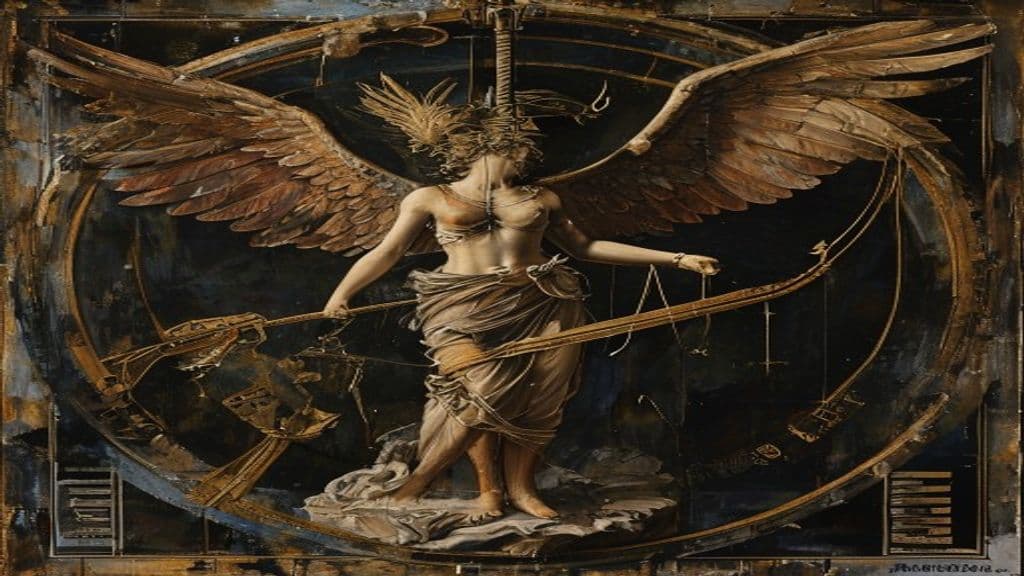
Nemesis (Greek: Νέμεσις), also called Rhamnousía in her local cult, is the personified goddess of distributive justice and retributive balance in ancient Greek religion and myth. She functions to restore due measure—rewarding or withholding according to desert—and punishes hubris and excessive fortune.

Ananke
In ancient Greek religion and Orphic tradition, Ananke (Ἀνάγκη) is the personification of necessity, compulsion, and inevitability. Presented as a primordial metaphysical power, she functions in cosmogony and moral-philosophical accounts as a binding principle that constrains gods and mortals alike.

Artemis
Artemis is an ancient Greek goddess of hunting, the wilderness and wild animals, transitions (especially childbirth and puberty), vegetation, and chastity. Twin sister of Apollo and daughter of Zeus and Leto, she functions as a protector of young children and maidens while also capable of inflicting disease or punishment for transgressions against her sacred laws.
Aceso
Aceso (Ancient Greek: Ἀκεσώ, Akesó) is an ancient Greek goddess who personifies the process of healing and convalescence. She is attested as a daughter of Asclepius and Epione and was worshipped in healing centers such as Athens and Epidauros, appearing in sculptural reliefs alongside her family.
Achelous
Achelous is the personified river-divinity of the Achelous River in ancient Greek religion and mythology. Regarded among the potamoi (river-gods), he is portrayed as a shape-changing elemental deity associated with springs, naiads, and the production of abundance (the horn/cornucopia motif); he appears in myths chiefly as suitor to Deianeira and as Heracles' opponent.
Actia
Actia (Ancient Greek: Ἄκτια) is attested in the supplied sources not as a supernatural being but as (a) the ancient festival and epithet of Apollo Actius associated with Actium and Nicopolis, and (b) a modern taxonomic and commercial name (genus of flies; company and product names). No folkloric or mythic entity named Actia is documented in the provided materials.
Adikia
Adikia (Ancient Greek: Ἀδικία) is the personification and embodiment of injustice and wrongdoing in ancient Greek religious and visual culture, typically portrayed as the opposite and vanquished counterpart of the goddess Dike (Justice). She appears chiefly in archaic vase-paintings and emblematic visual programs where Justice punishes or restrains her.
Adonis
Adonis is a mythic mortal youth in ancient Greek tradition, beloved by goddesses (notably Aphrodite and Persephone) whose death and seasonal return are the focus of the women’s midsummer festival Adonia. The cultic practices—planting short-lived 'gardens of Adonis' on rooftops, ritual lamentation, and casting an effigy and withered plants into the sea—symbolically link him to vegetation cycles and Near Eastern dying-and-regenerating god traditions.
Adrestia (Adrasteia)
Adrasteia (also Adrestia and multiple orthographic variants) is a figure in classical Greek tradition whose roles shift from a Phrygian mountain/mother-goddess probably associated with Cybele, to a Cretan nymph entrusted with nursing the infant Zeus, and by the fifth century BC identified with Nemesis as a deity/personification of divine retribution and balance.
Aeacus
Aeacus is a mythic king of the island of Aegina in Greek tradition, famed for his justice and piety. After death he is accorded a permanent office in Hades as one of the three judges of the dead alongside Minos and Rhadamanthus, and he is the eponymous ancestor of the Aeacidae.
Aegina
Aegina is an eponymous nymph of Greek mythology who personifies the island of Aegina in the Saronic Gulf. She is remembered primarily as the mother of the hero-king Aeacus and as the island’s mythical ancestress, anchoring local civic identity and cultic landscape.
Aesculapius (Asclepius)
Aesculapius (Greek Asclepius) is the classical divine-hero of medicine and healing in ancient Greek religion and later Roman cult. He functioned as the patron and legitimating divine figure for temples, attendants (therapeutae), and organized healing practices; his emblem, the rod of Asclepius (a snake-entwined staff), endures as a symbol of medicine.
Agathos Daimon (Agathodaemon)
A beneficent household and civic daemon attested in classical Greek and Graeco‑Egyptian religion. In domestic Greece it is a household spirit honored with post‑meal libations; in Ptolemaic Alexandria it appears prominently in serpentine civic and household forms and is syncretised with various Egyptian protective and fate deities in late antiquity.
Agetor
Agetor (Ancient Greek: Ἀγήτωρ; alt. Hegetor) is not an independent being but a theonymic epithet applied to multiple Greek gods—primarily Zeus in Lacedaemon, and also Apollo and Hermes—emphasizing a leading or ruling function of the deity in cult and literature.
Agoraeus / Agoraea
Agoraeus (masculine) and Agoraea (feminine) are adjectival epithets used in ancient Greek religion to mark a deity's protective or patronal relation to the agora (public square/marketplace). The term is not an independent supernatural being but a role-name attached to different gods (notably Hermes, Zeus, Athena, Artemis) indicating their guardianship of assemblies and commercial/civic activity in particular poleis.
Community Record
- [1]Adrasteia — Wikipedia article. Wikipedia: 'Adrasteia… originally a Phrygian mountain goddess… later a Cretan nymph… charged by Rhea with nurturing the infant Zeus' and 'goddess of inevitable fate'wiki
- [2]Adrasteia (Mysia) — Wikipedia article. Wikipedia: Adrasteia as a region, city, and valley of the ancient Troad or Mysia; eponymous city with an oracle of Apollo and Artemiswiki
- [3]Pleiades place resource: Adrasteia (mountain). Pleiades entry linking Adrasteia to a geographic/place identity in ancient sourcesother
- [4]Wikidata: Adrasteia. Wikidata entry noting identifiers and cross-references for Adrasteiaother