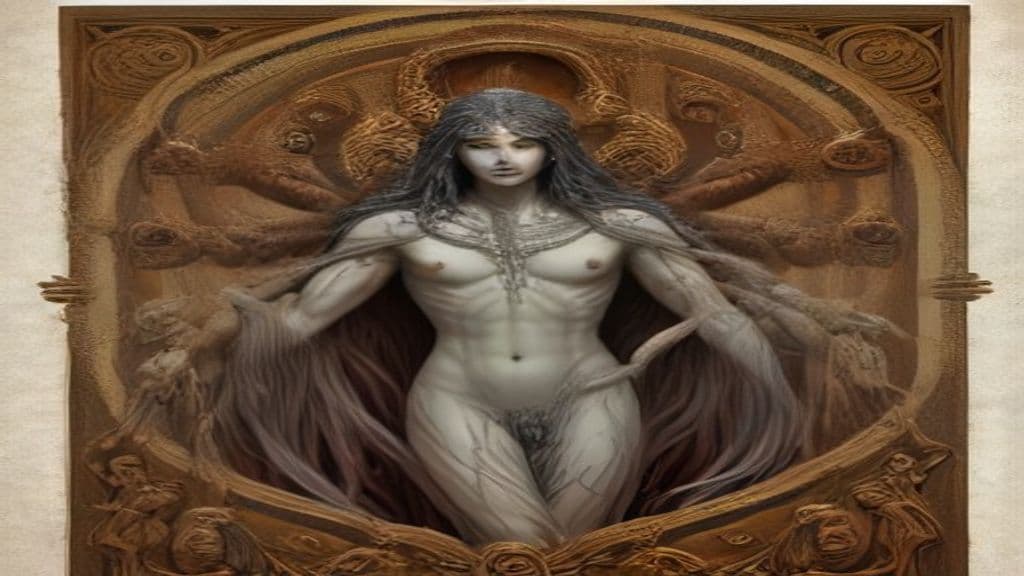
In the surviving literary account found in Nonnus's Dionysiaca, Alpos is described as a son of Earth (Gaea/Gaia), placing him among chthonic, earth-born monstrous offspring in Greek mythic imagination. The figure is attested in this epic episode as a localized, law-defying giant whose parentage is explicitly linked to Earth; beyond Nonnus's narrative there are no substantial attestations or cultic traditions tied to the name, and modern summaries note that the character does not appear elsewhere in the Greek corpus and received no known cult.
Nonnus's epic depicts Alpos with an overwhelmingly monstrous physiognomy: he is repeatedly said to possess many arms (a feature compared to the Hundred-Handed Ones), and his head is described as covered with vipers, an image compared to Medusa's serpentine hair. The poem furthermore employs epic images of voracity — a 'row of mouths' and descriptions of entombing victims in his gullet — which present him as multi-mouthed and capable of swallowing people and animals in the course of the narrative.
In the Dionysiaca Alpos acts as a territorial predator: he seizes, devours, and entombs wayfarers, shepherds, and livestock that pass his rock at Pelorus, and his presence is said to have driven away pastoral and craft activities from the surrounding countryside. The only recorded means of ending his depredations in the sources is martial/theomorphic: Dionysus confronts and slays Alpos with his thyrsus. The sources do not record any ritual powers, cultic capacities, or regular cycles of activity for Alpos beyond this narrative episode.
Weaknesses
- otherslain by divine/martial intervention (Dionysus with a thyrsus)
Wards
None recorded.

Alpha Flight
A fictional team of Canadian superheroes published by Marvel Comics, organized within the shared Marvel Universe as Canada’s primary superhuman response force under the oversight of a government project called Department H. The roster is composed of individually powered heroes drawn to represent Canadian regional and cultural diversity.
Alpha Primitive
A term used within Marvel Comics' Inhumans setting to denote a category of created or subordinate beings associated with Inhuman society. The available provided source (Wikipedia's Inhumans overview) references the Inhumans generally but does not supply detailed canonical information about Alpha Primitives themselves.
Alpha and Omega
A titulary formula and visual symbol formed from the first and last letters of the Greek alphabet (Α/α and Ω/ω), used in Christian scripture and art to denote God's or Christ's totality — 'the beginning and the end.' It functions as a theological appellation rather than an independent supernatural being.
Alphesiboea
Alphesiboea (Ancient Greek Ἀλφεσίβοια, Alphesíboia) is a proper name used for several distinct women in Greek mythic genealogies and narratives. Bearers of the name include mortal princesses and wives tied to dynastic stories (notably a Psophian princess married to Alcmaeon), an attested variant as wife of Pelias, a supposed mother of Adonis in one tradition, and an 'Indian' nymph who appears in a Dionysian episode.
Alpheus
Alpheus (Ancient Greek: Ἀλφειός) is the personified river and river-god of the Alpheios in the Peloponnese. He is classed among the river-deities descended from Oceanus and Tethys and appears in myths linking the Arcadian/Elian river to the Sicilian well Arethusa, to Artemis, and to the labors of Heracles.
Alphyn
The alphyn is a heraldic composite creature from medieval European heraldry and bestiary traditions, depicted as a chimera-like emblematic beast used on coats of arms, badges, and tapestries. Sources treat it as a stock heraldic motif with variable parts rather than as a folkloric spirit or deity.
Alraune
Alraune is the German folkloric figure identified with the humanoid-shaped mandrake (Mandragora officinarum) and the eponymous female character in Hanns Heinz Ewers's 1911 novel. In folklore the mandrake/Alraune is associated with love philtres, fertility, and a medieval gallows-origin legend; in literature the name labels a woman artificially conceived from a criminal's semen, whose emotional life and actions dramatize the folk moral about such origins.
Alrek and Eirík
Alrek and Eirík (also rendered Alaric and Eric) are legendary Swedish kings from the Old Norse saga tradition who are presented as joint rulers and as members of the Ynglinga royal genealogies. They appear in saga narratives as sons and heirs of King Agni, famed for martial and athletic prowess, and as hosts who receive the hero Starkaðr after the sacrificial death of Vikar.
Alseid
An Alseid (Ancient Greek: Ἀλσηΐδες, Alsēïdes) is a class of nymph in classical Greek mythology specifically associated with groves and glens. The term functions as a locality-category within the broader Greek taxonomy of nymphs; later modern sources reuse the label for varied fantasy and game creations.
Altes
Altes is a named Lelegian king of Pedasus attested in the Homeric tradition and later mythographic summaries. He functions in the epic genealogical network as the father of Laothoe (one of Priam's wives) and is in some accounts named as father of the Argonaut Ancaeus of Samos; no supernatural attributes are recorded in the supplied sources.
Altgermanische Religionsgeschichte
A historical survey of Germanic religious history, providing an overview of the pantheon of gods and goddesses. (Note: - Power tier is not applicable to historical surveys - The article should reflect that it's a historical survey, not an entity with abilities or appearance - Consider adding information on the signifi)
Althaea
Althaea is attested in the provided sources as (1) the Latinized form of the Greek name Ἀλθαία (Althaia), a mythological human figure recorded as daughter of Thestius and mother of Meleager, and (2) a botanical genus (Malvaceae) of perennial herbs including the marshmallow plant; the name may be etymologically linked to Greek ἀλθος (althos) 'healing'. The supplied material contains no evidence that Althaea is a supernatural being.
Community Record
- [1]Nonnus, Dionysiaca (summary and passages as cited). Passages and summary of Nonnus's Dionysiaca as quoted and paraphrased in modern summaries (see Theoi and Wikipedia entries).literary
- [2]Theoi Project — ALPOS. Entry summarizing Nonnus's account of Alpos, noting features such as many arms and viper hair and situating him in Sicily.other
- [3]Wikipedia — Alpos. Modern encyclopedia summary noting details from Nonnus's Dionysiaca, lack of cult, and singular attestation.wiki
- [4]Wikidata entry for Alpos. Structured data noting name forms and a variant genealogical entry; used cautiously for parentage references.other