
In Sumerian literary tradition Alulim is presented as the antediluvian first ruler installed at Eridu. The Eridu Genesis fragment names the major gods An, Enlil, and Enki as the appointing divinities who choose Alulim for the 'shepherdship of the entirety of the many people,' making him an etiological figure for the institution of kingship. The Sumerian King List places him explicitly before the flood with proverbially vast reign-lengths (examples attested in different tablets include 28,800 years in the King List and 36,000 years in the Ballad of Early Rulers), marking him as a denizen of mythic, antediluvian time rather than recorded history.
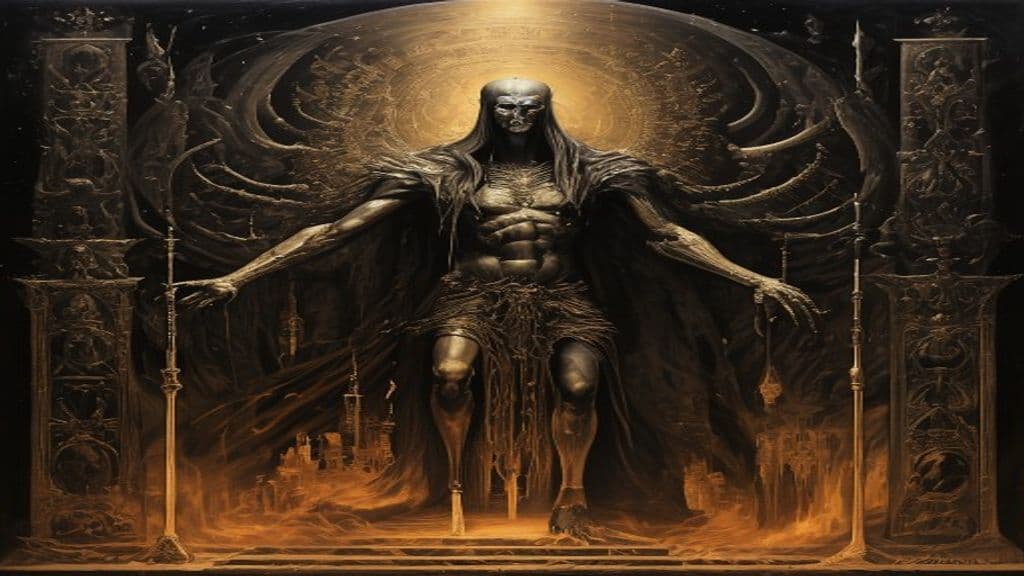
No consistent anthropomorphic or physical description of Alulim survives in the attested sources. The name occurs in Sumerian spellings (A₂-lu-lim / A-lu-lim, cuneiform 𒀉𒇻𒅆) and an Akkadianized variant Alulu; a separate variant Ayalu appears in the Uruk List of Kings and Sages and may relate to the Sumerian word ayyalu ('deer' or 'stag'). Jeremiah Peterson has suggested a grammatical ambiguity in the Eridu Genesis fragment that could render the form as a descriptor rather than a personal name, so Alulim in some contexts functions as a conceptual or typal figure rather than an individuated portrait. Late Neo-Babylonian ritual texts personalize him with narrative traits (enjoyment of milk, ghee, and beer; an aversion to 'queen Nisaba' as a metonym for grain) but the primary sources do not provide bodily attributes or iconography.
Primary: within Sumerian and Akkadian literary tradition Alulim's role is institutional—he is the first ruler appointed by the gods to shepherd people and thereby serves as the mythic origin of kingship. Secondary / late ritual attributions: Neo-Babylonian incantations against field pests invoke Alulim as an ancient king 'from before the deluge' who is credited in those texts with the ability to expel insects using a wand and with weeding the fields of the god Nergal; the same late texts present him paradoxically as created/deployer of insects in some formulations while also driving them off. The sources also record late narrative details (dietary likes and dislike of 'queen Nisaba'). The attested evidence confines his operational role largely to textual and ritual invocation rather than a catalogue of broader supernatural powers.
Nergal
Nergal is a major Mesopotamian deity associated with war, disease, inflicted death, and rulership of the underworld. Principal cult center at Kutha (temple E‑Meslam), he appears in hymns and myths (e.g., the Epic of Erra, "Nergal and Ereshkigal") and is sometimes equated with or called Erra or Meslamtaea.

Nisaba
Nisaba is an ancient Sumerian goddess chiefly associated with writing, the scribal arts, wisdom, and grain. Attested from the Fara (Early Dynastic) period onward, she functions as the divine patron and legitimizer of literacy, accounting, and the institutional arts of tablets and archives, and later becomes identified with grain itself.

Adapa
Adapa is a mythic figure from ancient Mesopotamian (Sumerian and Akkadian) literature: a mortal fisherman and temple sage of Ea at Eridu endowed with exceptional wisdom. He appears in a fragmentary tale in which he breaks the wings of the south wind and is summoned to the divine court; his name was later invoked in exorcistic and ritual contexts as an authoritative identity.

Etana
Etana is a legendary early king of Kish in Mesopotamian tradition who, according to epic texts and the Sumerian King List, aided an eagle and was conveyed to the heaven of the god Anu to seek a 'plant of birth' enabling him to sire an heir. He functions as a culture-hero whose narrative situates kingship, divine favor, and animal intermediaries within Mesopotamian cosmology.

Gilgamesh
Gilgamesh is a semi-divine legendary king of the Sumerian city of Uruk who features as the protagonist of a pan‑Mesopotamian epic tradition. Portrayed in literary sources as a demigod of superhuman strength, he is both a historical monarch recorded in king lists and a later object of cultic veneration.
Adapa
Adapa is a mythic figure from ancient Mesopotamian (Sumerian and Akkadian) literature: a mortal fisherman and temple sage of Ea at Eridu endowed with exceptional wisdom. He appears in a fragmentary tale in which he breaks the wings of the south wind and is summoned to the divine court; his name was later invoked in exorcistic and ritual contexts as an authoritative identity.
Aga of Kish
Aga of Kish (Aga, Agga, Akka) is an Early Dynastic Mesopotamian king recorded in the Sumerian King List, the Tummal Inscription, epigraphic objects, and the Sumerian poem "Gilgamesh and Aga." He functions in texts as a historical/legendary political actor who attempted hegemonic demands on Uruk and was ultimately captured and released by Gilgamesh.
Alû (Alu)
A named lemma attested in modern reference lists as 'ALU / Alu', but for which the supplied research corpus contains no substantive primary- or secondary-source information about nature, appearance, powers, or rituals in Mesopotamian tradition.
Amurru (Martu)
Amurru, Sumerian Martu, is a Mesopotamian deity who functions as the divine personification of the Amorites. Originating in Mesopotamian textual practice, he is associated with the steppe and mountains, depicted with a crooked staff, portrayed in hymnography as warlike and lightning-armed, and from the Old Babylonian period acquires a prominent exorcistic cultic role.
Ancestors of Enlil (Enki-Ninki deities)
A sequence of Sumerian divine pairs (en-/nin- names) conceived as the primordial ancestors culminating in Enlil; chiefly attested in god lists and invoked as authoritative primordial names in ritual, especially in incantations and exorcisms.
Anshar
Anshar is a Mesopotamian primordial deity whose name (Cuneiform AN.ŠÁR) literally means "whole sky" or "the whole heaven." He functions as an abstract ancestral figure in theogonic genealogies (not actively worshiped as a regular cult deity) and appears in literary contexts—most notably the Enūma Eliš—and in god lists where he legitimizes later supreme gods.
Anu
Anu (Sumerian An; Akkadian Anu/Anum) is the divine personification of the sky in ancient Mesopotamian religion, traditionally ranked at the top of god‑lists as the source of heavenly authority (anûtu/anuti) and the fount of legitimate rule for gods and kings. Though supreme in genealogies and astronomical schema, many periods portray him as a relatively passive or figurehead deity whose active cultic role is limited until a late Seleucid reinvention in Uruk.
Anunnaki
A variable collective of major deities in ancient Sumerian, Akkadian, Assyrian and Babylonian religious literature, described as offspring or descendants linked to the sky god An (Anu) and an earth/mother figure (Ki/Ninhursag). Texts portray them as participants in the divine assembly, decreers of human fate, and in some traditions a group of seven underworld judges; their number, membership, and functions vary across sources.
Anzû (Imdugud)
Anzû, also called dZû or Imdugud, is a large storm-associated bird-figure in Sumerian/Akkadian/Babylonian myth. Portrayed as a hybrid (commonly a massive bird with a lion's head or as a half-human storm-bird), Anzû is credited in mythic narratives with seizing the Tablet of Destinies and thereby challenging the authority of chief gods such as Enlil.
Apkallu (Abgal)
Apkallu (Akkadian; Sumerian: Abgal) are polyvalent Mesopotamian wisdom figures attested as mythic/semi-divine sages (notably a group of seven), as professional human experts (ummânu), and as apotropaic images used in household and cultic ritual. They are closely associated with the god Ea (Nudimmud) as transmitters of secret knowledge and are represented in diverse iconography including fish-man and bird-headed types.
Ara
Ara (Sumerian: A) is a minor Mesopotamian goddess attested as a servant or attendant of the god Enki. Earlier scholarship sometimes conflated her theonym with the attendant deity Isimud, but modern treatments distinguish Ara as a separate divine household figure.
Aruru
Aruru is a Mesopotamian goddess attested from Ur III onward whose identity shifts from an early vegetation-associated, forceful local deity to a later epithet or aspect of high mother/earth/vegetation goddesses (e.g., Ninhursag). She is frequently described as the 'older sister of Enlil' and appears in god lists, hymns, and later literary tradition.
Community Record
- [1]Alulim — Wikipedia. Wikipedia, 'Alulim' entry (summary of Sumerian King List, Eridu Genesis, Neo-Babylonian incantations, and reception)wiki
- [2]Alulim — Wikidata. Wikidata entry for Alulimwiki
- [3]Eridu — Wikipedia. Wikipedia, 'Eridu' (contextual information on Eridu as city of origins)wiki
- [4]Sexagesimal (context for large reign numbers). Sexagesimal number system reference (contextual for reign-length numeration)other
- [5]From Alulim to Zimudar – Jane Dougherty Writes. Blog post summarizing aspects of Alulim's attestation and receptionother
- [6]SaturnianCosmology — Kings list file (online text). Online transcription/collection referencing king-list numeration (used for comparative data in notes)other
- [7]WorldAtlas — Who Was The First King In The World?. Popular summary referencing early Mesopotamian first-king traditionsother