
No narrative mythic origin survives for Amasagnudi in the provided sources. Scholarly reconstructions based on lexical lists and late god-list arrangements propose three possibilities: that she was originally the sukkal (attendant) of Anu later supplanted by Ninshubur; that she functioned as an epithet or aspect of Ninshubur; or that she represented the consort of a male form of Ninshubur. These are hypotheses grounded in lexical equivalences and Seleucid Uruk god-list material rather than preserved mythic story material.
There is no preserved iconographic or physical description of Amasagnudi in the cited evidence. Her name begins with the Sumerian sign ama, 'mother', and scholarly translations render Amasagnudi variously as 'the indestructible mother,' 'the unmovable mother,' or 'the mother who does not go away.' An alternate appellation attested in the sources is Ninkagal (also read Nin-abul or Nin-abula), glossed as 'lady of the great gate.' Late and variant spellings in Seleucid-period texts (e.g., dAMA.SAG.QA.NU.NU and dAMA.PA.NU.UL) indicate scribal uncertainty about the original form and meaning of the name; beyond these lexical notes, the sources supply no depiction of dress, iconography, or bodily form.
Amasagnudi's functional role in the sources is bureaucratic and courtly rather than mythically demonstrative. She is described as a nin-sukkal — a female vizier/attendant and messenger — attached to Anu's household, a role that in Mesopotamian administrative-theological vocabulary implies duties as an attendant, envoy, and court official. In Seleucid Uruk material she is paired as the wife of Papsukkal. A single lexical text equates her with Ninshubur; otherwise her wider powers, miracles, or narrative actions are not attested. The appearance of her name in an Akkadian incantation against Lamashtu alongside Papsukkal is recorded in the sources but does not provide explicit evidence of an independent apotropaic function.
Weaknesses
- othernone attested in the provided sources
Wards
- otherno specific wards attested; only a tangential mention in an Akkadian incantation against Lamashtu which lists Amasagnudi alongside Papsukkal

Ninshubur
Ninshubur is a Mesopotamian divine attendant (sukkal) chiefly associated as the companion, messenger, and intercessor of the goddess Inanna. Functioning as a cultic office within the pantheon, Ninshubur mediates between petitioners and higher gods and appears in major myth cycles (e.g., Inanna's Descent) and in city cults across ancient Mesopotamia.
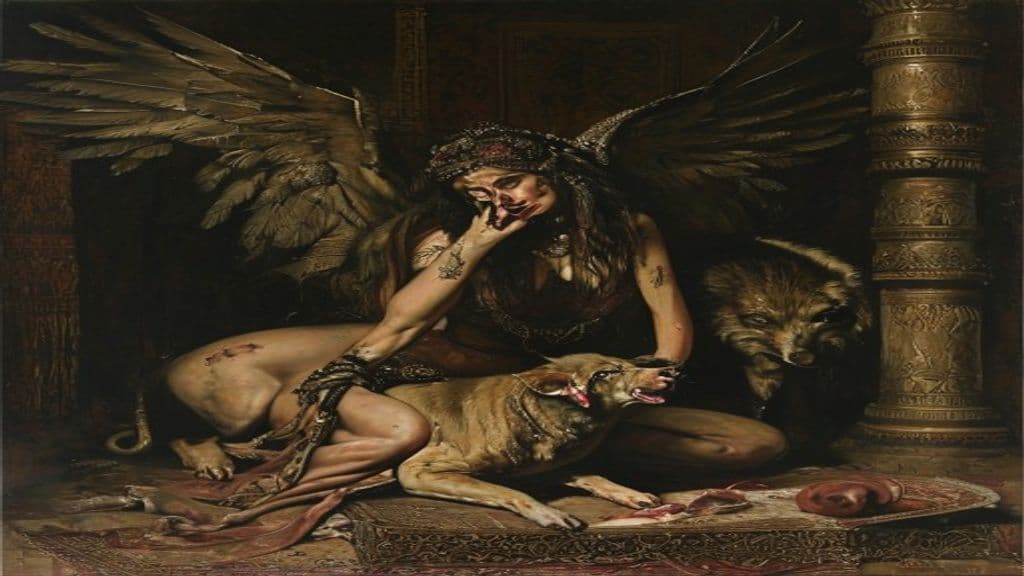
Lamashtu
The most feared demoness of ancient Mesopotamia — a divine daughter of Anu who preyed on pregnant women, caused miscarriages, and killed infants by nursing them with venom.
Abu
Abu is a poorly understood Mesopotamian god attested in modern reference summaries. Secondary literature tentatively links him with vegetation and snakes and records that he was often paired with a deity written gu2-la2, but primary details about his cult, iconography, and myths are lacking in the cited sources.
Alammuš
Alammuš is a Mesopotamian deity who functioned as the sukkal (attendant or court-official deity) of the moon god Nanna (Akkadian Sin). He is attested in offering lists, god-lists, oath formulas, legal and seal texts, and in Mesopotamian astronomical lists where he is paired with Ningublaga as the 'Little Twins.'
Alla
Alla (Alla‑gula) is a Mesopotamian underworld‑associated deity attested in Ur III and Old Babylonian texts. He functions in sources as the sukkal (attendant) of Ningishzida and is grouped with lamentation literature’s ‘dying gods’; many details of his character remain fragmentary and debated.
Antu
Antu (Antum) is a Mesopotamian goddess traditionally regarded as the feminine counterpart and spouse of the sky god Anu. Attestations range from Early Bronze Age references to a marked elevation of her cultic profile in Achaemenid and Seleucid-period Uruk, and in some late theological texts she is equated with earth or primordial and underworld figures.
Asalluhi
Asalluhi (also Asarluhi, Asarluhe, Asaralimnuna, Asaralim, Asalim, Asarnuna) is a Mesopotamian deity primarily associated with incantations and exorcism. He is described in some sources as a son of the god Enki and is likely identical with an earlier figure called Asar attested from the third millennium BCE.
Ea (Enki)
Enki (Akkadian Ea) is a major Mesopotamian deity associated with wisdom, crafts, fresh subterranean waters (the Abzû/Apsu), magic, and incantations. He functions as a benefactor of humankind and rulers, a source of ritual and healing authority, and the divine ruler of the subterranean freshwater domain called the Abzû.
Edimmu
In Mesopotamian religious tradition the edimmu are a type of utukku — restless, wind-like spirits of the improperly buried who can be vengeful, possessive, and life-draining; later popular media reinterprets them as vampire- or undead-styled monsters in games and fiction.
Erragal
Erragal (also Errakal, Errakalkal, Errakar, Erkal) is a Mesopotamian deity attested from the Isin‑Larsa through Neo‑Babylonian periods. He is polyvalent in function: identified with a star in the MUL.APIN tradition and invoked apotropaically in incantation series, associated in some texts with storm/destructive power and, in some contexts, linked to the underworld; scholarly opinion differs on whether he is distinct from, derived from, or an epithet of Erra.
Gibil (Girra)
Gibil (Akkadian Girra) is a Mesopotamian deity personifying fire in its constructive (furnaces, metallurgy, ritual purification) and destructive (lightning-set conflagrations, burning fields) aspects. He is attested in city cults (Shuruppak, Eridu, Nippur) and invoked in ritual and incantation literature (Maqlû, Šurpu, namburbi) for purification and counter-magic purposes.
Igigi
A class of younger heavenly beings in ancient Mesopotamian myth, the Igigi are attested chiefly as a subordinate, laboring cohort of gods contrasted with the higher-ranking Anunnaki; in the Atrahasis narrative they perform manual tasks for senior deities and at one point rebel from forced toil. The name is attested in Sumerian orthography (i-gi4-gi4, later í-gì-gì) and its ultimate lexical origin is unknown, though scribal spellings invite numerical wordplay.
Ilaba
Ilaba is a Mesopotamian deity attested from the Sargonic (Akkadian) period as the city god of Akkad and a tutelary war-god for Akkadian rulers. He is associated with a mace as his emblem, invoked in royal inscriptions, treaties, curse-formulae and continued to appear in post‑Akkadian cultic contexts.
Imzuanna
Imzuanna (also attested as Ninzuanna) is a Mesopotamian city goddess attested from the Ur III through Neo‑Babylonian periods. She functions mainly as the consort of Marad's tutelary god Lugal‑Marada, appears in offering lists, lamentation literature, and ritual corpora (notably Šurpu), and is otherwise sparsely attested in the surviving record.
Community Record
- [1]Amasagnudi (Wikipedia). Wikipedia contributors, 'Amasagnudi,' Wikipedia, The Free Encyclopedia.wiki
- [2]Papsukkal (Wikipedia). Wikipedia contributors, 'Papsukkal,' Wikipedia, The Free Encyclopedia.wiki