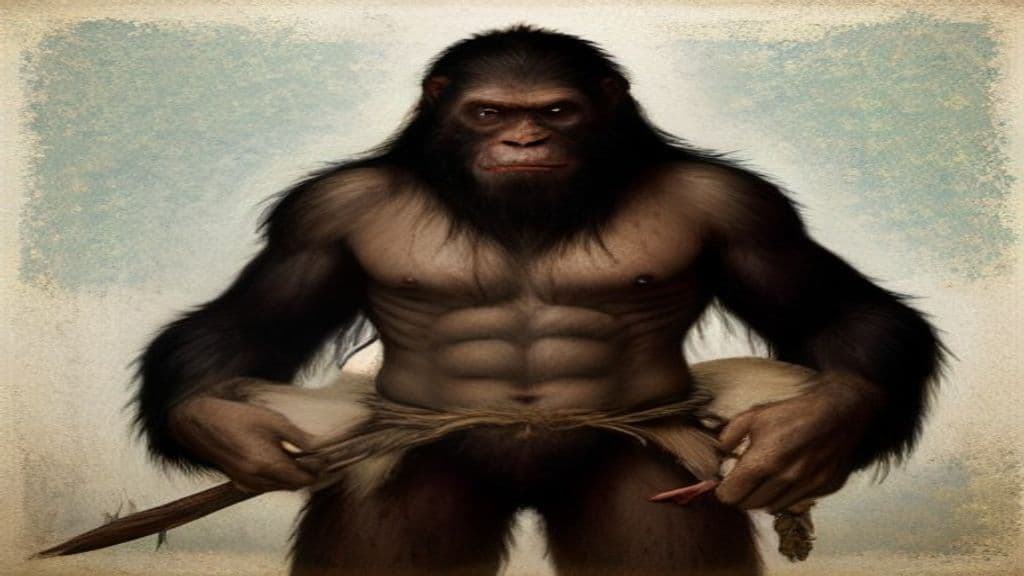
The sources do not record a detailed mythic origin story for Amomongo. In regional materials the name appears in traditional Visayan folktale contexts (for example the folktale titled "Amomongo and Iput-Iput") where the Amomongo functions as an ape character rather than a cosmological ancestor or spirit. In modern coverage the term is reactivated as a label for a purported wild hominoid reported in and around La Castellana, Negros Occidental; such modern accounts treat the creature as an animal of caves and volcanic foothills rather than as a being with a defined supernatural lineage. The name itself is reported to be "probably derived" from the Hiligaynon word amó, which translates as "ape" or "monkey," but sources stop short of offering a definitive etymology.
Across the folktale and contemporary reportage Amomongo is consistently described as an ape-like, man-sized, hairy creature with notably long, sharp nails. Local reports quoted in media describe it variously as a "hairy white ape" and record a witness statement placing its height at about 5 feet 4 inches (1.6 m). In folktale listings the entity is identified simply as an ape figure (the folktale "Amomongo and Iput-Iput") without extended physical detail; journalistic and cryptozoological sources supply the more specific attributes (hairy, man-sized, long nails) found in modern accounts.
Sources portray Amomongo as a violent, animal predator in modern incident reports: in the June 9–10, 2008 La Castellana episode aggregated by news outlets and later reprinted by cryptozoology sites, residents alleged the creature disemboweled goats and chickens to eat entrails and that two men sustained scratch wounds to face, back, and abdomen. Commentators and local informants emphasize that the native community regards Amomongo as a wild animal rather than an intelligent witch-like being (such as an aswang). Popular commentators and some cryptozoology writers compare it by analogy to international ape-cryptids (Bigfoot, Yeti), though at least one source explicitly cautions against equating the Amomongo case with Bigfoot research. Scientific and skeptical framings cited in the sources tend to treat Amomongo as legend, misidentification of known fauna, or tabloid amplification rather than proof of an unknown primate species.
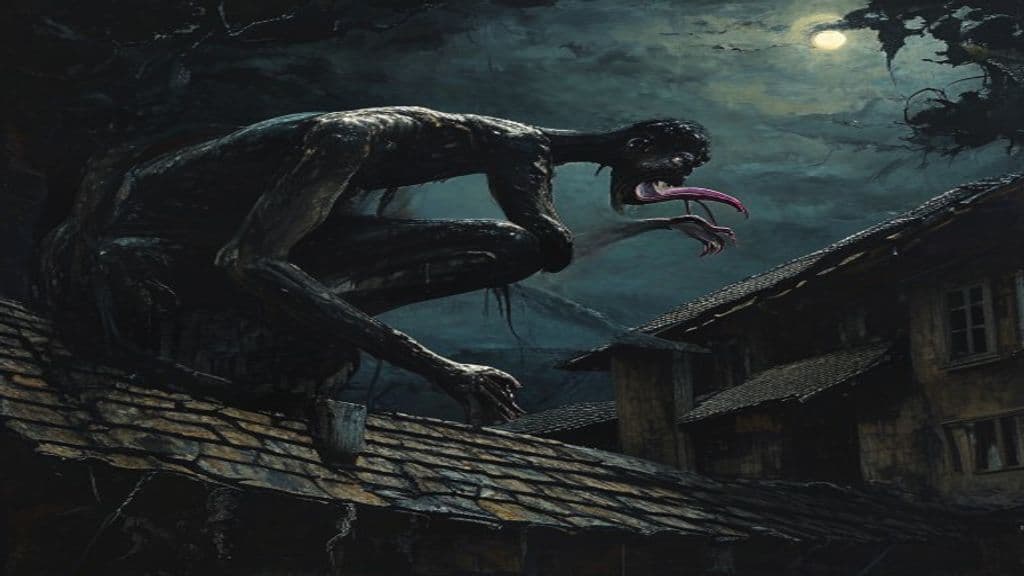
Aswang
The most feared supernatural being in Philippine folklore — a shape-shifting monster that appears human by day but transforms at night to prey on pregnant women and children.

Bigfoot (Sasquatch)
A North American folkloric large, hairy, bipedal humanoid reported chiefly from the forests of the Pacific Northwest. The figure functions as a 'wild man' type in regional and popular traditions and is documented primarily through sightings, footprint casts, media, and a subculture of enthusiasts rather than accepted biological evidence.
Ammon (tradition)
In the provided sources, 'Ammon' is primarily attested as the ethnonym and toponym of the ancient kingdom and people known as the Ammonites (centered on Rabbah/Rabbat Ammon, modern Amman) and as a component in later theonyms (e.g., 'Jupiter Ammon'). The corpus supplied contains etymological, geographic, biblical, and modern onomastic information but does not document 'Ammon' as a discrete folkloric spirit or supernatural being with a ritual corpus.
Ammut
Ammut is an ancient Egyptian chimeric creature associated with the Judgment of the Dead; traditionally described as a composite of lion, hippopotamus, and crocodile, she is said to consume the souls or the symbolic heart of those judged unworthy, preventing admission to the afterlife. Modern artistic and speculative retellings recast Ammut as a large scavenging semi‑aquatic animal whose corpse‑consuming habits inspired funerary beliefs.
Ammāvaru
Ammāvaru is a reverential designation for a mother-goddess figure in Hindu, especially Telugu/South Indian, contexts. In some accounts she is presented as a primordial maternal principle who preceded time and is said to have laid the egg from which Brahma, Shiva and Vishnu emerged; in practice the name functions as an honorific attached to multiple regional mother-goddess cults and temple images in Andhra Pradesh and nearby areas.
Amnisiades
The Amnisiades (Ancient Greek: Αμνισιαδες / Αμνισιδες) are a group of naiads — freshwater nymphs — associated with the Amnisos river in Crete. They are attested in Hellenistic poetry as members of Artemis's retinue and are linked by scholarship to cult activity at a cave of Eileithyia on the Amnisos.
Amnisos
Amnisos is a north-Cretan river, Bronze Age coastal settlement/port for Knossos, and in literary registers the river's divine personification (a river‑god). Attested in Mycenaean Linear B, classical literature, and archaeological remains (including a Late Minoan villa and submerged shorelines), Amnisos functions as hydrological feature, cultic locus (linked to the cave sanctuary of Eileithyia and to nymphs called the Amnisiades), and administrative place in the ritual economy of Knossos.
Amoghasiddhi
Amoghasiddhi is one of the Five Tathāgatas (Five Wisdom Buddhas) in Mahayana and Vajrayana/Esoteric Buddhism, representing the Karma family and the quality of "unfailing accomplishment". He functions as an archetypal, protective, and contemplative buddha-body within tantric mandalas, presiding over the northern quarter and invoked in mantras and ritual iconography.
Amon Sur
Amon Sur is a fictional Ungaran individual in the DC Comics universe who acts as an antagonist to members of the Green Lantern Corps. He is presented as the son of Abin Sur, bears resentment toward the Corps for his father's duty-related death, and in the narratives wields corps power rings (a Sinestro Corps duplicate yellow ring and later a Black Lantern ring after resurrection).
Amor asteroid
A class of near-Earth asteroids (NEAs) defined by orbital parameters: semi-major axis a > 1.0 AU and perihelion q satisfying 1.017 AU < q < 1.3 AU, placing their perihelia exterior to Earth's aphelion so they do not currently cross Earth's orbit. Named after the prototype object 1221 Amor, the group includes diverse bodies (e.g., 433 Eros) that are part of the dynamically evolving population of Earth-approaching small bodies.
Amorōnagu
Amorōnagu (Amorōnagu / 天降女子) is a tennyo or celestial maiden figure in the folklore of Amami Ōshima (Kagoshima Prefecture, Japan). Attested sources describe her as a heavenly woman who bathes in pools and waterfalls in ravines on the island.
Amos
Amos is a human prophetic figure in the Hebrew Bible, traditionally counted among the Twelve Minor Prophets. Presented as a rural, non‑professional prophet from Tekoa, he delivers visionary oracles condemning social injustice and ritual hypocrisy and is traditionally credited with the book bearing his name.
Amoz
Amoz (Hebrew: אָמוֹץ, ʼAmōṣ/Amotz) is a personal name in the Hebrew Bible identified as the father of the prophet Isaiah. In rabbinic tradition the naming of a prophet's father is sometimes read as implying that the father was also a prophet; later rabbis therefore ascribe prophetic status and royal kinship to Amoz in interpretive accounts.
Ampelos
Ampelos (Ancient Greek: Ἂμπελος, lit. 'Vine') is a mythological figure in Greek and Roman literature who functions both as the beautiful youth beloved of Dionysus/Bacchus and as a personification or origin-figure of the grapevine (and, in one account, a star). Surviving literary summaries record two main versions: in Nonnus a satyr youth is gored to death after provoking Selene and is transformed into the first vine by Dionysus; in Ovid a reckless boy falls while picking grapes and is placed among the stars (Vindemitor/Boötes) by Liber/Dionysus.
Community Record
- [1]Amomongo - Wikipedia. Wikipedia, 'Amomongo' article (entries summarizing folktale usage, etymology, and 2008 La Castellana reports).wiki
- [2]AMOMONGO: Visayan Folkloric Being or Cryptid? • THE ASWANG PROJECT. The Aswang Project, discussion of Amomongo in folktale and cryptid contexts; notes folktale title 'Amomongo and Iput-Iput' and use of term for an ape-like creature.folk
- [3]Amomongo Hominoid Terrorizes Philippines. CryptoZooNews coverage reprinting reports of the 2008 incidents and modern cryptid framing.other
- [4]This article was published in The Morning Star... (BigfootEncounters). BigfootEncounters: reprint and commentary noting that some bigfoot researchers seized on the story but stating 'It is not' (not part of Bigfoot research).other
- [5]CFZ REPOST: DALE DRINNON: Packda, Kapre, Muwas, Waray-waray and Omomongo: Probable Relic Orangutans of ... (Frontiers of Zoology). Frontiers of Zoology blog post discussing speculative connections between Philippine hominoid claims (mentions Omomongo/Amomongo in comparative speculation).other
- [6]Amomongo | Cryptid Wiki | Fandom. Cryptid Wiki entry summarizing folkloric and modern reports.other
- [7]Archive: Haunted Island of Coron - Palawan, Philippines (image archive). Archive item listed among collected online material referencing Philippine folkloric/cryptid images and reportage (used in source aggregation).other