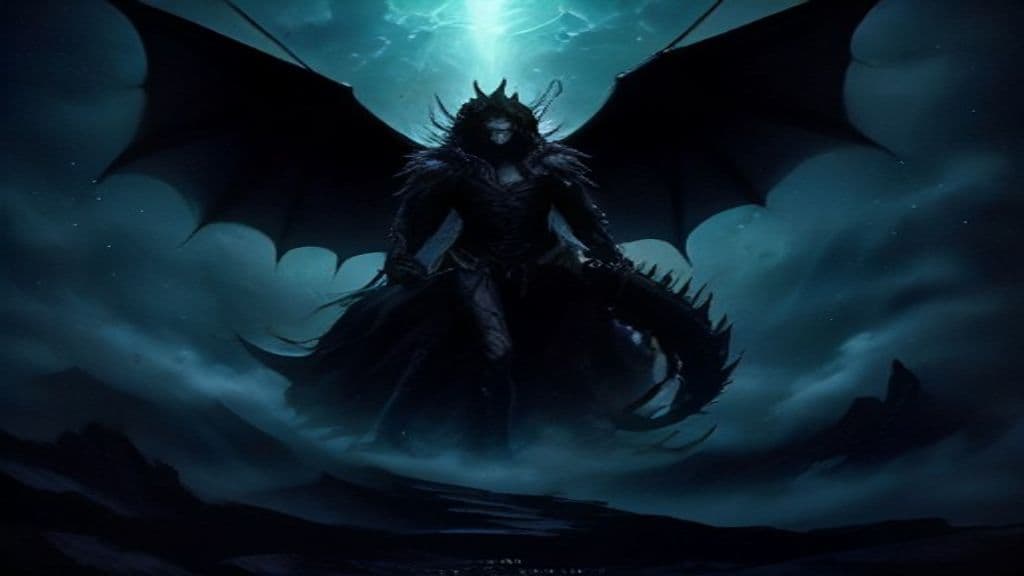
Bred in the depths of Morgoth's fortress Angband as an engineered instrument of war, Ancalagon is introduced in later versions of Tolkien's Quenta as the leader of the first winged dragons unveiled by Morgoth during the War of Wrath. He appears at the end of the First Age (accounts place the War of Wrath in year 587 of the First Age in the secondary summaries) when the Valar and their allies assault Angband; his deployment is presented as Morgoth's last resort to stem the Valar's invasion.
Described in the available sources as a dragon of immense scale, Ancalagon is specifically called 'the greatest of the dragons,' 'winged and black.' Tolkienian etymology ties his name to Sindarin elements meaning 'jaw' and 'rushing' (glosses such as 'impetuous jaws' or 'jaws-rushing'), emphasizing a powerful biting maw as a distinctive feature. Beyond these attestations—great size, black colour, wings, and an impressive jaw—primary descriptive detail in the supplied materials is sparse.
Ancalagon inaugurates and leads the first winged dragons in Tolkien's later accounts: his flight and aerial assault are central to his role in the War of Wrath. Secondary summaries report that his coming caused the Valar's forces to 'retreat before the thunder, lightning and hurricane of flames that preceded the dragons,' indicating overwhelming destructive might in aerial warfare. In the climactic duel he commands winged dragons in prolonged aerial combat; he is ultimately pierced and shot down in battle (Eärendil in Vingilot, aided by Thorondor and great eagles), and his fall upon the peaks of Thangorodrim causes catastrophic geological destruction.
Weaknesses
- otherdefeated by martial force (Eärendil with Thorondor and the great eagles)
Wards
None recorded.
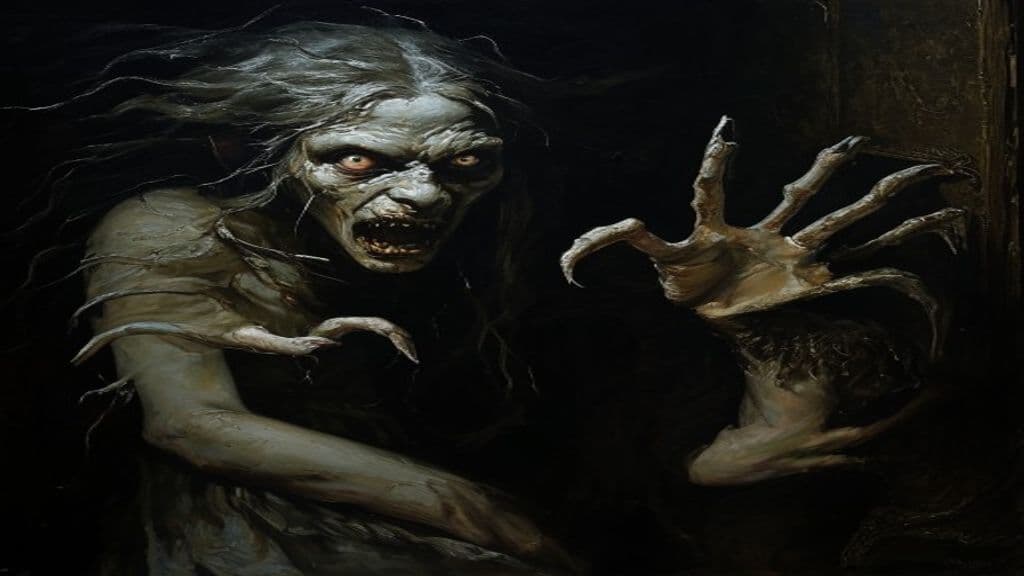
Mormo
A Greek child-eating bogeywoman used to frighten children into obedience, sometimes depicted as a shape-shifting female phantom who bit naughty children.
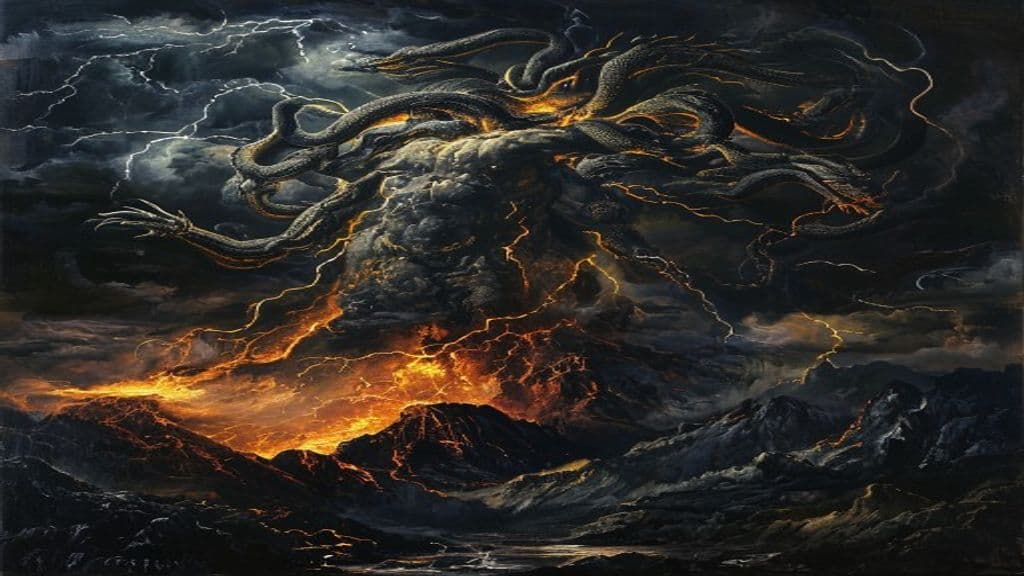
Typhon
The last great monster of Greek mythology — a vast, fire-breathing giant whose shoulders sprouted a hundred serpent heads, nearly toppling Zeus from Olympus.
Jann
The weakest class of djinn in Islamic tradition, associated with desert winds and taking the form of snakes or whirlwinds, dwelling in empty wilderness and posing little threat to those who know the proper invocations.
Anaxiroe
Anaxiroe is a named female figure in archaic Greek genealogical tradition associated with the ruling families of Elis. In the supplied sources she appears only in relational roles (daughter of Coronus; in some accounts the wife of Epeius) and carries no supernatural attributes, cult, or ritual functions.
Anaxo
Anaxo (Ancient Greek Ἀναξώ) is a proper name applied to mortal women in ancient Greek mythic genealogies and narratives. Attested figures named Anaxo appear as a Mycenaean princess—daughter of Alcaeus, wife of Electryon, and mother of Alcmene—and as a young woman from Troezen who was carried off by the hero Theseus. The name carries a lexical sense of female authority in Greek but denotes human participants in dynastic and abduction cycles rather than a supernatural class.
Anaye (Navajo tradition)
A 'race of monsters or evil gods' in Navajo mythology, killed by the hero Nayenezgani. (Note: - Power tier: Primordial (as they are described as "evil gods") - Appearance: Add that it's unclear and no physical description is provided - Abilities: Clarify that their powers were formidable enoug)
Anba George (Saint George of Assiut)
Anba George is a Coptic Orthodox bishop venerated as a saint and martyr in Coptic hagiographical and liturgical tradition. Associated with Assiut in Upper Egypt and the Monastery of St. George, his life is commemorated in Synaxarium-type records; hagiography recounts his leadership of communal fasting and prayer and his subsequent arrest and martyrdom in the 12th century.
Anbay
Anbay (Qatabanian: 𐩱𐩬𐩨𐩺, romanized ʾnby, ʾAnbāy) is a pre-Islamic South Arabian deity worshipped in the kingdom of Qataban (in modern Yemen). He functioned primarily as a god of justice and as an oracular deity, invoked in legal and administrative contexts and described as attendant to the moon god Amm.
Ancaeus (son of Poseidon)
Ancaeus is a mythic Greek heroic figure, typically described as king of Samos, an Argonaut and an especially skilled helmsman. Often presented as a son of Poseidon, he belongs to the generation of heroes who sailed with Jason in the quest for the Golden Fleece. In the tradition he is a mortal hero (semi-divine by parentage) rather than a deity or monster; he is also frequently confused with another Argonaut named Ancaeus (son of Lycurgus), both of whom share a motif of dying by a boar's tusk.
Ancamna
Ancamna is a Gallo‑Roman local goddess attested in the Moselle valley and commemorated as the consort of regional forms of Mars (notably Lenus Mars and Mars Smertulitanus). She appears in civic cult contexts at Trier, Ripsdorf and Möhn where altars and votive offerings link her to tribal protection and to the genii of Treveri pagi; some scholars suggest a possible association with a spring rather than a martial character.
Ancasta
Ancasta is a locally attested Celtic goddess known from a single Roman-period votive inscription from Clausentum (modern Bitterne, near Southampton). She appears as a named deity venerated in the context of a fulfilled vow; little else about her cult, appearance, or powers is recorded in the surviving sources.
Ancestors of Enlil (Enki-Ninki deities)
A sequence of Sumerian divine pairs (en-/nin- names) conceived as the primordial ancestors culminating in Enlil; chiefly attested in god lists and invoked as authoritative primordial names in ritual, especially in incantations and exorcisms.
Ancestral Spirit or Tutelary Deity
In Hawaiian tradition, an 'aumakua is a tutelary deity or ancestral spirit that watches over and protects specific families or individuals. (Note: - Power tier: Primordial does not match the abilities described (watching over families/individuals, associated with natural phenomena), which suggests a Greater or Lesser power tier would be more pla)
Anchimayen
Anchimayen is a small, childlike luminous creature in Mapuche mythology described as a servant or familiar kept by a kalku (Mapuche sorcerer). It is said to take the form of small children and to transform into flying fireballs that emit bright light; some sources also describe a later conception as a fuego fatuo (will-o'-the-wisp)-type being that can frighten travelers.
Anchiroe
Anchiroe (also rendered Achiroë, Anchirrhoë, or Anchinoë) is a figure in Greek myth described as a daughter of the river-god Nilus and the wife of the Egyptian king Belus; she is presented as the mother of Aegyptus and Danaus and, in some accounts, of Cepheus and Phineus. The sources treat her as a genealogical/maternal ancestor rather than an active supernatural agent.
Community Record
- [1]Ancalagon the Black — Wikipedia. Wikipedia: 'bred by Morgoth in the depths of his fortress of Angband'; 'unveils, as a last resort, the winged dragons led by Ancalagon the Black'; Valar's forces 'retreated before the thunder, lightning and hurricane of flames that preceded the dragons'; Ancalagon 'is shot down, bringing down the peaks of Thangorodrim and defeating its master.'wiki
- [2]Ancalagon (Valarguild entry). Valarguild gloss: 'Ancalagon's name means 'jaws-rushing' in Sindarin elvish. Anca means 'jaws'... He was the greatest of the dragons, winged and black.'other
- [3]The Lost Road and Other Writings (Tolkien etymology notes, cited in secondary literature). Tolkien's etymological note rendered in secondary discussions: name derived from Sindarin anc(a) 'jaw, bite' + alag/alagos 'impetuous'/'windstorm' yielding senses like 'impetuous jaws' or 'biting storm'; Tolkien also provided an Old English-form rendering 'Anddraca.'literary
- [4]Ancalagon the Black — supplementary discussions and forum/encyclopedic summaries. Secondary commentary and summaries describing his role as leader of winged dragons and his duel with Eärendil and Thorondor; notes on later drafts and variations in Tolkien's accounts.other