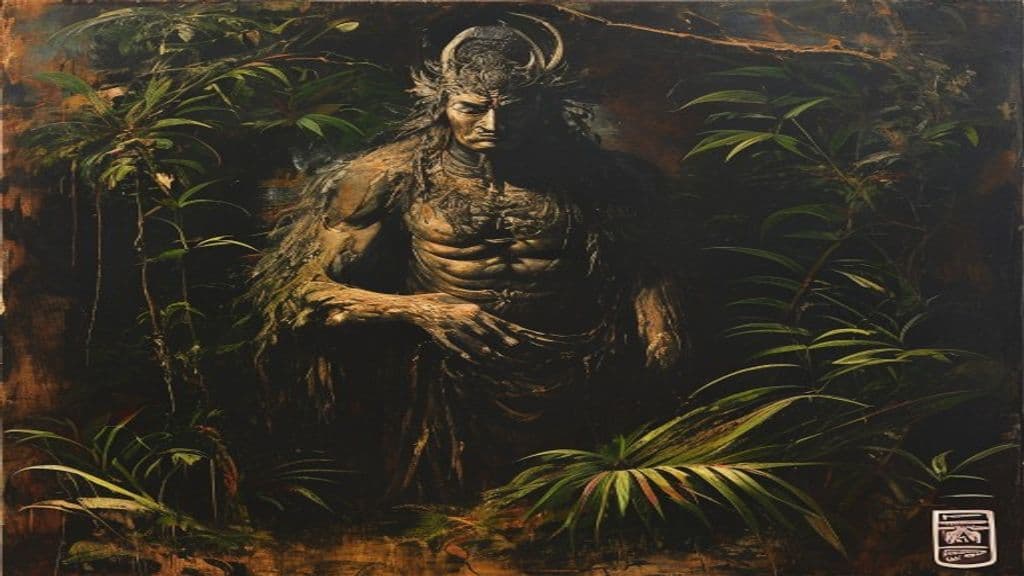
No specific physical description is provided in the source material.
Believed to watch over and protect its assigned family or individual, associated with natural phenomena such as weather patterns, landforms, or wildlife.

Anbay
Anbay (Qatabanian: 𐩱𐩬𐩨𐩺, romanized ʾnby, ʾAnbāy) is a pre-Islamic South Arabian deity worshipped in the kingdom of Qataban (in modern Yemen). He functioned primarily as a god of justice and as an oracular deity, invoked in legal and administrative contexts and described as attendant to the moon god Amm.
Ancaeus (son of Poseidon)
Ancaeus is a mythic Greek heroic figure, typically described as king of Samos, an Argonaut and an especially skilled helmsman. Often presented as a son of Poseidon, he belongs to the generation of heroes who sailed with Jason in the quest for the Golden Fleece. In the tradition he is a mortal hero (semi-divine by parentage) rather than a deity or monster; he is also frequently confused with another Argonaut named Ancaeus (son of Lycurgus), both of whom share a motif of dying by a boar's tusk.
Ancalagon the Black
A singular, individuated dragon of J. R. R. Tolkien’s legendarium, bred by the Dark Power Morgoth as a wrought weapon of war. Described as the greatest of the dragons and the first of the winged dragons, Ancalagon appears at the end of the First Age in the War of Wrath where his aerial assault and catastrophic fall shape the close of that age.
Ancamna
Ancamna is a Gallo‑Roman local goddess attested in the Moselle valley and commemorated as the consort of regional forms of Mars (notably Lenus Mars and Mars Smertulitanus). She appears in civic cult contexts at Trier, Ripsdorf and Möhn where altars and votive offerings link her to tribal protection and to the genii of Treveri pagi; some scholars suggest a possible association with a spring rather than a martial character.
Ancasta
Ancasta is a locally attested Celtic goddess known from a single Roman-period votive inscription from Clausentum (modern Bitterne, near Southampton). She appears as a named deity venerated in the context of a fulfilled vow; little else about her cult, appearance, or powers is recorded in the surviving sources.
Ancestors of Enlil (Enki-Ninki deities)
A sequence of Sumerian divine pairs (en-/nin- names) conceived as the primordial ancestors culminating in Enlil; chiefly attested in god lists and invoked as authoritative primordial names in ritual, especially in incantations and exorcisms.
Anchimayen
Anchimayen is a small, childlike luminous creature in Mapuche mythology described as a servant or familiar kept by a kalku (Mapuche sorcerer). It is said to take the form of small children and to transform into flying fireballs that emit bright light; some sources also describe a later conception as a fuego fatuo (will-o'-the-wisp)-type being that can frighten travelers.
Anchiroe
Anchiroe (also rendered Achiroë, Anchirrhoë, or Anchinoë) is a figure in Greek myth described as a daughter of the river-god Nilus and the wife of the Egyptian king Belus; she is presented as the mother of Aegyptus and Danaus and, in some accounts, of Cepheus and Phineus. The sources treat her as a genealogical/maternal ancestor rather than an active supernatural agent.
Anchises
Anchises is a mortal Trojan noble of myth, famed as the father of Aeneas and as a lover of the goddess Aphrodite/Venus; he appears in Greek and Roman epic traditions as a living elder rescued from Troy and later as an advising shade in the Roman underworld vision.
Anchius
Anchius is attested in modern compilations as a named member of the centaur class in Greek mythic listings. The supplied sources, however, provide no narrative, genealogy, or distinctive attributes for Anchius beyond his classification as a centaur (half‑human, half‑horse).
Ancient Egyptian corkscrew-horned sheep
An extinct ovicaprine form identified in modern scholarship as Ovis longipes palaeoaegyptiacus and depicted in early pharaonic art; its distinctive loosely spiralling horns were adopted as the horn-type for several ram-headed Egyptian deities and persisted in iconography after the animal vanished from the record.
Ancient Egyptian deities (nṯr / nṯrt)
In ancient Egyptian religion the beings called nṯr (masculine) and nṯrt (feminine) encompass a wide, fluid range of gods and divine figures — from state-level creators like Ra and Amun to local personifications, animal-headed figures, and certain deceased humans elevated by ritual. Deities embody natural forces, maintain cosmic order (maat), and are engaged through temple cults and ritual performance.
Community Record
- [1]