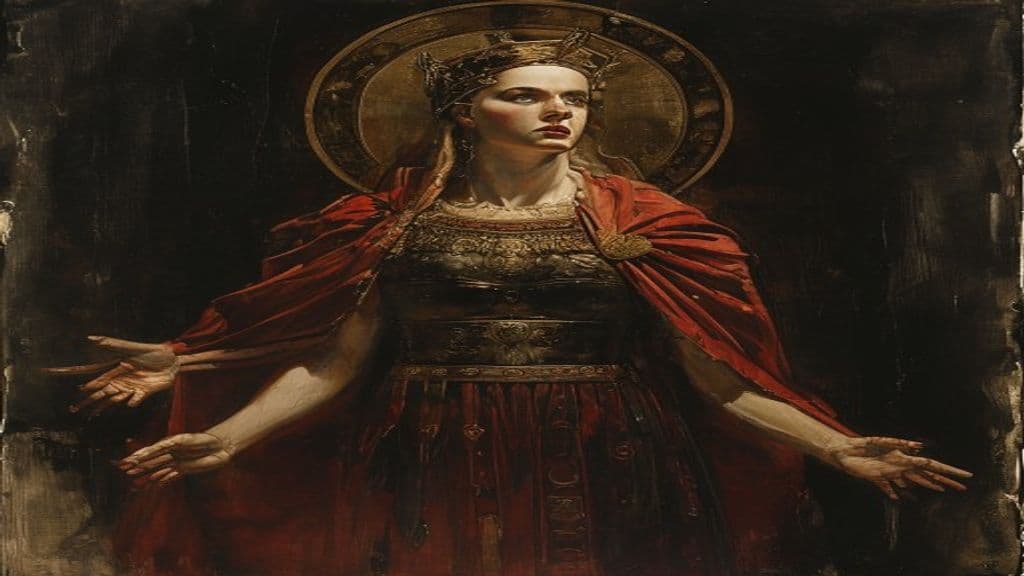
There is no surviving native narrative myth describing the origin of Andraste; the figure appears in the extant record through a Roman historiographical account of Boudica's revolt in AD 60. In that narrative the leader Boudica performs a public divinatory act and immediately addresses a named supernatural patron, thanking 'Andraste' and appealing for "victory and preservation of liberty." The Roman author Dio Cassius also later records the Iceni name 'Andate' and explicitly renders it as their name for Victory (Victoria), which places Andraste within a conceptual framework of a local victory-associated supernatural being as filtered through Roman interpretatio.
No contemporary physical description or iconography of Andraste is preserved in the supplied sources. The only surviving attestations are verbal: a named invocation recorded by a Roman historian. Comparative remarks in later commentary link Andraste conceptually to Mediterranean victory goddesses (e.g., Victoria, Nike) and to scholarly suggestions of affinities with figures such as Andarta, but such associations are interpretive and not presented in the primary Roman passage as descriptions of Andraste's appearance.
The primary attestation represents Andraste as a recipient of devotion in a martial context and as a being whose favor is sought for victory in battle and for the preservation of communal liberty. In Dio Cassius's report the invocation follows a divinatory omen (the release of a hare) and the public appeal implies that Andraste is understood as one who can be petitioned for success in armed resistance. Beyond this functional association with victory and protection of freedom, the supplied sources do not catalogue additional powers, temperament, or domestic roles.
Epona
Epona is a Gallo‑Roman/Celtic goddess chiefly associated with horses, protection of stables and riders, and fertility/abundance related to equine livelihoods. Her cult is attested across Roman Gaul and throughout the Roman Empire, notably adopted by mounted units; some scholars also suggest a possible funerary/psychopomp aspect based on select votive objects and iconography.
Andjety
Andjety is an ancient Egyptian regional deity of the ninth nome (Andjet/Busiris) associated with kingship, funerary renewal, and local underworld functions; he appears in Pyramid and Coffin Texts and is often syncretized with Osiris in temple imagery and royal ritual.
Andlang
Andlang (Old Norse Ǫndlangr / Andlang) is presented in Snorri Sturluson's Prose Edda as the second of a ninefold scheme of heavens, placed between the first heaven (containing the halls of the gods) and the third heaven, Vídbláin. In Snorri's account Andlang functions as a shelter and dwelling-place for the souls of the dead during and after the destruction of Ragnarök.
Andraemon
Andraemon (Ancient Greek: Ἀνδραίμων, Andraímon) is a personal name borne by several mortal figures in Greek myth and genealogical tradition. The name appears across variant accounts as husbands, fathers, kings, colonists, and a suitor; it functions within heroic genealogies and local foundation stories rather than as a supernatural being.
Andragius
Andragius (also attested Androgius) is a legendary king of the Britons recorded in Geoffrey of Monmouth’s pseudo‑historical regnal lists and later compilations. He appears as a node in a constructed sequence of rulers—not described as a supernatural being—and is principally attested by name, genealogical relationships, and position in succession.
Andras
Andras is a named infernal spirit from the Western grimoire/Goetic tradition, described as a hostile officer who sows discord and is dangerous to conjurers; modern roleplaying adaptations recast him as a demon raised from murderous souls with a purpose to destroy mortals.
Andrast
Andrast is a Sindarin place-name in J. R. R. Tolkien's Middle-earth, denoting a long coastal cape or peninsula in southwest Gondor (also identified with Ras Morthil). It is a geographic toponym recorded in Tolkien's maps and scholarly indexes rather than a sentient or supernatural being.
Andrea Beaumont (the Phantasm)
Andrea Beaumont is a fictional human character in the DC Animated Universe who, as the masked vigilante known as the Phantasm in Batman: Mask of the Phantasm (1993), stages a Death‑like avenger persona. Her apparent supernatural effects are produced by theatrical devices (not innate powers) and she functions narratively as a foil and dark parallel to Bruce Wayne/Batman.
Andrealphus
Andrealphus is a spirit named in the Ars Goetia (Lesser Key of Solomon) tradition, described as a Marquis who governs thirty legions. He is classically credited with teaching geometry, mensuration, and astronomy and with the ability to assume or cause bird/peacock form.
Andrew the Apostle
Andrew the Apostle (Greek Ἀνδρέας, Latin Andreas) is one of the Twelve Apostles in the New Testament, a fisherman from Bethsaida, the brother of Simon Peter, described as the “first-called” who introduced others to Jesus. Post-biblical traditions depict him as an early missionary and founder of Christian communities (notably claims of missions to Thrace, Scythia, and founding the see of Byzantium) and as a martyr crucified at Patras.
Androgeos
Androgeos (Greek Ἀνδρόγεως, Latin Androgeus) is a personal name borne by mortal figures in classical Greek and Roman literary tradition, most notably a son of Minos and Pasiphaë whose death in mythic narratives precipitates Athenian tribute to Crete. A separate, less-detailed bearer of the name is listed as a Greek soldier present at the sack of Troy in some sources.
Androgeus
Androgeus is a mythic human name borne by at least two distinct figures in Classical Greek and Roman tradition: a Cretan prince, son of Minos and Pasiphaë, famed for athletic victories and whose death in some accounts is linked to the Marathonian/Cretan bull; and Androgeos, a Greek soldier named by Virgil in the Aeneid who, during the sack of Troy, mistakes Aeneas and his companions for fellow Greeks. Both are mortal figures woven into larger heroic and epic cycles rather than supernatural beings.
Community Record
- [1]Andraste - Wikipedia. Wikipedia, 'Andraste' entry summarizing Dio Cassius and later commentary.wiki
- [2]Wikidata: Andraste. Wikidata entry for Andraste (Q492983) linking modern identifiers and summaries.other
- [3]Dio Cassius (summary as quoted in secondary sources). Dio Cassius as quoted in modern summaries: passage describing Boudica's hare-divination and her invocation: 'I thank you, Andraste, and call upon you as woman speaking to woman ... I beg you for victory and preservation of liberty.'literary