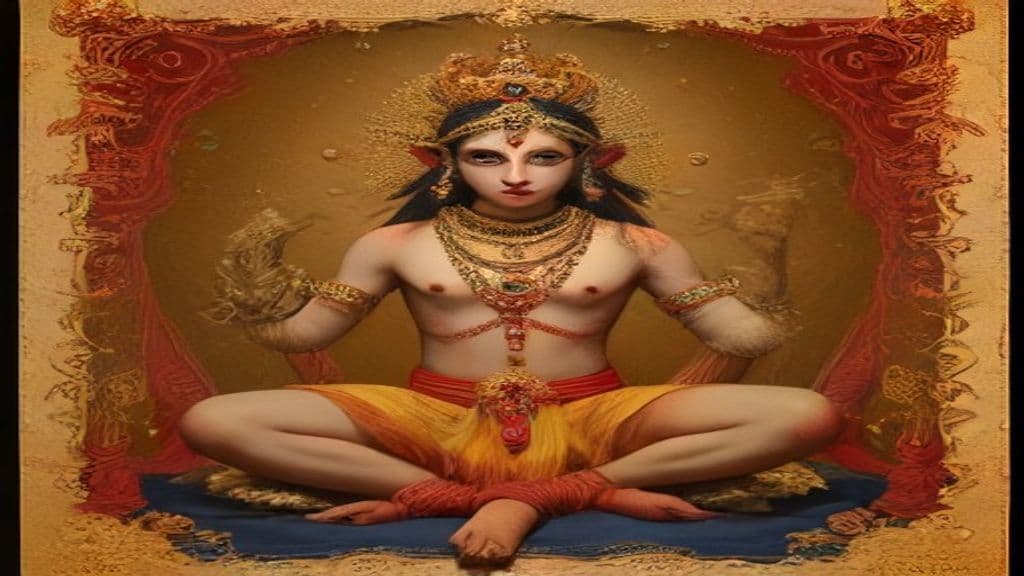
Angada is introduced in the Rāmāyaṇa as a scion of the vanara royal line: the son of the powerful vanara king Vāli and Vāli's wife Tārā. Following the death of Vāli and during the struggle for alliance and kingship in Kiśkindhā, Angada becomes a staunch ally of Rāma—joining Rāma's campaign to recover Sītā, acting in diplomatic missions on Rāma's behalf, and eventually being crowned king of Kiśkindhā after Sugrīva retires. His narrative is embedded in the epic's political and military sequence (the search for Sītā, the embassy to Rāvaṇa, and the Yuddha/war chapters) and later enters dramatic and festival performance contexts (for example, the medieval play Dūtāṅgada).
Primary sources identify Angada as a vanara—an anthropomorphic simian warrior and prince of Kiśkindhā, son of Vāli and Tārā. The supplied textual materials describe him by social rank and martial action rather than by detailed iconography or precise physical measurements; later visual representations exist in modern media and theatrical traditions, but those specifics are not documented in the cited textual extracts.
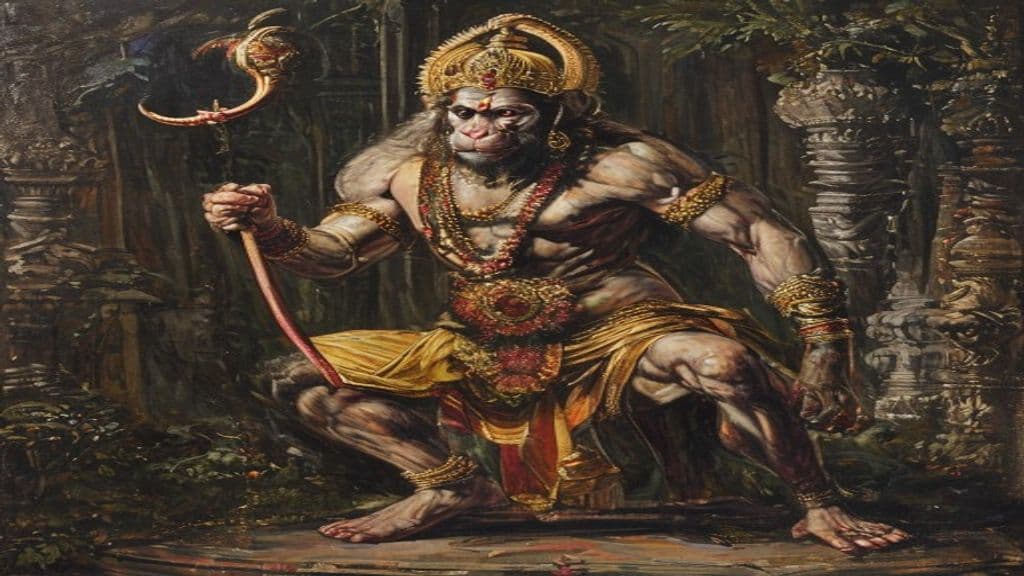
Within the Rāmāyaṇa narrative Angada functions as a capable warrior, commander, and diplomat. He leads the southward search party that locates Sītā, serves as Rāma's envoy to Rāvaṇa's court where he delivers a final message and publicly challenges the Laṅkā courtiers, and fights in the Battle of Laṅkā where Valmiki's text and later summaries attribute several battlefield kills to him (named enemies include Kampana, Prajaṅgha, Nārantaka, and others in the Yuddha Kāṇḍa summaries). Episodes in the embassy narrative emphasize exceptional physical strength and daring (for example, a court episode in which courtiers fail to move his leg until a confrontation with Rāvaṇa concludes with Angada removing it himself). He also exercises political agency—reconciling Rāma and Lakṣmaṇa with Sugrīva, persuading Sugrīva to keep oaths to Rāma, and ultimately accepting kingship of Kiśkindhā.
Andron
Andron (Ancient Greek: Ἄνδρων) is an ancient Greek personal name attested for multiple historical individuals (writers, a dancer/composer, historians, a sculptor, a physician) in classical biographical and bibliographical sources; it also appears as a modern given name/surname in contemporary records. The provided sources do not present Andron as a supernatural being.
Andvari
Andvari is a dwarf from Old Norse sources (attested in the 12th century) who lives beneath a waterfall, hoards gold, owns a magical ring called Andvaranaut, can change into a pike, and curses the gold when it is stolen—events that set in motion tragic outcomes in Norse heroic narrative.
Anemoi
In ancient Greek religion and myth the Anemoi (Ἄνεμοι, 'Winds') are the personified winds: a group of minor wind-gods each associated with a compass direction and with characteristic weather or seasonal phenomena that come from that direction.
Anethus
Anethus (Ancient Greek Ἄνηθος, Ánēthos) is a fragmentarily attested mythic figure from Greek tradition who is named as a beautiful youth transformed into the dill plant (Anethum graveolens). He functions as an aetiological or name-origin figure preserved only in late-antique grammatical/mythographic commentary.
Anextiomarus
Anextiomarus (Gaulish Anextlomāros; feminine Anextlomara) is an ancient Celtic theonym or epithet attested in Romano-British and Gallo-Roman inscriptions. In the sources it functions as an epithet of a solar deity syncretized with the Roman god Apollo and is glossed in one source as meaning roughly "Great Protection," indicating a protective, beneficent cult function in votive contexts.
Anextlomarus
Anextlomarus (also Anextiomarus; feminine Anextlomara) is a Romano-Celtic theonym attested in inscriptions from Roman Britain and Gaul. The name, interpreted as 'Great Protector', appears in dedicatory contexts and in one instance is equated with the Roman god Apollo, indicating a locally venerated protective deity integrated into Roman civic-religious practice.
Angak (Angak'china)
Angak, or Angak'china, is a male Hopi kachina spirit represented both by spirit dancers in village ceremonies and by carved kachina dolls. He is a rain‑bringing, fertility, healing, and protective figure whose songs and slow dances are intended to bring rain and flowers to Hopi villages.
Angalo
Angalo is a primordial culture-hero and giant in Ilocano mythology credited with shaping the landscape of Luzon and explaining natural phenomena; narratives present him as the first man and an ancestral figure whose bodily acts produced mountains, valleys, seas, and celestial features.
Angel
A spiritual or heavenly being functioning primarily as a messenger and intermediary between a transcendent deity and humanity; angels also act as protectors, guides, and executors of divine will across several Abrahamic and adjacent traditions.
Angel Moroni
In Latter Day Saint narratives, Moroni is a post‑mortem, angelic messenger and custodian of sacred scripture who is said to have appeared to Joseph Smith beginning in 1823 to reveal and deliver the golden plates that became the Book of Mormon. He is portrayed as a resurrected/ministering human who functions as intermediary, guardian of records, and revealer to a chosen prophet.
Angel Salvadore
Angel Salvadore is a fictional Marvel Comics character, a mutant who manifests insect-like physiology (butterfly-like wings, acid projection, and sonic blasts produced by wing vibrations). Introduced in X‑Men comics, she is depicted as a teenage mutant rescued and educated at the Xavier Institute and later appearing in other teams and media.
Angel of Hadley
A New England colonial legend of a sudden, providential defender who appeared in Hadley, Massachusetts during attacks in King Philip's War. The figure is commonly identified in tradition with the fugitive regicide Colonel William Goffe; accounts blend possible historical actions, contemporary silence or obfuscation, and later legendary embellishment that calls the rescuer an 'angel.'
Community Record
- [1]Angada — Wikipedia. Wikipedia, 'Angada' article (accessed via supplied research notes).wiki
- [2]Angada — Wikidata. Wikidata entry for Angada (referenced in supplied notes).other
- [3]Valmiki Rāmāyaṇa — Yuddha Kāṇḍa, Sarga 76 (prose and Sanskrit summaries). Valmiki Rāmāyaṇa, Yuddha Kāṇḍa Sarga 76 (prose summary and Sanskrit stanza reference cited in supplied notes).literary
- [4]Dūtāṅgada of Mahākavi Subhata (English translation) — Archive. Archive entry for Dūtāṅgada by Subhata, described in the supplied research notes as a one-act play about Angada's embassy.literary
- [5]Mythology & Folklore entry: Angada. Online encyclopedia summary of Angada (referenced in supplied notes).folk
- [6]Archive: Christus ein Inder? (mentions performance context). Archive material cited in the supplied notes which includes discussion of the Dūtāṅgada's festival performance context.other