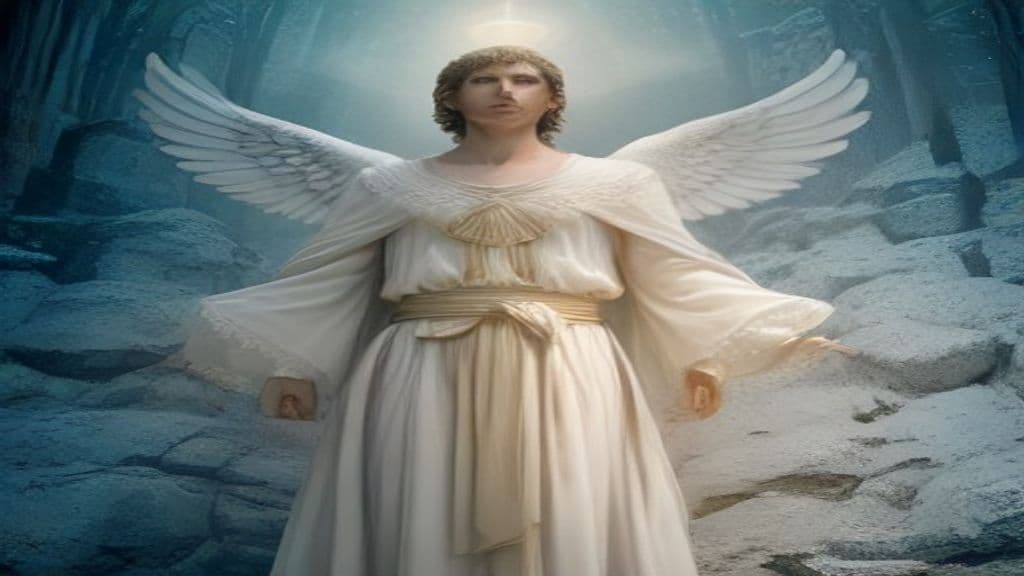
According to early Latter Day Saint accounts, Moroni was originally a mortal figure named Moroni (the last engraver described in the Book of Mormon) who, after death, exists in a resurrected or angelic form. In Joseph Smith’s account the angel Moroni appeared beginning on September 21, 1823, as the guardian of golden plates buried in a stone box a few miles from Smith’s home in western New York and instructed Smith how to obtain and later translate those plates into the Book of Mormon. Some early documentary variants and later editorial history show the angel once identified as 'Nephi' in an 1838 history draft, a reading most Latter Day Saints regard as a transcriptional error; the canonical and customary name in LDS sources is Moroni.
Contemporary visionary descriptions by Joseph Smith describe Moroni as an "angel of light" clad in a loose robe of extraordinary whiteness, with exposed hands and wrists; Smith called his entire person "glorious beyond description." Katharine Smith likewise described white raiment with a girdle and pure white hands. In later institutional and popular LDS visual culture Moroni is commonly represented in temple statuary and public art—frequently a standing figure placed atop temples, often shown holding a trumpet and in some modern representations also shown with plates—details drawn from sculptural and commemorative conventions rather than the foundational visionary text.
Sources attribute to Moroni the role of guardian of the golden plates, the ability to reveal and give directions to hidden sacred records, repeated visitations and visionary appearances to Joseph Smith and other early adherents (including the Three Witnesses), and functioning as an intermediary who imparts knowledge and direction that leads to new scripture. After translation, Smith reported returning the plates to Moroni, who retained possession. The figure operates as a ministering, revelatory being rather than a spirit to be warded against in the supplied sources.
Anextiomarus
Anextiomarus (Gaulish Anextlomāros; feminine Anextlomara) is an ancient Celtic theonym or epithet attested in Romano-British and Gallo-Roman inscriptions. In the sources it functions as an epithet of a solar deity syncretized with the Roman god Apollo and is glossed in one source as meaning roughly "Great Protection," indicating a protective, beneficent cult function in votive contexts.
Anextlomarus
Anextlomarus (also Anextiomarus; feminine Anextlomara) is a Romano-Celtic theonym attested in inscriptions from Roman Britain and Gaul. The name, interpreted as 'Great Protector', appears in dedicatory contexts and in one instance is equated with the Roman god Apollo, indicating a locally venerated protective deity integrated into Roman civic-religious practice.
Angada
Angada (Sanskrit: Aṅgada) is a legendary vanara prince in the Rāmāyaṇa tradition who serves as a warrior, envoy, and later king of Kiśkindhā. He is presented as the son of Vāli and Tārā, nephew and lieutenant of Sugrīva, a commander in the expedition to Laṅkā, and a dramatic figure in later literary and performative adaptations.
Angak (Angak'china)
Angak, or Angak'china, is a male Hopi kachina spirit represented both by spirit dancers in village ceremonies and by carved kachina dolls. He is a rain‑bringing, fertility, healing, and protective figure whose songs and slow dances are intended to bring rain and flowers to Hopi villages.
Angalo
Angalo is a primordial culture-hero and giant in Ilocano mythology credited with shaping the landscape of Luzon and explaining natural phenomena; narratives present him as the first man and an ancestral figure whose bodily acts produced mountains, valleys, seas, and celestial features.
Angel
A spiritual or heavenly being functioning primarily as a messenger and intermediary between a transcendent deity and humanity; angels also act as protectors, guides, and executors of divine will across several Abrahamic and adjacent traditions.
Angel Salvadore
Angel Salvadore is a fictional Marvel Comics character, a mutant who manifests insect-like physiology (butterfly-like wings, acid projection, and sonic blasts produced by wing vibrations). Introduced in X‑Men comics, she is depicted as a teenage mutant rescued and educated at the Xavier Institute and later appearing in other teams and media.
Angel of Hadley
A New England colonial legend of a sudden, providential defender who appeared in Hadley, Massachusetts during attacks in King Philip's War. The figure is commonly identified in tradition with the fugitive regicide Colonel William Goffe; accounts blend possible historical actions, contemporary silence or obfuscation, and later legendary embellishment that calls the rescuer an 'angel.'
Angel of Portugal
A Catholic devotional national guardian angel venerated as the heavenly custodian of Portugal. Recognized in popular devotion, private revelation narratives (notably the 1916 visitations connected to Fátima), and in Portuguese liturgical practice through a feast instituted in the early 16th century and restored in the 20th century.
Angel of the Lord
A recurring divine messenger in the Hebrew Bible and New Testament who appears on behalf of the God of Israel, acting as God's representative in speech and deed. The figure—Hebrew מַלְאַךְ יְהוָה (mal’ākh YHWH)—functions as intermediary, guide, protector, judge, and announcer at decisive narrative moments.
Angel of the Presence
A high-ranking heavenly attendant described in Hebrew and Second Temple literature as one who "stands in the presence" of God and acts on God's behalf toward Israel. Sources treat the figure either as an elite created angelic office (one of the attendants who enter before the Lord) or, alternately, as a scriptural idiom referring to God's own saving presence.
Angelia
Angelia (Ancient Greek: Ἀγγελία) is an ancient Greek poetic personification of 'Message', attested in Pindar (5th century BC) as named a daughter of the messenger-god Hermes. She functions in the literary-cosmic vocabulary as the embodiment of a delivered message rather than as a separately attested cultic deity or independent supernatural class.
Community Record
- [1]Angel Moroni — Wikipedia. Wikipedia, article "Angel Moroni"wiki
- [2]Wikidata: Angel Moroni. Wikidata entry Q862248other
- [3]Book of Mormon [First Edition 1830 Palmyra NY] (digital replica). Archive.org, 1830 Book of Mormon digital replicaliterary
- [4]Angel Moroni DC Temple Version (with plates) (3D model). Archive.org Thingiverse item: Angel Moroni DC Temple Version (with plates)other
- [5]Angel Moroni (Philadelphia Public Art). Philadelphia Public Art, "Angel Moroni"other
- [6]The Angel Moroni and Mormonism in New York State (John H. Martin). John H. Martin, "The Angel Moroni and Mormonism in New York State" (Crooked Lake Review)academic
- [7]Angel Moroni (Mormon Handbook). MormonHandbook.com, entry "Angel Moroni"other
- [8]The Angel Moroni (BYU‑Idaho speech page). BYU‑Idaho speech page, "The Angel Moroni"other
- [9]Temple Interesting Facts | ChurchofJesusChristTemples.org. ChurchofJesusChristTemples.org, temple factsother
- [10]AskGramps: Angel Moroni on temples. AskGramps.org, "Angel Moroni on temples"other
- [11]Angel Moroni (Kidadl activity). Kidadl activity page, "Angel Moroni: Dot To Dot"other
- [12]Latest News on the Bountiful Utah Temple | ChurchofJesusChristTemples.org. ChurchofJesusChristTemples.org, Bountiful Utah Temple newsother