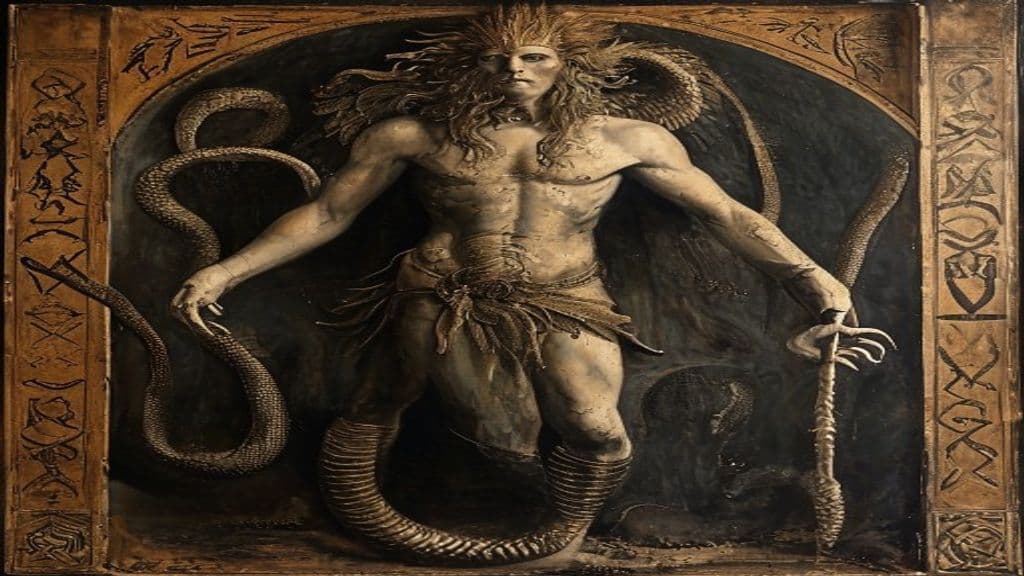
The anguiped is not presented in the sources as an originating mythic individual but as a Latin‑formed term (angui‑ + ped‑) designating a pictorial type: a human figure whose legs are replaced by snakes. The motif appears in syncretic amuletic and magical contexts in the Graeco‑Roman period; one prominent variant, Abraxas, is attested as the most common kind of anguiped in amuletic usage. Attestations and inscriptions associated with anguiped imagery (for example the name Iao appearing on some amulets) indicate the motif's incorporation into mixed cultic and magical practices rather than a single origin narrative.
Depicted as a human figure with serpent tails or snakes in place of legs; upper‑body, head, and attributes vary. A documented variant is Abraxas, often shown with the head of a rooster and snakes for legs. In Graeco‑Roman art, certain monstrous or chthonic figures such as Typhon and the giants are conventionally depicted as anguipeds. The motif also appears in public scenes (for example an equestrian Jupiter riding down an anguipedal giant) and on portable magical objects like gems and amulets.
Sources do not describe individual actions or powers of anguipeds as agents. The motif's presence on magical amulets and in depictions of mythic combat implies symbolic associations with chthonic, liminal, or potent forces harnessed in portable magic; however, no specific operative powers or behaviors are attested in the cited materials.
Weaknesses
None recorded.
Wards
- otherAmuletic depiction as protective/syncretic imagery
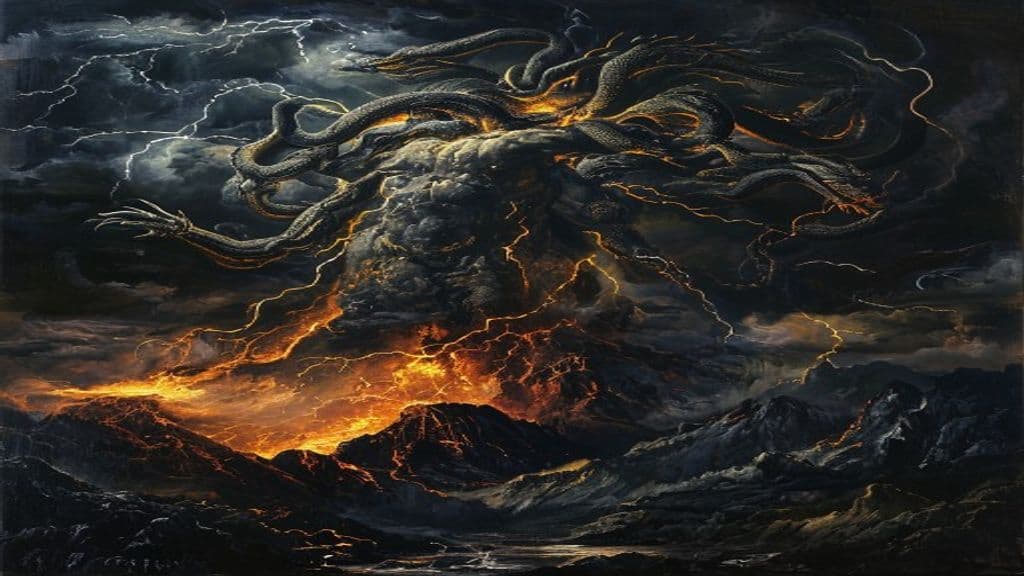
Typhon
The last great monster of Greek mythology — a vast, fire-breathing giant whose shoulders sprouted a hundred serpent heads, nearly toppling Zeus from Olympus.

Giant
A recurring figure-type in myth, legend, and folktale characterized chiefly by humanoid form combined with prodigious size and strength. Giants function variably as monsters, culture-heroes, ancestral figures, or etiological agents that explain landscape features and large ancient remains.
Angiras
Angiras (Sanskrit Aṅgiras/Aṅgirāḥ) is primarily a Vedic rishi (sage) and eponymous lineage (Angirasa) associated with authorship of Vedic hymns, priestly/fire functions, and transmission of mantras; later Puranic accounts multiply his identities in genealogies and lists of sages.
Anglo-Saxon Deities
A list of deities from the Anglo-Saxon pantheon, likely derived from Old English and other Germanic languages. (Note: 1. Power tier: Primordial seems too high given the sparse written record and limited information on abilities. 2. Appearance: Delete statement as no physical descriptions are provided in available sou)
Angolan talapoin
The Angolan talapoin (Miopithecus talapoin), also called the southern talapoin, is a real species of small Old World monkey in the family Cercopithecidae. The provided sources describe it in biological and ecological terms rather than as a mythic or supernatural being.
Angra Mainyu
In Zoroastrian tradition Angra Mainyu (Avestan) — often rendered Ahriman in later sources — is the personified destructive spirit and the principal adversary of the beneficent divine power (Spenta Mainyu) and, in some formulations, of Ahura Mazda. The figure functions as the opposing brother‑power within a foundational Mazdean dualism.
Angrboða
Angrboða is a jötunn (giantess) in Norse myth attested briefly in the Poetic Edda and Prose Edda as the partner of Loki and the mother of three world‑shaping offspring: Fenrir, Jörmungandr, and Hel. Surviving medieval attestations are sparse; most descriptions of her beyond genealogy derive from modern retellings and popular culture.
Anguila peluda
A Canary Islands (Tenerife, Anaga massif) popular-legend creature described as an enormous eel-like animal with a head covered in hair; locals historically regarded it as malign and believed it to be a demon in disguise that required exorcism, after which it disappeared or died.
Anguipede (motif)
The anguipede is a Greco‑Roman visual motif depicting a human torso above serpentine lower limbs, found widely on magical gems, amulets, coins, and architectural reliefs. It functions primarily as an apotropaic or symbolic image in varied contexts rather than as a named mythic personage with a single coherent cult or narrative.
Anguish of Ireland
A mythological character in King Arthur's stories, described as a king and enemy of Arthur. (Note: - Power tier should be Greater (Anguish is a regional power in the context of King Arthur's stories, not a deity-level Ancient being) - Abilities description is partially accurate; Anguish does acknow)
Angul
Angul is a legendary human eponymous ancestor attested in medieval Nordic origin narratives, most notably Saxo Grammaticus' Gesta Danorum, where he and his brother Dan are presented as forefathers and founders of the Danes; Angul is also named as ancestor of the Angles who later migrated to Britain and gave their name to England.
Anguta
Anguta is an ancestral/parent figure in Inuit cosmology associated with the sea-goddess Sedna and the underworld Adlivun. Different traditions variously portray him as a creator or supreme being (especially in some Greenlandic accounts), a mortal ancestor, and most consistently as a psychopomp or lord of the dead who ferries souls and supervises part of the afterlife journey.
Anhur (Onuris)
Anhur, also called Onuris, is an Ancient Egyptian war god worshipped especially at Abydos and Thinis. His name is glossed as "(one who) leads back the distant one," reflecting a myth in which he brings his consort Mehit from Nubia; he appears in Egyptian inscriptional and decorative programs such as polychrome inlays from Ashmunein (Hermopolis).
Ani-Men
Ani-Men is the name applied to several fictional teams in Marvel Comics that adopt animal-themed identities; incarnations range from costumed human criminals to scientifically altered operatives and High Evolutionary-created "New Men." They function in stories as criminal teams, henchmen for villains, or independent anthropomorphic militants rather than supernatural beings.
Community Record
- [1]Anguiped. Wikipedia, 'Anguiped'.wiki
- [2]Wikidata: Anguiped (Q2849794). Wikidata entry Q2849794, 'Anguiped'.wiki