
In the Vedic textual tradition Angiras appears as an early rishi credited with composing or transmitting numerous hymns (particularly in Rigvedic Mandalas I and VIII) and as the ancestor of a family/clan of seers called the Angirasa. Later Puranic layers present multiple, sometimes conflicting, genealogical accounts: some texts make him a son of Brahma or a Prajapati, and in some lists he is named among the Saptarishis while in others he is omitted. Manuscript traditions of the Atharvaveda include an attribution in the compound name 'Atharvangirasah' (Atharvan + Angira), signaling a literary/ritual linkage between Atharvanic and Angiras traditions. Scholarly commentary cited in the sources (Max Müller, via the supplied material) further distinguishes three related uses of the term in Vedic corpus: (1) the singular Vedic rishi Angiras, (2) the plural Angirasa referring to a lineage or clan of rishis, and (3) in some passages a class of divine beings also called Angirasa (which Müller interprets as described in one reading as 'sprung from coals (angara)').
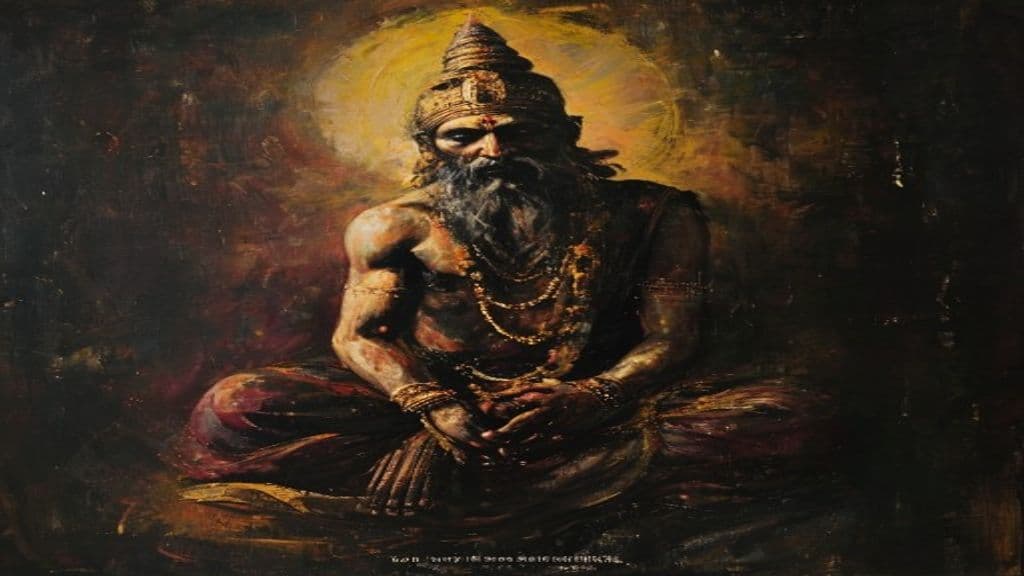
The supplied sources do not give an embodied or consistent visual description of Angiras. Instead, textual portrayals emphasize his social-ritual personae: a teacher of divine knowledge, mediator between humans and gods, fire-priest and singer in sacrificial contexts, and author/possessor of Vedic mantras and hymns (Rigveda; later Puranic hymnic and genealogical material). Puranic accounts stress spiritual attainment (penance and realization of Para-Brahman culminating in the status of 'Brahmarishi') rather than physical appearance. Thus, in the available material Angiras is represented as a textual, ritual and genealogical figure rather than a visually depicted supernatural apparition.
According to the Rigveda and synoptic summaries in the supplied material, Angiras functions as a teacher of divine knowledge and an intermediary between men and gods; some hymns describe him as (in those verses) the first among Agni-devas, linking him to fire-related sacerdotal roles. Many Rigvedic hymns credit the Angirasa (plural) as their authors, notably in Mandalas I and VIII, indicating authority in hymn composition and mantra transmission. Puranic narratives attribute to Angirasa ascetic accomplishment and mystical attainment: one legend recounts that Angirasa meditated on Para-Brahman, attained divine qualities and riches, and reached the state of 'Brahmarishi', bringing visions of Vedic mantras to the world; another tradition credits him (with sage Bhrigu) with introducing fire-worship. The supplied sources also report that Atharvaveda manuscript traditions sometimes present texts as 'Atharvangirasah', evidencing a ritual-literary role in Atharvanic rites. The sources note divergent vocational attributions in different texts (including a group named Angirasa in the Atharvaveda associated with sorcery in one scholarly reading), emphasizing that capacities ascribed to 'Angiras/Angirasa' vary by textual context.

Bhrigu
Bhrigu (Bhṛgu) is a Vedic rishi — one of the Saptarṣi and a mānasaputra (mind-born son) of Brahmā — remembered in Hindu tradition as a progenitor (Bhārgava), Upanishadic inquirer, contributor to legal and ritual corpus, and the attributed compiler of the astrological compendium Bhrigu Saṃhitā.
Atharvan
A legendary Vedic sage and creator of sacred texts, associated with the institution of fire sacrifices. (Note: - Power tier: Not Primordial (Atharvan's abilities are more in line with a Greater or Ancient power tier, given his association with the creation of sacred texts and institution of fire sacrifices). -)
Agastya
Agastya (also Agathiyar/Agasti) is a revered Vedic and later-period Indian rishi (sage) figure credited in textual traditions as an inspired seer, ascetic, teacher, culture-founder, and attributed author of Vedic, Puranic and Tamil works; in South Indian tradition he is associated with origins of Tamil grammar and Siddha medicine and is identified astronomically with the star Canopus.
Agiya Baital
The fire-form of the Vetala — a cremation ground spirit of UP and Bihar that manifests as a wandering flame rather than a corpse-inhabitor, leading night travellers off roads and into marshland or flames with a dancing fire that seems always just ahead.
Agneya / Āgneyī
Āgneyī (feminine) or Āgneya (masculine adjective) is a Vedic–Puranic divine figure and ritual principle tied to the fire-god Agni and the southeastern direction. In textual traditions she appears both as a personified daughter/shakti of Agni and as an adjectival/technical term applied to fire-consecrated things (direction, astra, etc.). She also occurs as the name Agneya (or Anala) among items revealed in a Shaiva-Agamic list associated with the Aghora face of Sadashiva.
Aleya
Ghost lights of the Sundarbans delta — flickering flames over swamp water said to be the souls of dead fishermen, luring the living off safe paths into drowning waters.
Ap (the Waters)
Ap (Vedic áp-, Classical Sanskrit āpas/āpa-) denotes the sacred category of 'the waters' in Vedic/Hindu thought: a physical element (water), an animate cosmic principle addressed in Rigvedic hymns, and an elemental category later counted among the Panchamahabhuta. The term names collective waters invoked in ritual, is linked to deities such as Varuna and the epithet Apām Napāt, and survives in related Indo-Iranian vocabularies (Avestan āpō/Aban, Persian āb).
Apsara
Celestial dancers and water nymphs of Hindu cosmology — beautiful semi-divine beings who dance at the court of Indra and, by his command, descend to earth to distract sages from excessive asceticism.
Asuras
In Vedic mythology, the Asuras are a group of beings described as the 'enemies' or 'opponents' of the Devas (gods), often associated with chaos and disorder. (Note: 1. Power tier should be Ancient (or Deity-level), as they are described as eternal enemies of the gods. 2. Sensory cues and wards/weaknesses sections should be filled in, as there's no information to )
Atri
Atri is a principal Vedic rṣi (seer) and eponymous founder of the Atreya lineage credited with composing hymns in the Rigveda (notably Mandala 5). He is portrayed in epic and puranic narratives as a mānasputra of Brahma, a practitioner of tapas whose austerities attract the Trimurti, and as the hospitable hermit-counselor in Ramayana episodes.
Bhoma
Primordial earth deity in Balinese mythology associated with fertility and vegetation. (Note: 1. Power tier should be Primordial, which is correct. 2. Appearance description matches source material; no corrections needed. 3. Abilities: Add "liminal space between wilderness and human settlement)
Bhoot (bhoota)
A bhoot (also bhoota, bhoot, bhut) is the culturally specific term across parts of the Indian subcontinent for a perturbed, restless spirit generally understood to be the ghost of a deceased person. Sources describe bhoots as arising when a person's death or post-death circumstances prevent them from moving on — for example violent death, unresolved affairs, or failures in funerary rites — and the term appears frequently in modern South Asian media and discussions.
Bidadari
Bidadari is a Southeast Asian regional term related to the South Asian apsara: a class of celestial/ethereal female beings originally associated with clouds and water in Hindu and Buddhist cosmology, later represented in regional art and performance as nymph- or fairy-like figures. The term is also widely used in modern Southeast Asian toponymy and popular culture (place names, media, vessel names), distinct from detailed mythic narratives in the provided sources.
Bordoisila
The storm deity of spring in Assamese tradition — Bordoisila is the daughter of Brahma who visits her mother's home at the end of winter, and whose journey back creates the violent pre-monsoon storms of April and May. She is a goddess-spirit propitiated in Assam for thousands of years.
Community Record
- [1]Angiras - Wikipedia (excerpt provided). Wikipedia contributors, 'Angiras', Wikipedia, The Free Encyclopedia (excerpted material supplied in research notes).wiki
- [2]Angiras - Wikidata. Wikidata entry for Angiras (identifier Q539899) (excerpted material supplied in research notes).other
- [3]William Kidd and the pirates of the Indian Ocean (table of contents reference). Archive.org table-of-contents listing includes a chapter title 'The Angiras: a family of pirates' (provided in research notes); no substantive connection to the Vedic rishi is contained in supplied excerpt.other