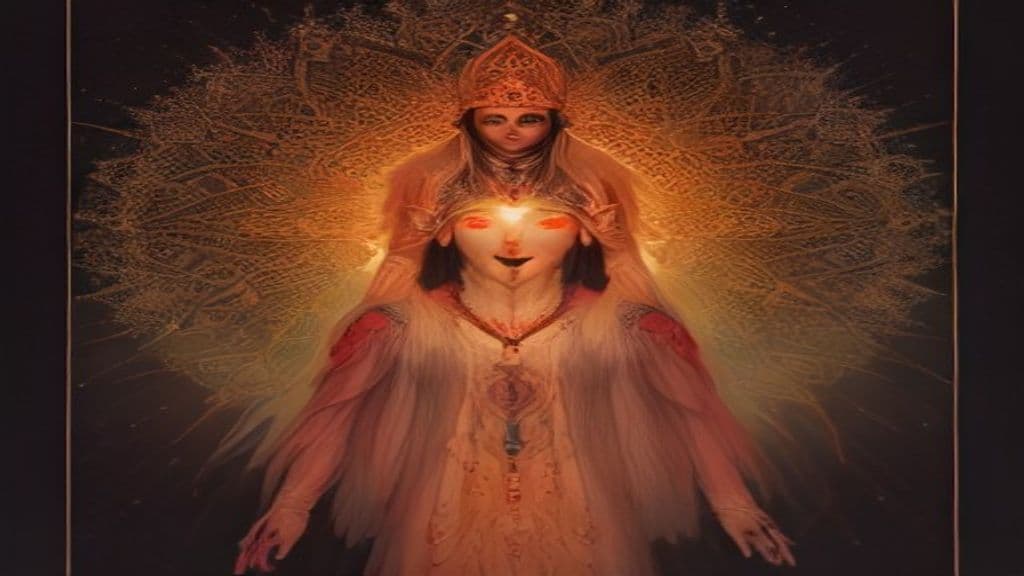
Anush is presented in Mandaean scripture and tradition as an uthra originating from the World of Light. He is identified as cognate with the biblical figure Enosh (Enosh/Ennosh) and is spoken of in the Book of John, the Genzā Rabbā, and the Qolastā as either the son or the brother of Šitil (Seth). The Mshunia Kushta is described in Mandaean sources as the shkina (dwelling) of Anush Uthra, locating him within the canonical habitation of lightworld beings.
The cited Mandaean sources do not provide a detailed physical description of Anush. He is classified in textual sources as an uthra, a being of the World of Light; where appearance is discussed it is in classificatory, not corporeal, terms. Available liturgical and scriptural texts treat him as a non-corporeal lightworld figure invoked in prayers rather than describing garments, colors, or iconography.
Mandaean scriptures (Book of John, Genzā Rabbā, Qolastā) portray Anush as an angelic, soteriological teacher and miracle‑worker: he is described as teaching John the Baptist and as performing many miracles within Jerusalem similar to those ascribed to Jesus in Christian narratives. His frequent inclusion in the triadic liturgical formula "In the name of Hibil, Šitil, and Anuš" in the Qolasta indicates an invoked role in liturgical protection and salvation. Texts thus present him both as an active ministerial figure in salvific narratives and as a named power invoked in priestly prayer.
Abatur
Abatur is an uthra (celestial emanation) in Mandaeism described as the 'father of the Uthras' and called the Ancient (ʿattīqā). He resides on the boundary between the World of Light and lower regions, functions as a judge who weighs souls (Abatur Muzania), and supplies instructions and materials to the demiurgic uthra Ptahil in accounts from the Diwan (Scroll) of Abatur.
Abel
Abel is the second son of Adam and Eve in the Genesis narrative, a shepherd whose accepted offering and subsequent murder by his brother Cain form the biblical account of the first death. Later interpretive traditions expand his role, treating him as an archetypal righteous victim, a postmortem avenging or adjudicating figure, and in some systems (notably Mandaean) identifying him with an angelic lightbeing.
Adam Kasia
In Mandaeism, Adam Kasia ('the hidden Adam') is the primordial, luminous human principle representing the soul of the first man and, by extension, the soul present in every human. He is an archetypal heavenly Adam, attested in Mandaean liturgical and priestly texts and associated in sources with the prototypical priestly figure Shishlam and a hidden/radiant Eve (Hawa Kasia).
Adam Pagria
In Mandaean cosmology Adam Pagria (Classical Mandaic: ࡀࡃࡀࡌ ࡐࡀࡂࡓࡉࡀ) is the primeval bodily man — the archetypal physical human body from which all human bodies derive. He is paired with Adam Kasia, the primeval soul, and is presented as the created, planetary-influenced material substrate that receives a World of Light soul via salvific agents.
Adathan and Yadathan
Adathan and Yadathan are a paired pair of uthras (high celestial beings) in Mandaeism who stand at the Gate of Life in the World of Light and are frequently invoked together in Mandaean liturgy. They are described in the Ginza Rabba and Qulasta as worshippers of Hayyi Rabbi and as guardians associated with the 'first river' (yardna qadmayya).
Amamit
Amamit is a female planetary figure in Mandaean cosmology associated with the planet Venus (Libat/Ishtar) and counted among the entourage of Ruha in the World of Darkness; she is attested in Mandaean texts with a role in eschatological decline.
Bihram (Bihram Rabba)
Bihram, often called Bihram Rabba ('Bihram the Great'), is an uthra (celestial being) in Mandaean cosmology who presides over the masbuta (baptism) and is invoked in Mandaean masbuta prayers; he also appears as an agent in mythic narratives such as the Book of John.
Demons in Mandaeism
In Mandaean cosmology, 'demons' are the hostile inhabitants of the World of Darkness, a structured underworld of kings, paired rulers, guards and lesser spirits that oppose the beings of Light. They appear throughout Mandaean scriptures (notably the Right Ginza and Diwan Abatur) as named personages, consorts, matarta (gate) guards, devourers and other functionaries encountered in mythic descent narratives.
Etinṣib Ziwa
Etinṣib Ziwa (also Ītinṣib Ziwa) is an uthra — a divine being or 'messenger of the light' — attested in the Mandaean Book of John (Chapter 3) where he initiates a battle with the figure Nbaṭ and fights with members of Yushamin's lineage.
Gubran
Gubran is an uthra (a heavenly guardian or angelic being) in Mandaeism, attested in the Mandaean Book of John and the Right Ginza as a named celestial agent who participates in a rebellion with Nbaṭ and is appointed to watch over the north and the city of Ur. He is associated with a female consort named Guban and rides a heavenly steed called Paraheil.
Gupna (Gufna)
In Mandaean cosmology, the gupna or gufna is described in secondary sources as an uthra — a personified, heavenly grapevine that resides in the World of Light. References are brief and present the figure as a sacralized vine elevated into the register of luminous beings rather than as a terrestrial plant.
Hayyi Rabbi
Hayyi Rabbi (Hiia Rbia, "The Great Life") is the supreme, singular divine Principle in Mandaean religion — the First Life and ultimate source of the Worlds of Light from which emanations, souls, and salvific guidance proceed. In Mandaean cosmology Hayyi is transcendent yet the origin of the Great Mana (over-soul) and presides as sovereign over lesser emanations who may act under delegation (e.g., Ptahil) in the formation of the material world.
Community Record
- [1]Anush (Mandaeism) — Wikipedia. Wikipedia, 'Anush (Mandaeism)'wiki
- [2]Anush (Mandaeism) — duplicate page. Wikipedia, 'Anush (Mandaeism)' (cited material)wiki
- [3]Ruha — Wikipedia (contextual reference). Wikipedia, 'Ruha' (contextual contrast with World of Darkness)wiki
- [4]Anush Angel (glossary entry). Imaginova glossary, 'Anush Angel (Mandaeism)'other
- [5]Hibil Ziwa (glossary entry). Imaginova glossary, 'Hibil Ziwa'other
- [6]Alternate Ending: Sects, Lies, and Videotape - Mandaean Documentaries. Alternate Ending, 'Sects, Lies, and Videotape - Mandaean Documentaries' (contextual material)other