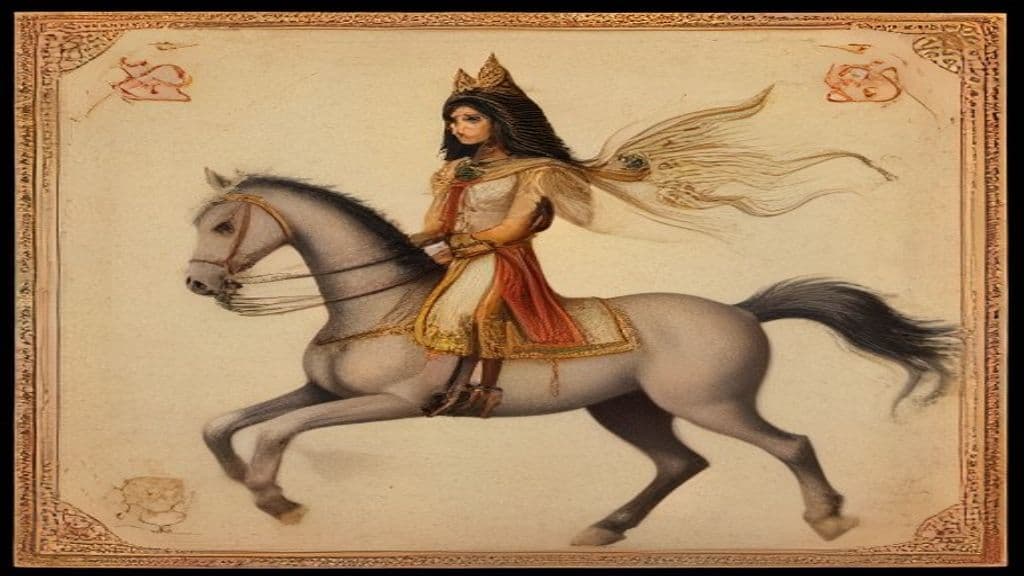
The provided sources do not record a cosmogonic origin story for Gubran. Narrative attestations place Gubran within Mandaean scriptural episodes: in the Mandaean Book of John he assists Nbaṭ in leading a rebellion against Yushamin and his twenty-one sons; in Right Ginza 5.1 he is named among the uthras appointed by Yawar Ziwa to watch over the north and the city of Ur. No source supplied a mythic account of his birth, creation, or ultimate origin.
No physical description of Gubran is recorded in the supplied materials. The only attested iconographic or object detail is that in Chapter 3 of the Mandaean Book of John Gubran's vehicle is named Paraheil, described as a heavenly steed or warhorse. Beyond the mention of this mount, the sources give no bodily, visual, or dress attributes for Gubran.
The sources ascribe custodial and active martial roles to Gubran within Mandaean narrative. He is reported to have assisted Nbaṭ in a rebellion against Yushamin and his twenty-one sons (Mandaean Book of John), indicating participation in supra-human conflict. He is also listed among uthras appointed by Yawar Ziwa over the north to watch over Ur (Right Ginza 5.1), indicating a guardianship or oversight function. The association with the vehicle Paraheil (a heavenly steed) is the only additional operational detail provided. The sources do not enumerate specific supernatural powers, vulnerabilities, or liturgical functions beyond these narrative roles.
Abatur
Abatur is an uthra (celestial emanation) in Mandaeism described as the 'father of the Uthras' and called the Ancient (ʿattīqā). He resides on the boundary between the World of Light and lower regions, functions as a judge who weighs souls (Abatur Muzania), and supplies instructions and materials to the demiurgic uthra Ptahil in accounts from the Diwan (Scroll) of Abatur.
Abel
Abel is the second son of Adam and Eve in the Genesis narrative, a shepherd whose accepted offering and subsequent murder by his brother Cain form the biblical account of the first death. Later interpretive traditions expand his role, treating him as an archetypal righteous victim, a postmortem avenging or adjudicating figure, and in some systems (notably Mandaean) identifying him with an angelic lightbeing.
Adam Kasia
In Mandaeism, Adam Kasia ('the hidden Adam') is the primordial, luminous human principle representing the soul of the first man and, by extension, the soul present in every human. He is an archetypal heavenly Adam, attested in Mandaean liturgical and priestly texts and associated in sources with the prototypical priestly figure Shishlam and a hidden/radiant Eve (Hawa Kasia).
Adam Pagria
In Mandaean cosmology Adam Pagria (Classical Mandaic: ࡀࡃࡀࡌ ࡐࡀࡂࡓࡉࡀ) is the primeval bodily man — the archetypal physical human body from which all human bodies derive. He is paired with Adam Kasia, the primeval soul, and is presented as the created, planetary-influenced material substrate that receives a World of Light soul via salvific agents.
Adathan and Yadathan
Adathan and Yadathan are a paired pair of uthras (high celestial beings) in Mandaeism who stand at the Gate of Life in the World of Light and are frequently invoked together in Mandaean liturgy. They are described in the Ginza Rabba and Qulasta as worshippers of Hayyi Rabbi and as guardians associated with the 'first river' (yardna qadmayya).
Amamit
Amamit is a female planetary figure in Mandaean cosmology associated with the planet Venus (Libat/Ishtar) and counted among the entourage of Ruha in the World of Darkness; she is attested in Mandaean texts with a role in eschatological decline.
Anush (Anush Uthra)
Anush, or Anush Uthra, is an uthra — a lightworld being in Mandaean religion — portrayed in Mandaean scriptures as a soteriological figure who taught John the Baptist and is said to have performed miracles in Jerusalem analogous to those ascribed to Jesus. He is frequently invoked in the Qolasta liturgical formula alongside Hibil and Šitil and is associated with the Mshunia Kushta, described as his shkina (dwelling).
Bihram (Bihram Rabba)
Bihram, often called Bihram Rabba ('Bihram the Great'), is an uthra (celestial being) in Mandaean cosmology who presides over the masbuta (baptism) and is invoked in Mandaean masbuta prayers; he also appears as an agent in mythic narratives such as the Book of John.
Demons in Mandaeism
In Mandaean cosmology, 'demons' are the hostile inhabitants of the World of Darkness, a structured underworld of kings, paired rulers, guards and lesser spirits that oppose the beings of Light. They appear throughout Mandaean scriptures (notably the Right Ginza and Diwan Abatur) as named personages, consorts, matarta (gate) guards, devourers and other functionaries encountered in mythic descent narratives.
Etinṣib Ziwa
Etinṣib Ziwa (also Ītinṣib Ziwa) is an uthra — a divine being or 'messenger of the light' — attested in the Mandaean Book of John (Chapter 3) where he initiates a battle with the figure Nbaṭ and fights with members of Yushamin's lineage.
Gupna (Gufna)
In Mandaean cosmology, the gupna or gufna is described in secondary sources as an uthra — a personified, heavenly grapevine that resides in the World of Light. References are brief and present the figure as a sacralized vine elevated into the register of luminous beings rather than as a terrestrial plant.
Hayyi Rabbi
Hayyi Rabbi (Hiia Rbia, "The Great Life") is the supreme, singular divine Principle in Mandaean religion — the First Life and ultimate source of the Worlds of Light from which emanations, souls, and salvific guidance proceed. In Mandaean cosmology Hayyi is transcendent yet the origin of the Great Mana (over-soul) and presides as sovereign over lesser emanations who may act under delegation (e.g., Ptahil) in the formation of the material world.
Community Record
- [1]Gubran. Wikipedia, article 'Gubran'.wiki
- [2]Gubran (Wikidata). Wikidata entry Q111475836 for Gubran.other