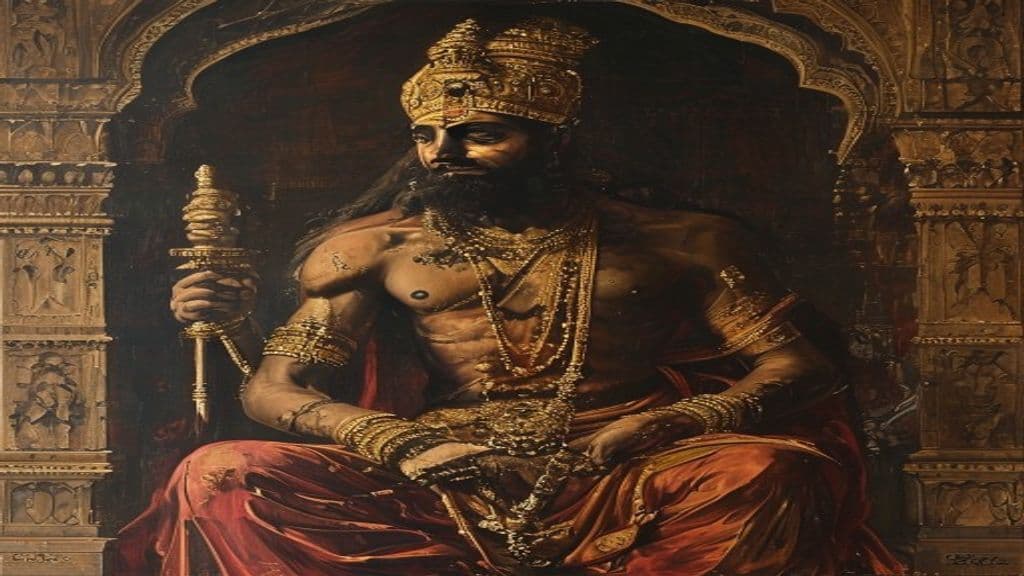
In the Jain chronological scheme Aranātha appears as the eighteenth Tīrthaṅkara of the present half cycle (Avasarpini). The provided sources place his birth in the Ikshvaku royal line at Hastinapur to King Sudarshana and Queen Devi (Mitra), with a calendrical birth date recorded as the tenth day of the Migsar Krishna month. One source gives a traditional cosmological numeric date for his birth (around 16,585,000 BCE) as part of Jain temporal reckoning; this is presented in the sources as traditional chronology rather than modern historical dating.
The supplied Jain excerpts do not include sensory or iconographic description of Aranātha in life. Biographical markers in the sources record his royal parentage, birthplace (Hastinapur), and precise calendrical birth date but do not provide depictional features. A distinct fictional character named Aranatha (from unrelated Malazan fiction) is described elsewhere with long black hair, black skin, and silver eyes; that usage is separate and not part of the Jain tradition.
Within the Jain framework presented in the sources, Aranātha's capacities are primarily spiritual: he functions as a Tīrthaṅkara, a teacher who establishes or re‑establishes the dharma and provides the path across saṃsāra, and at the end of his life he becomes a siddha, described as a liberated soul that has destroyed all karmas. The provided materials do not enumerate specific miracles, rituals, or supernatural feats beyond these canonical roles; a biographical note in HereNow4U indicates he taught and gave instructions to subjects in a past‑life episode, consistent with the pedagogical role of Tīrthaṅkaras.
Abhinandananātha
Abhinandananātha is the fourth Tīrthaṅkara (ford-maker) of the current Jain cosmic age (avasarpini). Traditional accounts place his birth in Ayodhyā to the Ikshvāku (Solar) dynasty, describe his renunciation and attainment of omniscience beneath a priyangu tree, and record his liberation on Mount Śikharjī.
Ajitanātha
Ajitanātha is the second tirthankara of the current cosmic age in Jainism: an enlightened spiritual teacher who renounced worldly life, attained omniscience (kevalajñāna), and achieved liberation (moksha), and who is credited with establishing a large four-part monastic order in the tradition's hagiography.
Akshayavata
In Hindu mythology, Akshayavata is a sacred banyan tree and/or lake that symbolizes eternal life. It is mentioned in both Hindu and Jain traditions and associated with the Puranas. (Note: - The power tier should be "Greater" or at least "Ancient", as it is associated with the Puranas, which are considered ancient texts. - No specific physical description is provided, but that doesn't m)
Ambika (Jainism)
Ambika is the yakṣiṇī (Śāsana Devī, protector-goddess) and tutelary attendant of the 22nd Tīrthaṅkara Neminatha in Jain tradition. Venerated both as an attendant spirit and an independent goddess (kuladevi) she features in devotional, temple and tantric ritual contexts, and is associated with fertility, prosperity and protection.
Anantanātha
Anantanātha is the fourteenth Tīrthaṅkara of the present age (Avasarpini) in Jain tradition, a perfected spiritual teacher who became a siddha (liberated soul) after destroying all karma and whose role is to reveal the dharma and provide a ford (tīrtha) across saṃsāra.
Arihant
In Jain doctrine an arihant is a soul (jiva) that has conquered inner passions and destroyed the four inimical (ghātiyā) karmas, thereby attaining kevala jñāna (omniscience) while still embodied; on final shedding of remaining karma an arihant attains siddhahood (moksha).
Chakreshvari
Chakreshvari (also Chakreshwari or Apraticakra) is an attendant goddess (yakshini) in Jain cosmology who serves as the guardian or tutelary deity of the first Tirthankara, Rishabhanatha. She is an object of popular devotion in Jain communities and is counted among the three yakshinis—alongside Ambika and Padmāvatī—that attract the most devotional worship.
Dharmanātha
Dharmanātha is the fifteenth Tirthankara of Jainism's present age (Avasarpini). Sources state he attained siddhahood (liberation by destroying all karma) and is portrayed in tradition as a supreme spiritual teacher who establishes the ford (tīrtha) across saṃsāra.
Gandharva
A class of non-human celestial or semi-celestial beings in Indic religions associated principally with music, song, dance, fertility, and an escort/guardian role for liminal arrivals (such as Soma or beings). In Hinduism they are minor deities and musicians of the devas; in Buddhist cosmology they are a low rank of devas and the term (gandhabba in Pāli/commentary) is also used doctrinally for a sentient intermediate state between death and rebirth.
Garuda
Garuda is a divine, eagle-like being in South Asian traditions best known as the vahana (mount) of the god Vishnu. In Vedic, Purānic and later texts he appears as a powerful, solar-associated bird-personage who is both an individual mythic personality (son of the sage Kaśyapa and Vinatā) and an archetype invoked in temple iconography and theological metaphor.
Guardians of the Directions (Dikpāla / Lokapāla)
A class of deities or divine offices that guard and sacralize spatial directions in South Asian and some Southeast Asian religious cosmologies. Appearing in Hinduism, Jainism and Vajrayāna Buddhism (and in regional systems such as Meitei and Javanese/Balinese traditions), they are represented in temple architecture and invoked as protectors of sacred space and the dharma.
Indra
Indra is a major Vedic deity, king of the devas and lord of Svarga (heaven), associated primarily with the sky, storms, lightning, rain, rivers and martial heroism; he is central in the Rigveda and later appears across Hindu, Buddhist and Jain cosmologies with varying status.
Community Record
- [1]Aranatha - Wikipedia. "Aranath(Arnath) was the eighteenth Jain Tirthankar of the present half cycle of time (Avasarpini)."; "He became a siddha i.e. a liberated soul which has destroyed all of its karmas."; "Aranath was born to King Sudarshana and Queen Devi (Mitra) at Hastinapur in the Ikshvaku dynasty. His birth date was the tenth day of the Migsar Krishna month of the Indian calendar."wiki
- [2]Aranatha (Wikidata). Wikidata entry for Aranatha (linked identifier for the same Jain Tīrthaṅkara).wiki
- [3]Jain Legend : Lord Śrī Aranātha (HereNow4U). "After Lord Śrī Kuṃthunātha the 18thTīrthaṃkara was Lord Śrī Aranātha." (biographical/legendary note referencing teaching role in lives connected to Aranātha)folk
- [4]Tirthankara (Jain Society of Tampa Bay). "In Jainism, a Tirthankara (Sanskrit: tīrthaṅkara; English: literally a 'ford-maker') is a saviour and supreme spiritual teacher of the dharma(righteous path)." (definition of the role into which Aranātha is situated)other
- [5]Digamber Jain Bada Mandir Hastinapur - Wikipedia. Reference to Hastinapur as an important tirtha and to the temple complex associated with Jain Tirthankara birthplaces, contextualizing Aranātha's birthplace.wiki
- [6]Aranatha | Malazan Wiki | Fandom. Fictional character named Aranatha (Tiste Andii) with physical description in the Malazan Book of the Fallen setting; noted in sources as an unrelated homonymous usage.literary