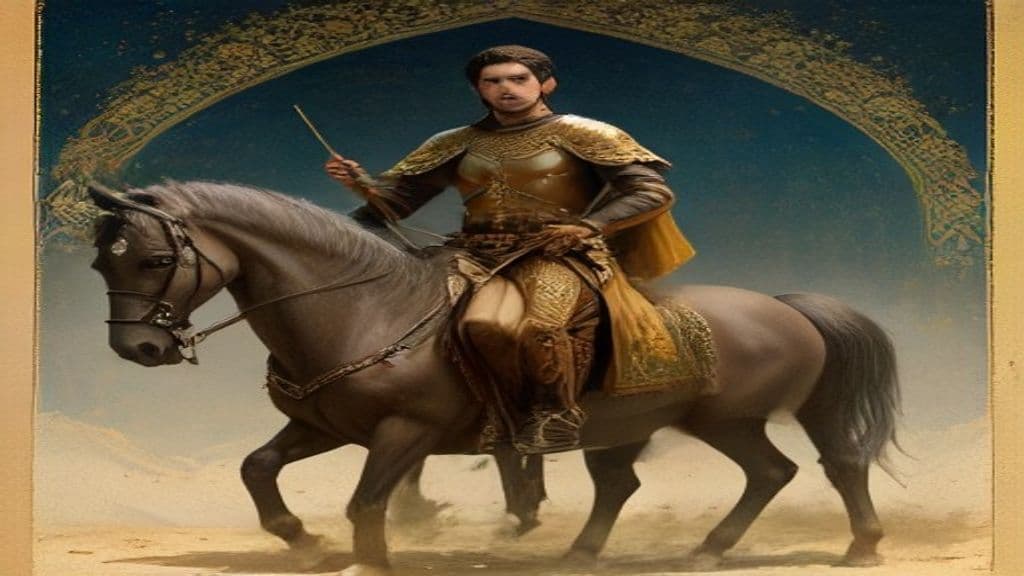
In the assembled textual tradition Arash appears as an exemplary archer called upon during a boundary dispute between Iran and Turan. In Avestan and later accounts an angelic or divine figure (named in some sources as Isfandaramad / Spendarmad, equated with Spenta Armaiti in Middle Persian formulations) instructs King Manuchehr to prepare a special bow and arrow and to designate Arash as the archer. Arash's single shot, guided or sanctioned by this sacred injunction, is then used to mark the national border and to allocate the khwarrah (royal glory). Variants differ over many circumstantial details (the precise place of launch and landing, and whether Arash survives), but the core narrative presents a human hero acting under divine direction to secure the polity.
Surviving sources give no stable, detailed anthropomorphic description beyond identifying him by his skill and role: the epithet kaman-gir ('bow-expert' or 'bow-carrier') is the dominant descriptor. The Avestan name Erekhsha is glossed as 'of the swift arrow,' emphasizing his identity as the wielder of a uniquely swift shot. There are no consistent supernatural physical traits recorded in the cited materials; Arash is portrayed as a human archer rather than a recurrent spirit or monstrous being.
Arash's defining ability is extraordinary archery: he launches a single arrow whose flight covers an exceptional distance and thereby fixes the political boundary between Iran and Turan. Descriptions of the arrow's range vary across sources — measures include a thousand leagues/farsakhs, 'forty days' walk,' and temporal descriptions such as flight from dawn to noon or from dawn until sunset. In some recensions the act involves self-sacrifice (Talebi and Bal'ami report Arash is destroyed by the shot and disappears), while other versions (al-Tabari) say he is celebrated and lives in honor. The shot's purpose is juridical and cosmological—establishing territory and distributing khwarrah—rather than malevolent aggression.
Aralez (Aralezner)
Aralez (Aralezner in plural) are ancient Armenian dog-like spirit-beings traditionally credited with resurrecting fallen warriors by licking their wounds. Described in source material as part of the older strata of Armenian sacred imagination, they occupy a liminal role between animals, spirits, and ancient gods.
Aram (Nahapet)
Legendary leader and patriarch in Armenian tradition who united Armenians into one state. (Note: - Power tier: Primordial (given cosmic/unifying abilities) - Summary: Expand to include "unification of Armenians" as a key aspect of his leadership - Abilities: More specific and detailed description)
Arang (Korean folklore)
Vengeful spirit driven by a desire for justice in Korean folklore, particularly during the Joseon Dynasty. (Note: 1. Power tier should be Primordial since it is described as having a cosmic level of influence in causing fear among magistrates. 2. The description for weaknesses is missing; add that Arang's weaknes)
Aranzaḫ
Aranzaḫ is the Hurrian divine personification of the river Tigris, treated in Hurrian religion as a numen and river-god who appears in the Kumarbi Cycle and as an ally-protector in the tale of Gurparanzaḫ. The figure is attested in Hurrian theophoric names and is discussed in scholarship in relation to later regional cultic references to the Tigris source.
Aranātha
Aranātha is the eighteenth Tīrthaṅkara (ford‑maker) in the Jain tradition of the present half‑cycle (Avasarpini). In the provided sources he is presented as a spiritual exemplar born in the Ikshvaku dynasty at Hastinapur who attains siddhahood (liberation) after completing his life.
Arariel
Arariel is an angel attested in rabbinic tradition as having charge over the waters of the Earth. Later popular and New Age sources expand this terse attribution into devotional uses (invocation for fishing, mental calm), but primary sources recorded here offer only the brief custodial office.
Arautauta
The Arautauta is a significant waka (canoe) in Māori tradition, playing a key role in the migration of people to New Zealand. (Note: - Power tier: Should be Primordial (as it's a significant waka in Māori tradition) - Abilities: Should mention its use for transporting people and goods as a notable aspect of its significance - Appea)
Aravis
Aravis is a fictional human character from C. S. Lewis's The Horse and His Boy (1954). A Tarkheena (female noble of Calormen), she flees an arranged marriage, travels north with talking horses and companions, is wounded by a lion, undergoes moral transformation after encountering Aslan, and later becomes queen of Archenland and appears among the redeemed in Aslan's Country.
Arawa (canoe)
In Māori tradition, the Arawa is a supernatural canoe representing the ancestors' journey to New Zealand. (Note: * Power tier: Primordial (or not specified at all, as there's no indication of supernatural powers beyond its symbolic and cultural significance) * Appearance: No physical description mentioned in sou)
Arawn
Arawn is the ruler (king) of Annwn, the Otherworld in medieval Welsh narrative. He appears most prominently in the First Branch of the Mabinogi, where he exchanges places with the mortal Pwyll for a year and a day and is associated in folklore with the Cŵn Annwn (Hounds of Annwn) and other supernatural animals.
Araṇyānī
Araṇyānī is the Vedic forest goddess/personified presence of the wild in early Hindu literature, best known from the Aranyani Suktam (Rigveda 10.146). She embodies the autonomous, productive character of untamed woodlands—elusive, a provider of sustenance, and perceptible by the tinkling of anklets rather than by sight.
Arcadia (Utopia)
In Greek tradition, Arcadia is an idealized concept representing a harmonious relationship with nature. (Note: 1. The power tier should be "Primordial" is correct, but clarify that this refers specifically to its conceptual or idealized nature, not implying it has traditional magical powers. 2. No explicit des)
Community Record
- [1]Arash (Wikipedia). Wikipedia, 'Arash' article (summary of Avestan, Middle Persian, and Islamic-era traditions)wiki
- [2]Wikidata entry: Arash. Wikidata item for Arashother