
In the Hebrew Bible (Genesis 14) Arioch appears as the named king of Ellasar who, with Amraphel of Shinar, Chedorlaomer of Elam, and Tidal of Goiim, led a coalition that fought against the kings of the Jordan plain at the Battle of Siddim. The supplied sources present Arioch primarily as a human ruler in a patriarchal-era narrative; later literary and occult traditions reuse the name for infernal or chaotic figures. Scholarly sources summarized in the provided material offer multiple, competing identifications for the place name Ellasar (including Larsa/Eri-Aku, Cappadocia, Alashiya/Elishah, and an Ilānṣurā/Arriuk reading), but none are settled in the cited summaries.
The biblical text provides no physical description of Arioch, identifying him only by name and title (king of Ellasar). Later imaginative sources vary: Greyhawk lore (as summarized in provided material) describes a stylized diabolic humanoid form (purple- to wine-red skin, head resembling a lion-maned crocodile) specific to that fictional setting; Michael Moorcock's fiction and related commentary portray Arioch in some contexts as a monstrous or giant figure wielding a black runesword. These later depictions are literary inventions and are not present in the Genesis account.
In Genesis 14 Arioch's recorded activity is political and military—participation in a coalition war, plunder, and taking captives—without supernatural powers attributed in the biblical account. Later traditions recast the name as belonging to infernal or chaotic personae: summaries note appearances in grimoires (as a named demon), inclusion among fallen angels in Milton's Paradise Lost, depiction as a lord of Chaos in Michael Moorcock's fiction, and a duke of Hell in Greyhawk lore; the provided sources do not offer a consistent, cross-tradition catalog of supernatural abilities tied to the name.

Djinn
The class of supernatural beings created from smokeless fire in Islamic cosmology — a parallel civilization to humanity, capable of belief or unbelief, with their own prophets, society, and judgment before God.
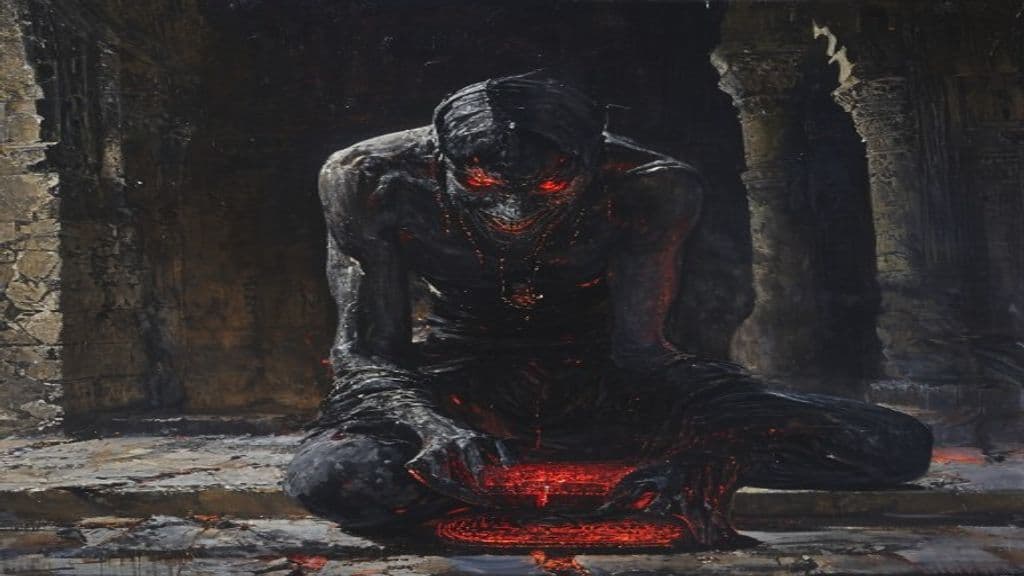
Shaitan
A class of corrupted djinn who follow Iblis and dedicate themselves to leading humans astray — distinct from Iblis himself, the Shayatin are a species of evil djinn who whisper doubts and temptations into the minds of the living.
Aribeth de Tylmarande
Aribeth de Tylmarande (commonly Aribeth or Lady Aribeth) is a fictional human paladin of Tyr in the Forgotten Realms setting, portrayed as a high-ranking civic and religious officer in the city-state of Neverwinter whose grief and crisis of faith lead her from defender and ally to an antagonist in the Neverwinter Nights narrative.
Ariel
Ariel is named in the provided materials as an angel appearing primarily in Jewish and Christian mysticism and apocrypha. The supplied sources give the Hebrew form אֲרִיאֵל (romanized ʾÁrīʾēl) and identify Ariel as an angelic figure but do not provide further doctrinal, narrative, or ritual detail.
Arihant
In Jain doctrine an arihant is a soul (jiva) that has conquered inner passions and destroyed the four inimical (ghātiyā) karmas, thereby attaining kevala jñāna (omniscience) while still embodied; on final shedding of remaining karma an arihant attains siddhahood (moksha).
Arikura-no-baba
Arikura-no-baba (蟻鞍の婆, glossed "ant-saddle hag") is a local legendary figure from Takayama in Gifu Prefecture, Japan, described in sources as an old woman with supernatural powers. She is credited in the cited accounts with stopping a mountain eruption by prayer after it had been rumbling for seven days and with cooling the water of an onsen by throwing a horse's hoof into it.
Arimanius
Arimanius is a Greco-Roman rendering of the Iranian adversary Ahriman attested in classical literature (notably Plutarch) as the dark opposing principle to Oromazes/Ahura Mazda, and as a deity-name found on several Roman Mithraic dedications. Literary and inscriptional uses differ: Plutarch presents a morally malign, cosmological figure associated with pestilence and darkness, while Mithraic inscriptions invoke the name in dedicatory contexts with ambiguous or reinterpreted valence.
Arinniti (Sun goddess of Arinna)
The Sun goddess of Arinna, often called Arinniti, is the chief solar female deity of the Hittite state religion, venerated as the protector and tutelary goddess of the Hittite kingdom with her cult center at the sacred city of Arinna. She is described as the "Queen of all lands" and is closely associated with the Hittite weather god Tarḫunna.
Arion
Arion (Ancient Greek: Ἀρίων) is a legendary/kitharode musician in Greek mythic-poetic tradition, famed for exceptional skill on the kithara and for a narrative in which his singing summons dolphins that rescue him from shipboard treachery; the episode ends in cultic commemoration and aetiology linking the dolphin to the constellation Delphinus.
Arishem the Judge
Arishem the Judge is a fictional cosmic being in Marvel Comics, one of the Celestials whose specific role is judicial: judging civilizations and leading Celestial landing parties. Portrayed as an immense, near-immortal cosmic entity, Arishem has created species, culled populations, and participated in multiversal cycles of creation and destruction.
Arisia Rrab
Arisia Rrab is a Green Lantern Corps officer in DC Comics continuity: a Graxos IV alien who serves as an interstellar law-enforcement Lantern. Her abilities are primarily mediated through her Corps power ring; narrative arcs include service on Oa, assignments in Sector 2815, interpersonal relationships with other Lanterns, an apparent on-panel death and later revealed survival due to a healing factor.
Aristaeus
Aristaeus (Ancient Greek: Ἀρισταῖος) is a mythic culture-hero and minor godlike figure in Greek tradition, honored as the patron and transmitter of rural arts (notably beekeeping, dairying, olive cultivation, and viticulture). He functions as a liminal figure between mortal heroes and divinities, appearing in local cults across the Greek world and in literary narratives that explain the origin and restoration of pastoral practices.
Aristo of Chios
Aristo of Chios (Greek: Ἀρίστων ὁ Χῖος, fl. c. 260 BC) was a Hellenistic Greek philosopher associated with the Stoic tradition who founded a distinct, ethics-focused current often labeled the Aristonians. A pupil of Zeno of Citium who later taught at the Cynosarges gymnasium in Athens, he is remembered for rejecting the Stoic emphasis on logic and physics and for advocating a narrowed, practice-oriented program centered on defining the Supreme Good.
Aristomachus
Aristomachus (Ancient Greek: Ἀριστόμαχος) is a Greek personal name borne by multiple historical and mythological individuals rather than a single supernatural being. Bearers include mythic figures listed in genealogies, two Hellenistic tyrants of Argos, a Crotonian political actor, a writer cited by Pliny on agriculture/domestic economy, a sculptor from the banks of the Strymon, and a Byzantine official in sixth‑century Egypt.
Community Record
- [1]Arioch — Wikipedia. Wikipedia, 'Arioch' (summary of biblical appearance, later literary and grimoire uses)wiki
- [2]Genesis 14 (Archive transcription). Archive.org transcription of Genesis 14 (mentions 'Arioch king of Ellasar')literary
- [3]Arioch — International Standard Bible Encyclopedia (entry). International Standard Bible Encyclopedia entry summarizing biblical appearanceacademic
- [4]Arioch — Greyhawk Wiki (Great Library of Greyhawk). Greyhawk wiki entry describing the name's use as a duke of Hell and a fictional appearance (setting-specific depiction)wiki
- [5]What sword is fluctuating next to Arioch in the first volume of the Corum Chronicles? (Scifi.StackExchange). Discussion noting Michael Moorcock's use of Arioch as a lord of Chaos and literary depictions (Corum-related reference)other
- [6]Abarim Publications — 'Arioch' (name and etymology summary). Summary of Hebrew form (ʼAryōḵ) and discussion of proposed identifications cited in secondary summariesother
- [7]Genesis Apocryphon / Book of Jubilees (summarized variants). Summarized note (via Wikipedia) that Genesis Apocryphon calls Arioch 'king of Cappadocia' and Book of Jubilees uses a variant 'Sellasar'wiki