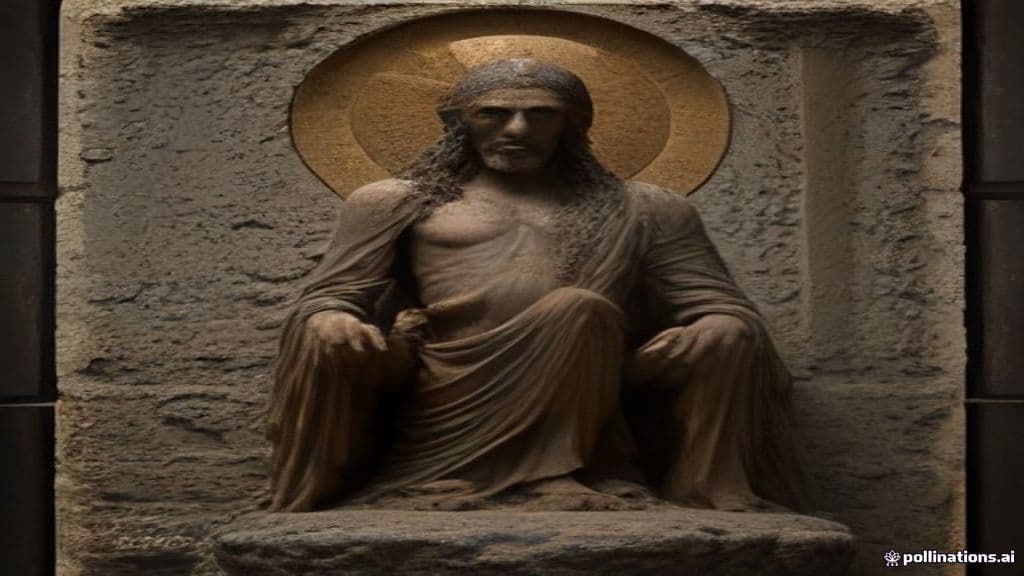
Accounts vary: some medieval texts describe Armilus as a created or artificial being born from a statue or stone, while other narratives state he is the offspring of Satan and a virgin. The Jewish Encyclopedia and modern commentators treat the virgin/statue birth motifs as syncretic or polemical, noting resemblance to Christian legend and to living-statue tales; scholarly proposals also connect his name etymologically to Romulus or to Ahriman, suggesting links to Roman/imperial enemies or cosmic evil. These variants are presented across Sefer Zerubbabel, the Apocalypse of Zerubbabel, Les signes du Messie, and related sources rather than as a single unified origin.
Descriptions differ by source. Midrash Vayosha depicts Armilus as bald, partially deaf, partially maimed, and partially leprous. Other works emphasize his status as a created/artificial rival (born from a statue/stone) or note the virgin-birth motif; in such accounts physical portraiture may be subordinated to his origin as an artificial or demonically begotten antagonist.
Medieval texts attribute to Armilus sweeping political and military power: he conquers the nations, centralizes authority in Jerusalem, and persecutes Jewish believers. He functions as a religious-political deceiver — in some polemical accounts Christians recognize him as their messiah or god — and is the catalyst for eschatological wars in which Messiah ben Joseph may fall. His reign is temporary and permitted as part of end-time testing; he is ultimately defeated by the Jewish Messiah (accounts vary whether Messiah ben Joseph or Messiah ben David effects final victory) and by divine means such as fire and sulphur from heaven. Sources that present him as created emphasize his artificial or satanic production as part of his hostile agenda.
Weaknesses
- otherdefeated by the Jewish Messiah
- substancefire and sulphur sent from heaven
Wards
- conditiondivine intervention and messianic victory
- conditionfidelity to covenant / Israel's preservation (narrative safeguard rather than a ritual)
Arkan Sonney
A Manx folkloric 'fairy animal' whose name is also the everyday Manx word for hedgehog; in tradition it appears as a white pig that brings good fortune to those who see or catch it but causes misfortune if held too long.
Arkaroo
Arkaroo is a primordial ancestral serpent of the Dreaming associated with the northern Flinders Ranges (Ikara/Wilpena Pound) in South Australia. In local creation narratives it drank the waters of Lake Frome, carved valleys by reclining in the mountains, and left waterholes where it rested; the being is commemorated in place-names and rock art at sites such as Arkaroo Rock.
Arke
Arke (Ancient Greek Ἄρκη, Árkē; variant Arce) is a minor Greek messenger-divinity, daughter of Thaumas, who sided with the Titans in the Titanomachy. After the Titans' defeat she was punished by Zeus — her wings were cut off and she was cast into Tartarus — and in some traditions her severed wings were later given to Peleus and Thetis and then to Achilles.
Arkon
Arkon is a fictional extradimensional warlord and ruler (titled Imperion) of the extra-dimensional world Polemachus in Marvel Comics. He is portrayed as a superhuman warrior-leader who travels between his world and Earth (and other planes) pursuing solutions to existential crises and engaging in conquest, alliance, and romantic entanglements with Earth heroes.
Armandine
Armandine is not attested in the supplied sources as a folkloric or supernatural entity. The string 'Armandine' appears only as a modern feminine personal name, a toponym, and as the name of fictional characters in contemporary media.
Armenus
A mortal figure and Argonaut in Greek mythology, participating in the quest for the Golden Fleece. Relatively unknown in the larger mythological narrative. (Note: * Power tier should be changed to Primordial is incorrect; since Armenus is a mortal figure in human mythology. * Add sensory cues: Since there's no physical description available, it could say "None )
Arnaeus (Irus)
Arnaeus, commonly called Irus in English translations, is a mortal beggar who appears in Book XVIII of Homer's Odyssey as a hanger‑on in the hall of Odysseus on Ithaca. He functions in the narrative as a social type and a foil for the disguised Odysseus, provoking a public fight that illustrates themes of hospitality, social disorder, and appearances versus reality.
Arnakuagsak
Arnakuagsak is an Inuit sea-mother deity worshipped primarily in Greenland, described as an 'old woman from the sea' who is responsible for ensuring hunters' success and the health and strength of the people. She is treated in sources as essentially equivalent to related sea-mother figures in Canadian and Alaskan Inuit traditions.
Arnapkapfaaluk
A fearsome sea-being of the Coronation Gulf Copper Inuit who controls access to seals and other marine mammals; she withholds game as punishment for taboos or indiscretions and thus governs hunters' success.
Arnavāz
Arnavāz is a named royal woman in Persian epic tradition (Shahnameh and related recensions). She is presented as a consort of the usurper Zahhāk who, after his defeat, is taken into Fereydun's household and in some versions is mother of Iraj, thus functioning as a dynastic node in the epic genealogy.
Arne (daughter of Aeolus)
Arne (Ancient Greek: Ἄρνη, Árnē) is a mortal woman in Greek mythic genealogy, presented as daughter of Aeolus and Melanippe and as ancestress of the Boeotians through her son Boeotus. Her narrative links human lineages with divine action (Poseidon) and local eponymy (a city named for her appears in the Iliad's Catalogue of Ships).
Arne Sithonis
A figure from Ovid's Metamorphoses: a princess who accepted Minos' bribe to betray her island and was punished by the gods with metamorphosis into a black-footed, black-winged jackdaw forever attracted to gold and shining objects. The tale is attested only in Ovid (as preserved in modern summaries) and functions as a moral exemplum about greed and betrayal.
Community Record
- [1]Armilus. Wikipedia: Armiluswiki
- [2]ARMILUS - JewishEncyclopedia. JewishEncyclopedia: ARMILUSliterary
- [3]Apocalypse of Zerubbabel. Apocalypse of Zerubbabel (summary, Wikipedia)literary
- [4]Les signes du Messie (archive summary). Les signes du Messie (archive.org descriptive summary)literary
- [5]Who is Armilus? (Judaism StackExchange summary). Judaism.StackExchange Q&A (community summary of tradition presence)other