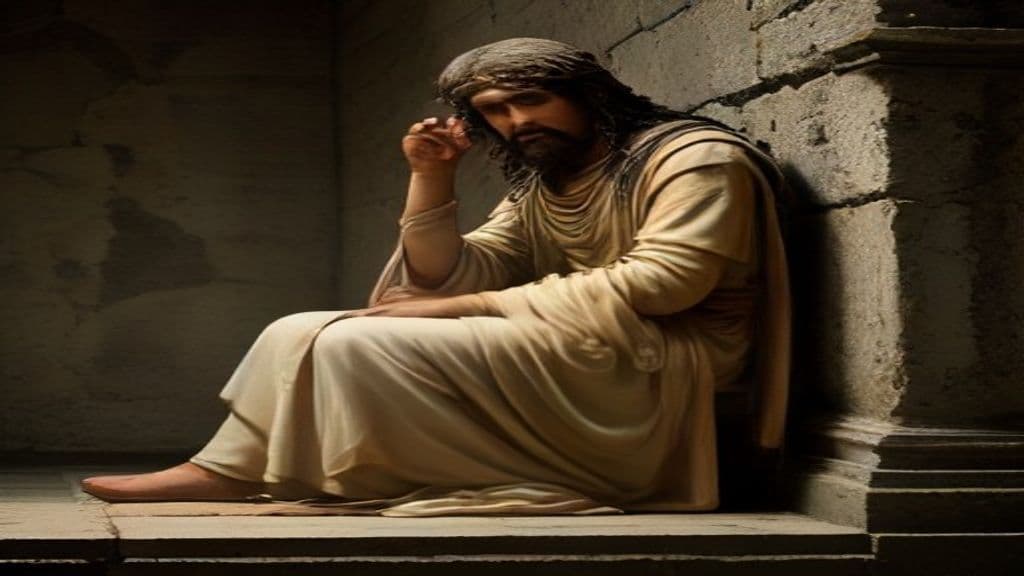
Homer provides no mythic origin for Arnaeus. In the Odyssey he is presented as a resident mendicant of Ithaca and a regular beggar in the social milieu of Odysseus' household; the poem treats him as a human social figure rather than as a divine or supernatural progeny.
Primary Homeric translations describe Arnaeus as a common tramp or beggar who frequents the city and the suitors' hall. He is characterized by surly manners and low social status; the narrative contrast that exposes Odysseus' hidden strength (aided by Athena in the poem) creates a momentary physical juxtaposition, but Homer does not provide a detailed canonical description of Arnaeus' size or features beyond his role as a mendicant.
Arnaeus displays ordinary human behaviors: begging around Ithaca, accepting commissions from the suitors (running messages), insulting other beggars, and being willing to fight for food or status. In the fight with Odysseus he is struck hard (his jaw is crushed in some translations), quickly defeated, dragged out, and left to sit outside to scare pigs and dogs. No supernatural powers are attributed to him in the cited sources.
Weaknesses
- conditionSocial vulnerability to the suitors' threats (e.g., Antinous' rhetorical threat of banishment to King Echetus)
- conditionPhysical vulnerability to stronger men (defeated by Odysseus in the fight)
Wards
None recorded.
Amphimedon
In Homer's Odyssey, Amphimedon (Ancient Greek: Ἀμφιμέδων) is an Ithacan, son of Melaneus, one of the suitors of Penelope who fights in Odysseus's hall, is killed during the slaughter of the suitors, and (within the Homeric narrative) later appears among the dead in the Underworld to recount the events of that slaughter. The same name is also used in modern biological taxonomy for a genus of sponges; that referent is distinct.
Elpenor
Elpenor is a named human figure in the Homeric epic tradition (Odyssey) who dies accidentally on Circe’s island and later appears as a shade in Hades during Odysseus’ katabasis to plead for a proper cremation and burial. He functions in the poem as an example of neglecting funerary obligation and the moral duty of the living to care for the dead.
Eudoros
Eudoros (Ancient Greek Εὔδωρος) is a Homeric heroic-age leader, the second of Achilles' five commanders in the Iliad. Presented as a demigod son of Hermes and the mortal Polymele, he commands a contingent of Myrmidons and is praised for speed and fighting skill.
Eumaeus
Eumaeus is a mortal character of the Homeric Odyssey: the loyal swineherd and household attendant of Odysseus, raised in his master's household and notable for his hospitality, fidelity, and practical skill in animal husbandry during Odysseus's return to Ithaca.
Eurylochus
Eurylochus is a mortal seaman in Homer's Odyssey, serving as Odysseus' second-in-command and leader of contingents of crewmen. He is portrayed through actions and speech as a cautious but quarrelsome subordinate whose persuasion and dissent contribute to critical narrative catastrophes (notably the slaughter of Helios' cattle).
Halitherses
Halitherses (Ancient Greek: Ἁλιθέρσης) is an Ithacan seer and elder in the Homeric Odyssey cycle, named as the son of Mastor. He interprets signs from Zeus, pronounces their meaning publicly, and counsels restraint and deference to the gods; his warnings are often disregarded by the suitors and portions of the community.
Iamenus
Iamenus (Ancient Greek: Ἰαμενός) is a named Trojan warrior in Homer's Iliad (Book XII) who takes part in the cavalry charge against the Achaean wall and is recorded as slain there by the Greek warrior Leonteus. He is a minor mortal participant in the epic rather than a supernatural being.
Armandine
Armandine is not attested in the supplied sources as a folkloric or supernatural entity. The string 'Armandine' appears only as a modern feminine personal name, a toponym, and as the name of fictional characters in contemporary media.
Armenus
A mortal figure and Argonaut in Greek mythology, participating in the quest for the Golden Fleece. Relatively unknown in the larger mythological narrative. (Note: * Power tier should be changed to Primordial is incorrect; since Armenus is a mortal figure in human mythology. * Add sensory cues: Since there's no physical description available, it could say "None )
Armilus
Armilus is an eschatological anti-messiah figure in medieval Jewish apocalyptic literature who rises at the end of days to conquer the nations, persecute Israel, and is ultimately destroyed by the Jewish Messiah and divine intervention. He functions as a foil to messianic figures and is variously portrayed with syncretic origins and differing physical descriptions across sources.
Arnakuagsak
Arnakuagsak is an Inuit sea-mother deity worshipped primarily in Greenland, described as an 'old woman from the sea' who is responsible for ensuring hunters' success and the health and strength of the people. She is treated in sources as essentially equivalent to related sea-mother figures in Canadian and Alaskan Inuit traditions.
Arnapkapfaaluk
A fearsome sea-being of the Coronation Gulf Copper Inuit who controls access to seals and other marine mammals; she withholds game as punishment for taboos or indiscretions and thus governs hunters' success.
Community Record
- [1]The Odyssey, Book XVIII (Butler translation). Homer, The Odyssey, Book XVIII; Butler translation, excerpt describing the arrival of a 'certain common tramp' who begged around Ithaca.literary
- [2]The Odyssey, Book XVIII (alternate translation). Homer, The Odyssey, Book XVIII; alternate translation excerpt describing the beggar (translation wording varies).literary
- [3]Arnaeus — Wikipedia. Wikipedia summary entry for Arnaeus (Irus), noting his role as a beggar in Ithaca and his service to the suitors; summarizes themes and the Book XVIII episode.wiki
- [4]Wikidata: Arnaeus (Q4794415). Wikidata entry for Arnaeus/Irus, identifying the Homeric character.other