
Aurnavabha appears in Vedic textual sources as a proper name in hymnic onomastics and later as an attributed commentator in modern bibliographic indexes. In the Rigveda the form Aurṇavābha occurs within a catalogic verse addressed to Śatakratu/Indra (Rig Veda, Book 8: Hymn LXVI). Separately, nineteenth- and twentieth-century theosophical reference works and indexes list 'Aurnavabha Acharya' as a Vedic commentator and cite an exegetical reading attributed to him concerning Vishnu's three strides (SD References - Volume 1; At-Az: Index to The Secret Doctrine). The sources do not provide a biographical narrative linking the Rigvedic occurrence and the commentator attribution, so any historical relation between the name in the hymn and the later commentator attribution is not directly attested in the provided materials.
The provided sources do not supply any physical or personified description of Aurnavabha. In the Rigvedic context the name functions as part of a poetic catalogue and carries no bodily attributes in the cited verse (Rig Veda, Book 8: Hymn LXVI). When the name is treated as 'Aurnavabha Acharya' in bibliographic listings, it denotes an authorial or scholastic role rather than a described corporeal presence.
No supernatural powers or agency are ascribed to Aurnavabha in the sources. The only 'ability' attested is exegetical: the theosophical references credit Aurnavabha with an interpretive reading of Vishnu's three strides, understanding them as the rising, culmination, and setting of the sun (SD References - Volume 1). In the Rigveda the name appears among appellations in a hymnic list addressed to a heroic figure, functioning as an element of poetic nomenclature rather than a described agent with actions beyond its mention (Rig Veda, Book 8: Hymn LXVI).
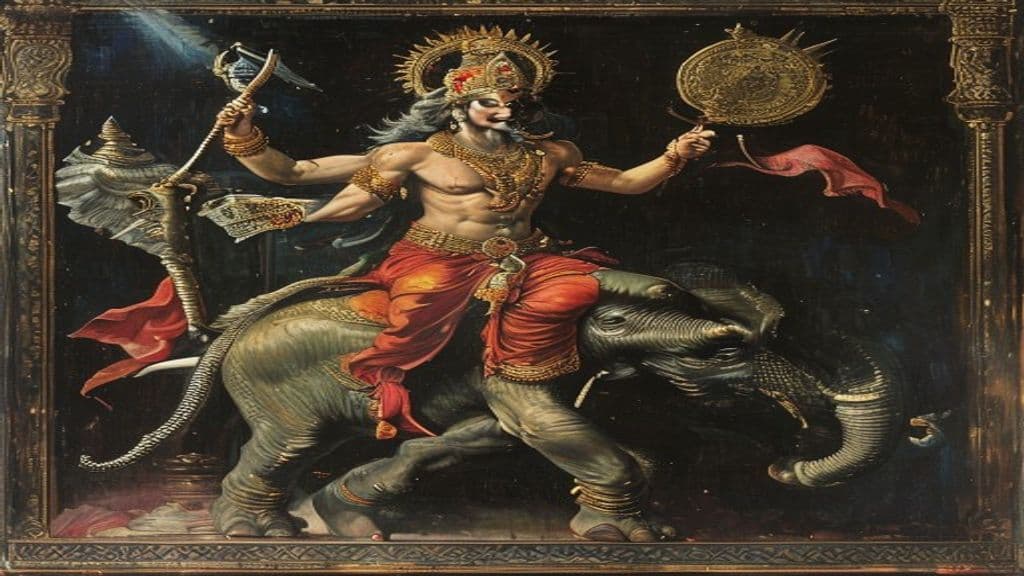
Vāmadeva
Vāmadeva is a Vedic rṣi (seer) attested as the author of Mandala 4 of the Rigveda and later as a teacher, priest, and moral-ritual authority in Upanishadic, epic, and Purāṇic narratives. Texts record him composing hymns, advising kings, issuing curses and boons, and acting within hermitage and court settings.
Aun the Old
Aun (Old Norse: Aunn inn gamli; Latinized Auchun) is a legendary Swedish king of the Yngling dynasty attested in Old Norse sources (Ynglingatal, Ynglinga saga in Heimskringla, and Historia Norwegiae). He is portrayed as a mortal ruler who prolonged his life by performing human sacrifices to the god Odin until his community refused a final offering.
Aunt Em (Emily Gale)
Aunt Em (Emily "Em" Gale) is a fictional human character in L. Frank Baum’s Oz series, the married partner of Uncle Henry and the guardian/aunt of Dorothy Gale. Presented as an ordinary Kansas farmwife whose life is altered by Dorothy’s voyage to Oz, she later relocates to the Emerald City and is given a ceremonial civic occupation there.
Aura
Aura (Ancient Greek Αὔρα, plural Αὔραι) is a minor Greek and Roman divine figure personifying a cool breeze. She appears both as an individual breeze-nymph in literary accounts (most fully in Nonnus) and as a class of breeze-spirits (Aurae) in other sources and lexica.
Aura (paranormal)
Auras are described in modern esoteric and New Age sources as subtle, nonmaterial emanations or energy fields that surround living beings and objects, presented as part of a 'subtle body' and used diagnostically to indicate health, personality, or moral/spiritual state. The concept was popularized in late-19th/early-20th-century Western occultism (notably Theosophy) and later adapted by New Age and holistic-health practitioners; scientific investigation finds no reproducible evidence for literal aural perception and offers physical explanations for photographic effects often labeled as 'auras.'
Aurboða
Aurboða is a jötunn (giantess) in Norse mythology attested as the wife of the jötunn Gymir and mother of the jötunn Gerðr; the name also appears separately as one of the nine maidens in the poem Fjölsvinnsmál. Her name is debated etymologically as either 'gravel-bidder' (aurr + boða) or, in an alternative reading, 'gold-bidder' (aur + boða).
Aureily
No evidence in the provided sources supports treating 'Aureily' as a folkloric or supernatural entity. The string appears in the sources either as part of Latin-derived numismatic terminology ('aureus' / 'aurei' — a Roman gold coin) or as a contemporary image-credit/creator name in commercial media; neither source presents origin, appearance, powers, or ritual material for an entity called 'Aureily'.
Aurora (Sleeping Beauty)
Aurora is the princess protagonist of the Sleeping Beauty tale as popularized in Charles Perrault's literary tradition and later by the 1959 Disney film and stage/ballet adaptations. She is a mortal royal whose fate is determined by the interventions of beneficent and maleficent fairies, most notably being placed under a death-sleep curse that is altered to a prolonged enchanted sleep.
Aurvandill
Aurvandill is a figure attested in medieval Germanic onomastics and Norse narrative, most famously remembered in an Old Norse tale where Thor carries him across icy rivers and his frozen toe is cast into the sky as the star called Aurvandils-tá. Comparative linguistic study reconstructs a Common Germanic name associated with dawn or the morning star.
Auseklis
Auseklis is a named youthful celestial being in Latvian folk-song tradition (dainas), associated with the dawn and a particular eight-pointed star emblem. He appears among the Dieva dēli (sons of Dievs) as an attendant of the Sun (Saule), a suitor in the mythic 'celestial wedding', and a participant in household-like sky rituals.
Austri, Vestri, Norðri and Suðri
A quartet of named dwarfs in Old Norse cosmology positioned at the four cardinal points who are described in medieval sources as holding up the sky after the gods made heaven from Ymir’s skull. They function as structural/cosmogonic supports and are attested in the Prose Edda and the Dvergatal of Völuspá, with echoes in skaldic kennings and in later scholarly interpretation linking their role to roof-beam terminology.
Autochthe
Autochthe (Ancient Greek: Αὐτόχθη) is a minor mythological princess of the Perseid line, named in classical genealogies as a daughter of Perseus and Andromeda. In some traditions she is said to have married Aegeus of Athens and borne daughters but no sons, and her chief narrative role is as a dynastic connector between ruling houses (Argos/Mycenae and Athens).
Community Record
- [1]Rig-Veda, Book 8: HYMN LXVI. Indra.. Rig Veda, Book 8: Hymn LXVI (translation excerpt containing 'Aurṇavābha')literary
- [2]At-Az: Index to 'The Secret Doctrine'. Index entry listing 'Aurnavabha Acharya, Vedic commentator, on Vishnu’s three strides I 112' (Theosophical index)other
- [3]SD References - Volume 1. Reference stating: 'The second writer, Aurnavabha, interprets Vishnu's three strides as the rising, culmination, and the setting of the sun.' (SD References - Volume 1)other
- [4]Vamana (Wikipedia) — contains links to avatara material. Wikipedia entry (used in the cited research notes as a contextual link for avatara and related Vedic/mythic material)wiki
- [5]Avatara — Mythology and folklore encyclopedia entry. Reference work on avatara motifs cited in the research notes; contextual background for interpretive traditions.other
- [6]SED - note on Nirukta and index entries. Bibliographic note referenced in the research material indicating absence of Aurnavabha in certain traditional lists (SED)other
- [7]Vedic Reader - Few Excerpts. Excerpt collection cited in the research notes as part of the corpus referencing Vedic names and passages.other
- [8]Knowing Indra | mAnasa-taraMgiNI (blog post). Scholarly-blog commentary on Indra and related hymnic catalogues; cited in research notes for contextual background.other