
The supplied sources contain no origin story, genealogy, or mythic narrative for an entity named 'Az'. The only relevant material in the corpus treats 'demon' as a broad category (see Source 1) and describes Avestan daevas as Zoroastrian supernatural beings to be rejected (Source 11). Beyond noting that many traditions feature harmful unseen beings, there is no source-provided origin for 'Az' specifically.
No source in the provided material gives a physical or visual description of an entity named 'Az'. General treatments of 'demons' in the corpus do not supply consistent appearance details that can be attributed to a specific being called 'Az'.
There are no source-attested, specific powers or behaviors for an entity named 'Az'. By analogy to the general category discussed in Source 1, demons are often conceived as malevolent supernatural entities capable of harming humans and, in many traditions, causing possession that may require exorcism; however, these are category-level observations and not documented abilities of a named being 'Az'.
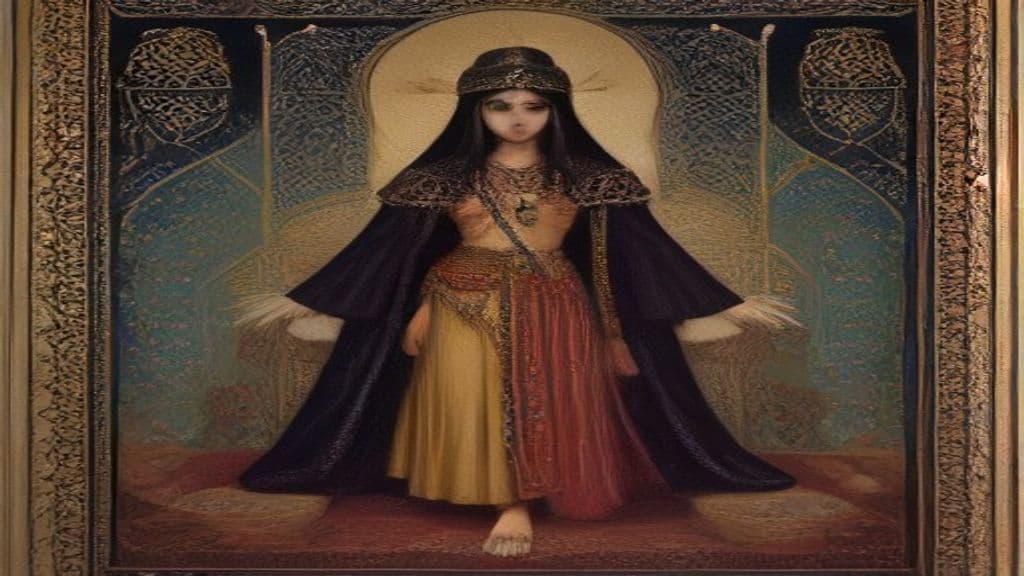
Daeva
In Zoroastrian and Iranian tradition, a daeva (Avestan daēuua) is a class of supernatural being that the Zoroastrian revelation repudiates; in the oldest texts they are 'gods that are (to be) rejected' and in later tradition they come to be depicted as divinities promoting chaos and, ultimately, as personifications of evil.

Djinn
The class of supernatural beings created from smokeless fire in Islamic cosmology — a parallel civilization to humanity, capable of belief or unbelief, with their own prophets, society, and judgment before God.
Ayida Wedo
Ayida Wedo is a primordial rainbow-serpent loa of Haitian Vodou (with counterparts in Fon and Ewe vodun) associated with water, the rainbow, and the elemental forces; she often appears paired with Damballa as the dual cosmic serpent that assisted the creator in forming and upholding the world.
Ayizan
Ayizan is a racine (root loa) in Haitian Vodou and related West African-derived Vodoun traditions, functioning as the archetypal mambo (priestess) and a guardian of ritual order, initiation (kanzo), and the transmission of sacerdotal implements such as the asson. She is also associated with the marketplace and commerce and is syncretized with the Catholic Saint Clare.
Ayla Ranzz
Ayla Ranzz is a DC Comics character and member of the Legion of Super-Heroes. Across multiple publication continuities she is portrayed as a Winathian Legionnaire whose powers alternate between electrical manipulation and gravity/anti-gravity effects; she is the sister of Garth (Lightning Lad) and Mekt (Lightning Lord).
Aymara people (tradition)
Aymara cultural and ritual traditions of the high Andean Altiplano centering on long-term place-based continuity (Lake Titicaca, Tiwanaku), ancestor mortuary practices (chullpas), oral and musical repertoires, and distinctive linguistic cosmologies that shape how the community apprehends time, space, and relations with powerful places. The supplied sources do not record a single named supernatural entity; this entry documents the ethnographic and cosmological context relevant to Aymara beliefs about ancestors, sacred places, and ritual practice.
Ayyappan
Ayyappan is a Hindu deity venerated as a youthful warrior-yogi and protector of dharma, prominent in Malayalam folklore and centered on the Sabarimala pilgrimage. He is traditionally described as born of Shiva and Mohini (the female avatar of Vishnu) and functions as a reconciliatory figure between Shaiva and Vaishnava traditions.
Ayyur
The string 'Ayyur' (also attested as Ayur, Ayoor) appears in the supplied sources only as a toponym and as part of bibliographic or archival titles; the provided materials contain no evidence that Ayyur is a mythological or supernatural entity.
Azadeh
Azadeh (Persian: آزاده) is a Persian female given name meaning broadly 'free' or 'free-minded'; some sources also gloss it as 'someone noble'. The name appears in modern Iranian usage (borne by several contemporary public figures) and as the name of a character in Ferdowsi's Shahnameh. It is a personal name rather than a supernatural being in the provided sources.
Azan
No mythological or folkloric information about an entity named 'Azan' is present in the supplied sources. The string 'Azan' appears in the provided materials primarily as an alternate spelling of the Islamic Adhan (call to prayer) and in modern media titles; there is no documented mythic persona, attributes, or traditions available in these sources.
Azariah
Azariah (Hebrew: עֲזַרְיָה ‘Ǎzaryāh, 'Yah has helped') is principally a theophoric Hebrew personal name borne by multiple figures in biblical, apocryphal, and modern contexts. In the provided sources it appears as the name of a prophet in 2 Chronicles 15:1–8, as an alias used by the archangel Raphael in the Book of Tobit, as a guardian-angel name in modern private revelation, and as the name of various priests, kings, and later individuals.
Azariah IV
Azariah IV is presented in the supplied materials as a label applied to a biblical/historical person bearing the theophoric name Azariah (Hebrew Azaryah/Azari'ah). The sources do not treat Azariah IV as a supernatural being; rather, Azariah is one of several individuals named in Israelite genealogies, priestly lists, and prophetic narratives (e.g., 1 Chronicles 6; prophetic episode with King Asa).
Azatiwada
Azatiwada was a historical late-Hittite (Neo-Hittite) dynast — a local ruler of the Karatepe (Karatepe-Aslantas) fortress in Cilicia whose bilingual Phoenician–Luwian inscription (the Karatepe or Azatiwada inscription) records building works, dedications, and administrative/ritual formulae.
Azazel
In earliest biblical usage Azazel is a ritual locus or destination in the Yom Kippur scapegoat rite to which communal sins are sent; in later Second Temple and subsequent Christian and Islamic receptions Azazel becomes personified as a fallen angel associated with rebellion and the transmission of forbidden knowledge to humans.
Community Record
- [1]Demon. Wikipedia contributors, 'Demon', Wikipedia, The Free Encyclopediawiki
- [2]Daeva. Wikipedia contributors, 'Daeva', Wikipedia, The Free Encyclopediawiki
- [3]Research notes (corpus assessment). Compiled research notes provided for this entry (no direct attestations of 'Az')other