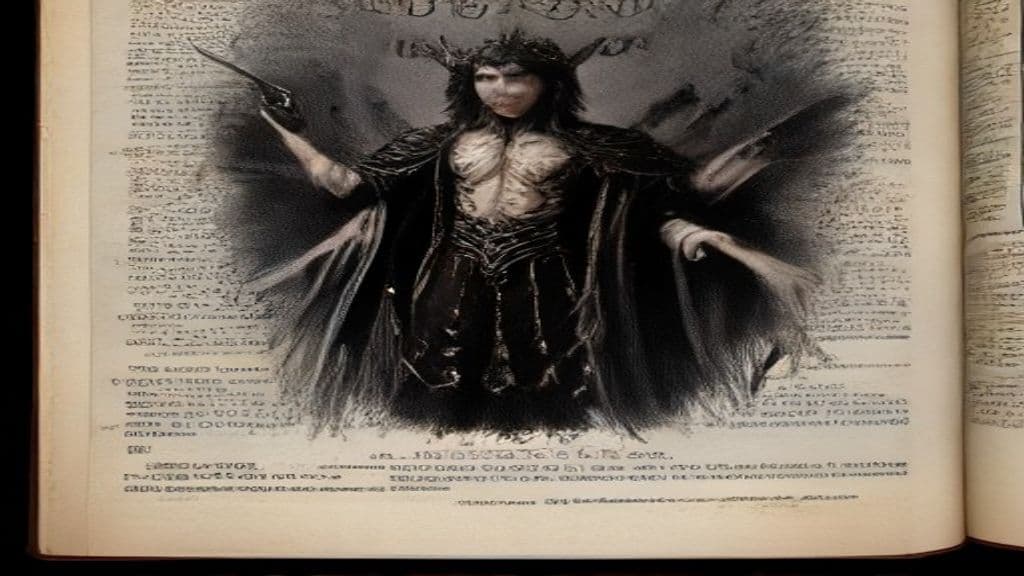
Within the corpus of post‑medieval European ritual grimoires and demonological compilations cited in the supplied materials, Bael appears as a cataloged infernal ruler. He is named and ranked in works such as the Pseudomonarchia Daemonum and The Lesser Key of Solomon (the Lemegeton), where he is presented as the opening or first spirit in some lists; he is also included later in reference works such as the Dictionnaire Infernal. The supplied sources treat Bael as a literary/ritual entity within these demonological taxonomies rather than providing an indigenous mythic origin story.
The supplied excerpts provide only sparse descriptive details. Summaries cite Bael as a king characterized by a hoarse voice. Illustrations associated with later reference works (for example, the Dictionnaire Infernal as noted in secondary summaries) exist in the reception history, but the provided materials do not contain consistent primary‑text pictorial descriptions and note that such images are later or secondary renderings.
In the excerpts examined, Bael is presented primarily by name and rank (a king) with an identifying vocal characteristic (hoarse voice). The supplied materials do not include the fuller grimoire entries (sigils, specific powers, or procedural conjurations) that would ordinarily enumerate magical functions or abilities. Some modern secondary sources and gaming adaptations attribute commands of legions or martial roles, but those claims are derivative and not corroborated in the primary demonological excerpts provided.
Botis
Botis is a named spirit from Renaissance and early modern ceremonial grimoires, variously ranked as a President, Earl, or Count. Appearing in sources such as the Ars Goetia (Lesser Key of Solomon), the Pseudomonarchia Daemonum, the Munich Manual of Demonic Magic (as Otius), and mentioned in the Grand Grimoire as subordinate to Agaliarept, he is summoned by ritual operators to answer questions, reveal knowledge, and reconcile allies and enemies.
Bune
Bune is a ducal spirit in European grimoire tradition, listed in works such as the Lesser Key of Solomon, Pseudomonarchia Daemonum, Dictionnaire Infernal, and the Livre des Esperitz. Described as commanding many legions and able to move the dead, confer wealth, and grant eloquence and wisdom, Bune functions as a summonable operant office within early modern ceremonial magic.
Gemory (Gremory)
Gemory (also Gremory, Gamori, Gomory, and variants) is a named Goetic spirit catalogued in medieval and early modern European grimoires. Described as a crowned woman riding a camel, she is attributed powers over hidden treasures, knowledge of past/present/future, and procuring love; her rank and legion counts vary between sources.
Paimon
Paimon is a high-ranking spirit from early-modern and medieval European grimoire traditions (notably the Ars Goetia and related compilations). He is depicted as a king who rules other spirits, teaches sciences and secret knowledge, and can be summoned and compelled by ceremonial operators within the ritual corpus.
Badb
Badb is an Irish supernatural female figure associated with warfare, death, and prophecy. She commonly appears as a crow or raven and as a wailing omen, acts on battlefields to sow confusion and foretell slaughter, and is often treated as one member of the triadic Morrígna.
Badoon
The Badoon are a fictional reptilian extraterrestrial species and interstellar polity in Marvel Comics, created by Stan Lee and John Buscema and first appearing in Silver Surfer #2 (October 1968). In the comics they function as a technologically advanced, spacefaring empire notable for strict gender-segregated societies (the Brotherhood and the Sisterhood) and recurring roles as conquerors and antagonists in Marvel's cosmic milieu.
Badrock
Badrock (Thomas John McCall) is a fictional superhero from Image Comics who, as a transformed 16-year-old, possesses a body of organic rock and serves as a member of teams such as Youngblood. He appears across Image Comics titles and crossovers, participating in team-based national-security level missions and occasional metaphysical storylines.
Baduhenna
Baduhenna is a named female deity attested once in Tacitus (Annals) as having a sacred grove (lucus) in ancient Frisia; modern scholarship interprets her name as linking a battle element with the matronal name-element and therefore views her as a local matron-like goddess with associations to war and a cult-site.
Baetyl
A Baetyl is a sacred stone believed to be the dwelling place of a god or deity in ancient Greek tradition, often housed in temples and venerated for its spiritual significance. (Note: 1. Power tier: Primordial (as it houses deities, indicating a higher power level) 2. Abilities: Remove claim that Baetyl's "potentially imbue them with supernatural powers and abilities" as this is no)
Bagalāmukhī
Bagalāmukhī (also Bagalā, Pitambarā-devi) is a Tantric Hindu goddess counted among the ten Mahāvidyās. She is a manifestation of the Dēvī whose specialized power (stambhana) is invoked to immobilize, silence, or control enemies and hostile speech, and to grant certain siddhis to devotees.
Bagdana
Bagdana is the name of a supernatural being attested in early medieval Mesopotamian Jewish magical texts. The name occurs on Aramaic incantation texts and on incantation bowls from Nippur, where it appears among named spirits addressed by ritual practitioners.
Bagh Bhoot
No folkloric information about an entity called 'Bagh Bhoot' is available in the provided source. The only occurrence in the source is the film title Bhooth Bangla (2026), which does not supply ethnographic, descriptive, or ritual data about a supernatural being by this name.
Community Record
- [1]Bael (demon) — Wikipedia. Wikipedia: Bael (demon) — notes Bael appears in The Lesser Key of Solomon and the Pseudomonarchia Daemonum (where he is the first spirit mentioned) and in the Dictionnaire Infernal; describes him as a hoarsely voiced king.wiki
- [2]Baal — Thelemapedia (summary excerpt). Thelemapedia summary — notes ambiguity that the name Baal/Baal' can refer to multiple figures and references the Dictionnaire Infernal illustration of Baal; cautions about varied uses of the name.other
- [3]Names of the Goetia demons (list). Names of the Goetia demons — situates Bael within rosters used in later occult compilations and lists of named spirits associated with The Lesser Key of Solomon tradition.other
- [4]Bael Demon Names List — HellHorror (derivative entry). HellHorror entry — modern/derivative source that ascribes additional attributes (e.g., suggested paraphernalia) not corroborated in the primary demonological excerpts and therefore treated as speculative in the supplied notes.other
- [5]Bael Demons | The Neverwinter Vault (game material). Neverwinter Vault — modern gaming adaptation that reuses the name Bael for fictional creatures; included in the source set but noted as derivative and not as primary grimoire evidence.other