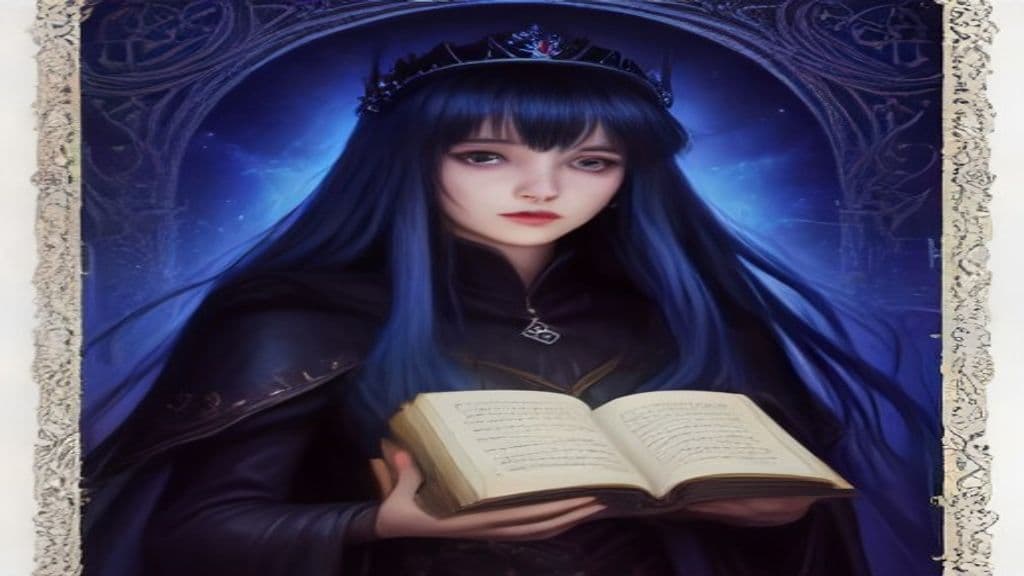
Gemory does not possess a narrative origin tale within the cited materials; rather, she appears as a catalogued spirit across multiple grimoires. She is named and described in compilations such as the Munich Manual of Demonic Magic, the Liber Officiorum Spirituum, the Pseudomonarchia Daemonum, the Lesser Key of Solomon (Goetia), and later works summarized in Dictionnaire Infernal. These sources present her as one of the organized, individuated spirits invoked or catalogued by ritual magicians; they do not offer a mythic birth or genealogy for the entity in the excerpts provided.
Gemory is consistently described in the grimoire summaries as appearing in the form of a beautiful woman wearing a duchess's crown and riding a camel. Several Goetic texts nevertheless use masculine grammatical pronouns when listing such spirits. Some manuscripts (Pseudomonarchia Daemonum and the Lesser Key) report the duchess's crown as placed at the waist; editors Skinner and Rankine have suggested this reading may stem from a mistranslation of Latin cingitur and that the crown likely encircles the head. The provided summaries emphasize the visual motif of a crowned female figure mounted on a camel.
Across the cited grimoires Gemory is attributed the ability to reveal hidden treasures, to answer questions about the past, present, and future, and to procure love from women. The Liber Officiorum Spirituum specifically describes her as "a companion of the love of women, and especially of maidens." Sources assign her a ducal/princely/captain status and credit her with commanding multiple legions of spirits; the number of legions varies between texts (commonly 26 in Pseudomonarchia Daemonum, the Lesser Key, and Dictionnaire Infernal; 27 in the Munich Manual; and differing figures such as 5 or 42 in Liber Officiorum Spirituum).
Weaknesses
- otherNo specific weaknesses listed in the provided sources
Wards
- otherThe cited grimoires and summaries do not supply explicit warding measures or vulnerabilities for Gemory
Bael
Bael (also spelled Baal or Ba'al) is a named kingly spirit appearing in post‑medieval European demonological grimoires. He is listed as the opening or first spirit in some catalogs (notably the Pseudomonarchia Daemonum and The Lesser Key of Solomon) and is described in short summaries as a hoarsely voiced king; fuller ritual texts and attributes are not present in the supplied excerpts.
Botis
Botis is a named spirit from Renaissance and early modern ceremonial grimoires, variously ranked as a President, Earl, or Count. Appearing in sources such as the Ars Goetia (Lesser Key of Solomon), the Pseudomonarchia Daemonum, the Munich Manual of Demonic Magic (as Otius), and mentioned in the Grand Grimoire as subordinate to Agaliarept, he is summoned by ritual operators to answer questions, reveal knowledge, and reconcile allies and enemies.
Bune
Bune is a ducal spirit in European grimoire tradition, listed in works such as the Lesser Key of Solomon, Pseudomonarchia Daemonum, Dictionnaire Infernal, and the Livre des Esperitz. Described as commanding many legions and able to move the dead, confer wealth, and grant eloquence and wisdom, Bune functions as a summonable operant office within early modern ceremonial magic.
Paimon
Paimon is a high-ranking spirit from early-modern and medieval European grimoire traditions (notably the Ars Goetia and related compilations). He is depicted as a king who rules other spirits, teaches sciences and secret knowledge, and can be summoned and compelled by ceremonial operators within the ritual corpus.
Gelanor
Gelanor is a name attested in two distinct contexts in the supplied sources: (1) as an alternate personal name for Pelasgus, an Inachid king of Argos in Greek mytho-historical tradition; and (2) as the Latinized scientific name of a genus of arachnids. Neither source presents Gelanor as a supernatural being.
Gelede (Gẹlẹdẹ)
Gelede is a Yoruba public masquerade spectacle and the ritual institution that honors and manages the spiritual power of 'Mothers' (senior women, female ancestors and deities). As a multi-media performance of carved and painted headdresses, masks, dance and music, Gelede functions to celebrate fertility and motherhood, educate the community, and placate potentially dangerous female powers.
Gello
A child-strangling demoness of Greek and Byzantine tradition, the spirit of a young woman who died before marriage, now preying on pregnant women and newborns.
Gelonians (Geloni)
The Gelonians (Geloni) are described in Herodotus and later summaries as a settled, urbanized people of the forest‑steppe north of the Black Sea who inhabited the city of Gelonus. In Herodotus' ethnographic account they are distinguished from neighbouring nomads by agriculture, crafts, wooden temples, and a triennial Bacchic/Dionysian festival; archaeological verification of some claims (e.g., sanctuaries) is noted as lacking in the supplied sources.
Genderuwo
Genderuwo is a Javanese/Indonesian supernatural humanoid spirit, commonly depicted in modern sources as a large, hairy, muscular creature with reddish or black skin and bulging eyes; it is described as able to appear, disappear, and assume human form. It is treated in regional folklore and popular culture as one member among many named hantu (supernatural beings) in the Malay–Indonesian mythic landscape.
General Ironfist
“General Ironfist” is not a single folkloric or mythic being but a recurring modern fictional epithet or proper name applied to disparate martial characters across games, pulp fiction, comics, and novels. The label signals martial authority, toughness, or fighting prowess in English-language popular media rather than a unified supernatural tradition.
General Sinui
A legendary figure in Korean tradition who attempted to cheat death, but failed. (Note: 1. Power tier: Incorrectly classified as Minor Spirit. Given that General Sinui is a legendary figure who defied death, it's likely he should be categorized as a Greater (powerful regional) or at leas)
Genevieve of Brabant
Genevieve of Brabant (Genoveva, Genoveffa) is a legendary/hagiographic medieval European heroine: a chaste wife falsely accused of adultery who survives execution, lives in exile with her child nourished by a roe deer, and is later vindicated and restored to honour. The tale functions as a moral exemplum and became popular in early modern drama, opera and puppet theatre.
Community Record
- [1]Gemory - Wikipedia. Wikipedia entry summarizing grimoire descriptions (Gemory/Gremory) and variants; reports appearance, powers, rank variations, and Rudd's angelic opposition Poiel.wiki
- [2]Gremory - Wikidata. Wikidata item noting variant name 'Gomory' among forms.wiki
- [3]Gemori | Megami Tensei Wiki. Notes on popular-cultural portrayals and remarks that Gemory is depicted as female in some modern media and that Goetic texts often use masculine pronouns despite female form.wiki