
Accounts of Bahamut appear in medieval Islamic cosmographies and tafsir and in qiṣaṣ literature: compilers such as al‑Thaʿlabi, al‑Qazwini, Yaqut al‑Hamawi, Ibn al‑Wardi, and al‑Damiri (and later summarizers/translators such as Edward Lane) present a created cosmological schema in which God created enormous creatures to constitute the deep, hidden strata beneath the earth. Manuscript traditions vary: some name the fish Lutīyā with byname Balhūt and nickname Bahamūt (as in al‑Thaʿlabi), while other compilers use Balhūt or Bahamūt; scholarly commentary suggests the name was later associated etymologically with the biblical Behemoth, a proposal found in modern references and some source notes. The story functions within explanatory cosmology rather than as a biographical myth of a sentient deity: variants across manuscripts disagree about details (e.g., whether a sandhill separates bull and fish, what lies beneath the fish—water, air, darkness—or whether the serpent Falak lies still deeper), but they consistently place the fish as a deep, created foundation-beast in a stacked, concrete model of the cosmos.
Sources describe Bahamut in piscine terms (Arabic hūt, which can mean fish or whale) as a gigantic fish or huge whale; for example Edward Lane summarizes a traditional simile that all the seas placed in one of the fish's nostrils would be like a mustard seed in the desert. Al‑Thaʿlabi explicitly records a single created animal called a large fish (nūn), a huge whale named Lutīyā, byname Balhūt and nickname Bahamūt. In cosmographic diagrams the fish lies below a bull that bears a gemstone slab and an angel who supports the earth; some manuscript variants insert a sandhill or heap of sand between the bull and the fish. Physical anatomical detail beyond great size and piscine/whale form is not given in the cited texts; emphasis is placed on scale and position within the layered cosmos rather than on fine morphology.
The texts attribute to Bahamut functional, physical roles within a system of cosmic maintenance rather than volitional powers. In the cosmography preserved by Yaqut, Ibn al‑Wardi and related compilers the bull and fish together regulate the seas and earth: the bull's breathing is said to cause the waxing and ebbing of tides; the bull and fish drink the water that runs off the earth into the sea, a mechanism said to counteract rising sea-levels; when these foundation beasts become engorged or agitated their agitation is linked in the sources to earthquakes and, in some accounts, is taken as a sign marking the approach of Judgment Day. These attributions are presented as part of a technical cosmological explanation in the cited medieval sources rather than as demonstrations of independent agency or moral intent.
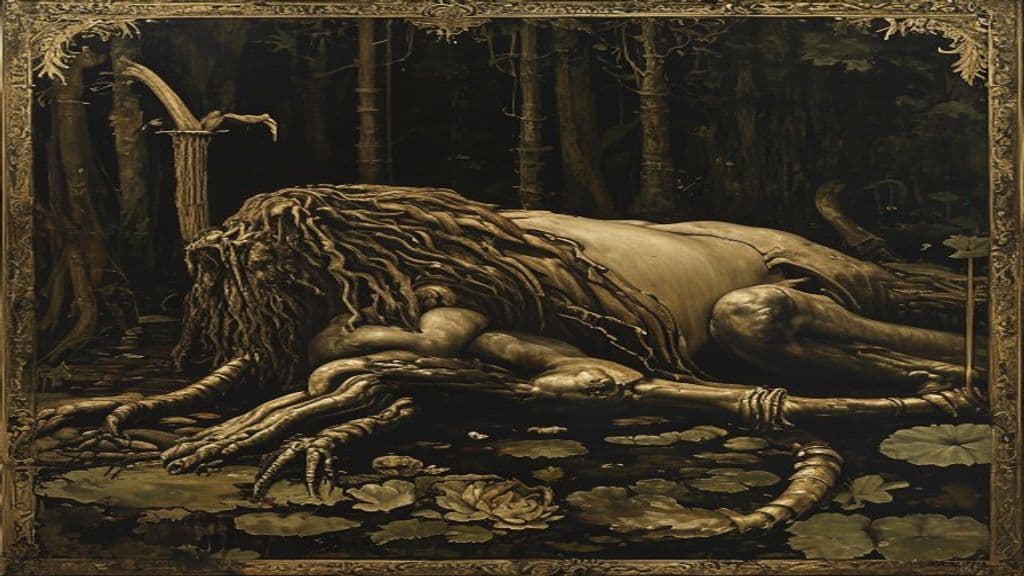
Behemoth
Primordial creature from Jewish tradition, representing chaos-monster or embodiment of primordial forces. (Note: - Power tier should be revised as Primordial is not an official power tier classification; however, given Behemoth's abilities and origin story, it can be re-classified as Ancient (deity-level). - App)
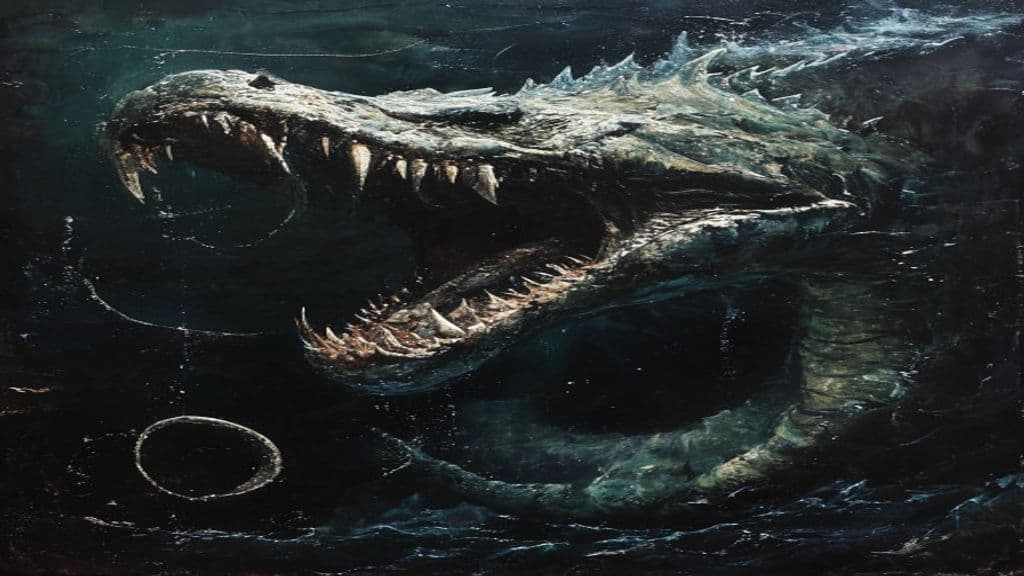
Leviathan
A giant sea serpent in Jewish mythology, embodying chaos and serving as a metaphor for a powerful enemy. (Note: - Power tier should be Ancient (Leviathan's abilities are often described as deity-level, such as threatening the damned after their lives are over and being annihilated) - Appearance is not mentioned)
Baetyl
A Baetyl is a sacred stone believed to be the dwelling place of a god or deity in ancient Greek tradition, often housed in temples and venerated for its spiritual significance. (Note: 1. Power tier: Primordial (as it houses deities, indicating a higher power level) 2. Abilities: Remove claim that Baetyl's "potentially imbue them with supernatural powers and abilities" as this is no)
Bagalāmukhī
Bagalāmukhī (also Bagalā, Pitambarā-devi) is a Tantric Hindu goddess counted among the ten Mahāvidyās. She is a manifestation of the Dēvī whose specialized power (stambhana) is invoked to immobilize, silence, or control enemies and hostile speech, and to grant certain siddhis to devotees.
Bagdana
Bagdana is the name of a supernatural being attested in early medieval Mesopotamian Jewish magical texts. The name occurs on Aramaic incantation texts and on incantation bowls from Nippur, where it appears among named spirits addressed by ritual practitioners.
Bagh Bhoot
No folkloric information about an entity called 'Bagh Bhoot' is available in the provided source. The only occurrence in the source is the film title Bhooth Bangla (2026), which does not supply ethnographic, descriptive, or ritual data about a supernatural being by this name.
Bagha Qaghan
Bagha Qaghan (reign c. 587–588) was the seventh khagan of the First Turkic (Göktürk) Khaganate, recorded in Chinese sources under transcriptions such as 莫何可汗 and the personal name 阿史那处罗侯 (Ashina Chuluohou). He is represented in the sources as a historical political ruler who continued alliance policies with the Sui dynasty, acted as a viceroy of the eastern wing, and led military actions against rivals such as Apa Qaghan and Western Göktürk leaders.
Bagha Shad
Bagha Shad (Old Turkic: 𐰉𐰍𐰀𐱁𐰑, baγa šad; Chinese 莫贺设/莫賀設, mòhè shè) was an early 7th-century Göktürk shad (dynastic prince/general), a close kinsman and subject of the Western Turkic khagan Tong Yabghu, attested in Chinese sources as sojourning in China in 618–626 and probably the father of Böri Shad.
Bahkauv
Aachen-area monstrous figure in Rhineland folklore depicted as an elongated or deformed calf with sharp fangs that lurks near wells, springs, sewers and fountains and traditionally ambushes intoxicated men at night, latching onto their shoulders before attacking. The creature is tied to urban water features in Aachen and appears in civic memory (notably a statue placed over an associated well in 1902 and replaced in 1967).
Bahram (Shahnameh)
Bahram is an Iranian heroic figure in Ferdowsi's Shahnameh, presented as a human warrior and counselor. He is named as a son of Goudarz and brother of Rohham, Giv, and Hojir, and appears in the episode of Siavash as one of Siavash's counselors alongside Zange-ye Shavaran.
Bahubali
Bahubali is a prominent figure in Jain hagiography: a royal scion who renounces worldly rule, undertakes prolonged standing ascetic meditation (kayotsarga), attains omniscience (kevala jnana) and ultimately liberation (moksha) to become a siddha. He is widely commemorated in Jain art and by monumental monolithic statues (notably the Gommateshwara at Shravanabelagola).
Bai Baianai
Bai Baianai is a Turkic‑Altaic protective spirit and sometimes goddess associated with forests, animals, hunters, fishing, fertility and material wealth. In the Yakut/Altai tradition she functions as a patron of hunters and a provider of abundance, yet in some accounts she can punish humans with drought, crop‑burning or livestock disease if offended.
Bai Longma (White Dragon Horse)
A dragon-being from the 16th-century Chinese novel Journey to the West who serves as the monk Tang Sanzang's steed during the pilgrimage and is later ordained to the Buddhist office Babu Tianlong Guangli Bodhisattva. Presented in the narrative as a dragon in horse form or a dragon who takes on the role of a horse/servant.
Bai Suzhen (White Snake)
Bai Suzhen (白素貞), commonly called the White Snake, is a cultivated snake spirit who attains human form and is the central figure of the Legend of the White Snake. Sources present her as a one‑thousand‑year‑old snake spirit who transforms into a beautiful woman, engages in a romantic marriage with a human (Xu Xian), is opposed by Buddhist exorcism in many variants, and in some local traditions is venerated as Madam White Snake (白蛇娘娘).
Community Record
- [1]Bahamut — Wikipedia (summary of medieval Islamic accounts). Wikipedia entry summarizing medieval Islamic cosmography and manuscript variants (citing al‑Qazwini, al‑Thaʿlabi, Yaqut, Ibn al‑Wardi, al‑Damiri, Edward Lane).wiki
- [2]Edward William Lane — paraphrase and summary of Islamic cosmographies (as cited in secondary sources). Lane's English paraphrase (often cited in modern summaries) describing the fish's simile (mustard seed) and recounting traditional stacked cosmography.literary
- [3]Al‑Thaʿlabi (as summarized in assembled materials). Summary of al‑Thaʿlabi's account recording the fish as nūn, named Lutīyā, byname Balhūt, nickname Bahamūt (as cited in the assembled research notes).literary
- [4]Yaqut al‑Hamawi and Ibn al‑Wardi (cosmographical summaries). Summaries attributed to Yaqut and Ibn al‑Wardi linking the fish and bull to tides, sea‑level maintenance and earthquakes; used in assembled notes to describe functional cosmology.literary
- [5]Assembled research notes (compiled source list provided). Consolidated notes summarizing variants, etymological suggestions (connection to biblical Behemoth), manuscript differences, and the absence of ritual/warding material in the cited cosmographies.other