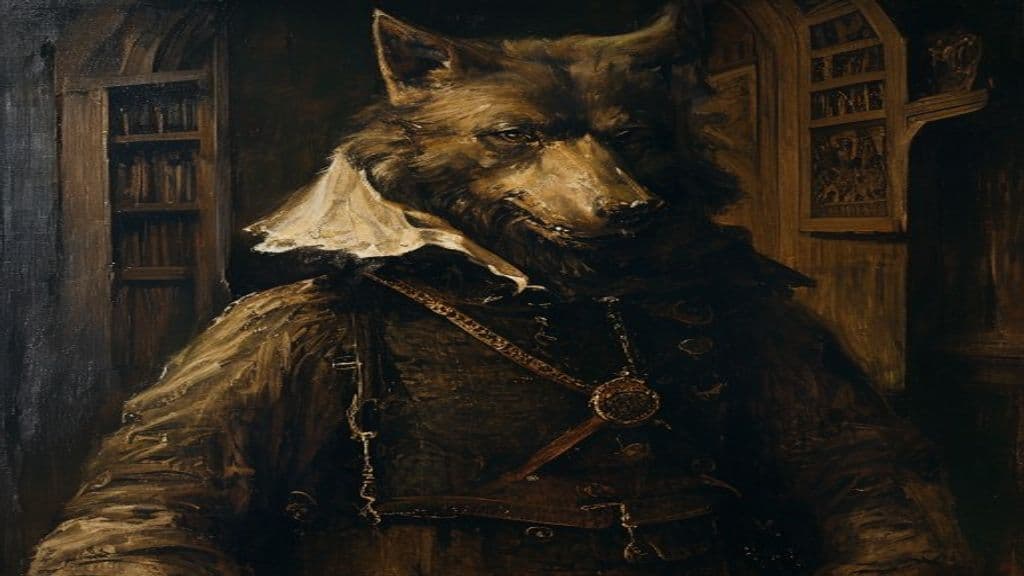
Two distinct registers are recorded in the sampled material. In a folkloric register Beerwolf is presented simply as a German folk-tale monster equated with the werewolf (Werwolf/Bärwolf) without a specific origin narrative given in the available sources. In an intellectual-political register the term is introduced in a 1539 debate arranged by Philip of Hesse and the Elector of Saxony, where Martin Luther used 'Beerwolf' to label the Pope and the Emperor; this rhetorical move was subsequently taken up in Protestant resistance writings, including the 1550 Magdeburg Confession and later Huguenot Monarchomach literature.
The provided sources do not record a distinctive physical description for Beerwolf beyond its identification with the general werewolf tradition. No specific traits (fur, size, posture, or other marks) are attested in the sampled materials; in the political-theoretical register the term functions as a metaphor and carries no physical appearance.
Folkloric sources in the sample do not specify particular supernatural powers or behaviors unique to the Beerwolf beyond its equation with the broader werewolf category (which elsewhere is associated with shape-changing and predation, though such attributes are not documented here). In the political-theoretical register the 'ability' attributed to a Beerwolf is metaphorical: a ruler so described is said to have 'not only broke the law, but overturned the entire moral order upon which it is based,' a status that, in the arguments that use the term, removes ordinary obligations of subjects and can justify resistance up to and including killing the ruler.
Weaknesses
- otherSubject to juridical and doctrinal adjudication (Magdeburg 'Beerwolf' clause)
Wards
- otherProcedural/legal safeguards and collective resistance criteria (as set out in the Magdeburg Confession)
Beckumia
No evidence in the provided scientific and paleontological sources identifies Beckumia as a folkloric or supernatural entity. The supplied documents instead concern mammalian clades and paleontological taxa; therefore no folkloric attributes for Beckumia can be supported from these sources.
Bedivere
One-handed knight and marshal of King Arthur's Round Table, known for returning Excalibur to the Lady of the Lake. (Note: - Power tier should be Greater (powerful regional), as Bedivere is a human character with significant roles within the Arthurian court, but not necessarily on a cosmic or deity-level. - Appearance: Th)
Bedwyr (Bedivere)
Bedwyr (Welsh; Anglicized Bedivere) is a named heroic figure in early Welsh poetry and later medieval Arthurian romances. Presented in the sources as a human warrior and courtier — famed as the one‑handed great warrior Bedwyr Bedrydant in Welsh texts and later as a Knight of the Round Table and Arthur's marshal who, in English versions, returns Excalibur to the Lady of the Lake.
Bee
The bee (Anthophila) is a group of winged insects within the order Hymenoptera, best known as pollinators and, in some species, producers of honey; the provided sources treat bees as biological organisms and as subjects of human husbandry (apiculture/meliponiculture) rather than as supernatural beings.
Beelzebub
Originally the name of a Philistine city-deity of Ekron recorded in the Hebrew Bible (2 Kings), Baʿal-zəḇūḇ was later used in Jewish polemic as a derisive title and appears in Christian texts as a designation for a principal demonic figure (rendered Beelzebul/Beelzebub) often called the 'prince of demons.' Over subsequent centuries the name is incorporated into medieval and early modern demonological hierarchies and literary depictions of infernal powers.
Beeri
Beeri (Hebrew: בְּאֵרִי, Bə’êrî) is a personal name appearing in the Hebrew Bible for at least two distinct human figures: a Hittite father of Judith (Genesis 26:34) and the father of the prophet Hosea (Book of Hosea). Jewish tradition treats the latter as a minor prophetic figure whose brief utterances are traditionally linked to Isaiah 8:19–20.
Befana
In Italian popular and folk culture, the Befana is a witch‑like old woman associated with the Feast of the Epiphany who, on Epiphany Eve (night of January 5), brings sweets to good children and coal to bad children. She is an ambivalent household/seasonal figure involved in domestic and communal Epiphany rituals such as mumming, effigy‑making and bonfires, and her origins are debated between liturgical personification and survivals of older household goddess offerings.
Begoe
Begoe is a scarcely attested named figure in Etruscan religious tradition, recorded in a 19th‑century retelling as able to slay an ox by whispering a sacred name. Modern references sometimes list Begoe as a variant spelling of the better‑attested Etruscan figure Vegoia/Vegoe, but evidence is fragmentary.
Behedety
Behedety is attested in the supplied sources only as an Egyptian deity label; the available materials do not provide mythological narratives, attributes, iconography, cult practice, or functions. One modern musical release uses the name as a title, but offers no traditional information.
Behemoth
Primordial creature from Jewish tradition, representing chaos-monster or embodiment of primordial forces. (Note: - Power tier should be revised as Primordial is not an official power tier classification; however, given Behemoth's abilities and origin story, it can be re-classified as Ancient (deity-level). - App)
Beira / Cailleach
A Gaelic seasonal figure: an old-woman 'hag' who personifies winter, storms, and the shaping of landscape. Known across Ireland, Scotland, and the Isle of Man, she appears in contrast to younger spring/summer goddesses such as Brìgde.
Beithir
In Scottish Gaelic tradition the beithir is a very large snakelike creature—often called a serpent or dragon—associated with mountains, corries and bodies of water. It is portrayed as venomous and deadly in local tales, linked in etymology and interpretation to lightning/thunderbolt imagery, and classed among water-associated monsters (fuath).
Community Record
- [1]Beerwolf. Wikipedia, 'Beerwolf' entrywiki
- [2]Beerwolf (Wikidata). Wikidata item Q4880100other