
The name Baʿal-zəḇūḇ appears in the Books of Kings as the title of a deity worshipped in the Philistine city of Ekron. In the Hebrew/Jewish polemical context the form was treated derisively — commonly glossed as 'Lord of the Fly' — as a way of mocking a foreign Baal. In New Testament usage the name (in forms such as Beelzebul/Beelzebub) is applied to a leading adversarial spirit, the 'prince of demons,' and medieval and early modern Christian writers and occult compilers incorporated the name into hierarchies of fallen angels and infernal princes. Thus the term's history runs from a local city-Baal through polemical renaming to a theological and literary label for a high-ranking demonic power.
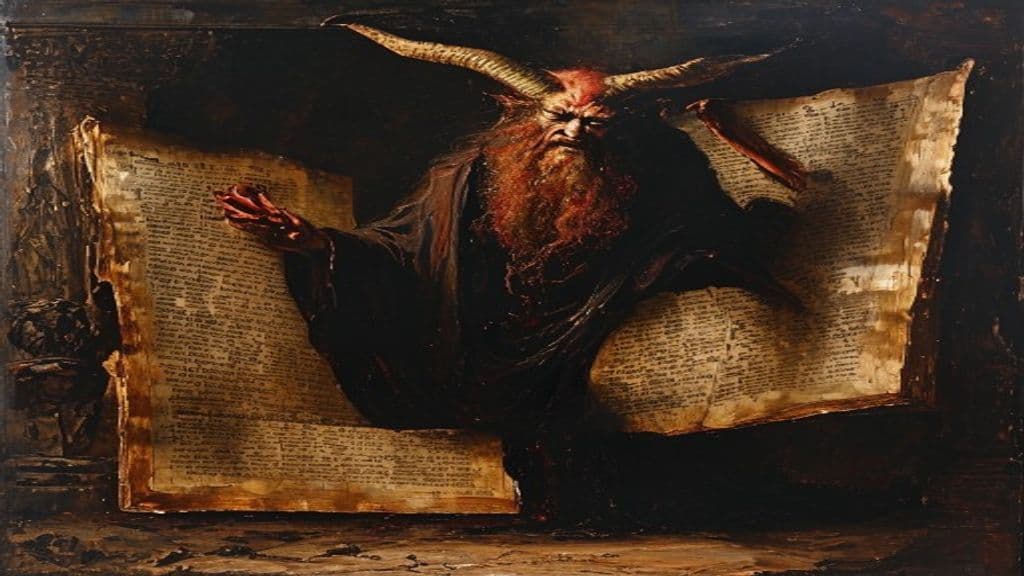
Primary biblical and early sources do not provide a consistent corporeal description. Later demonological summaries and folkloric listings emphasize role and attributes rather than a standardized physical form. Occult and literary treatments (e.g., the Dictionnaire Infernal and Miltonic imagery as reported in summaries) associate the name with fly/flight imagery and with a high-ranking fallen-angelic posture, but no single canonical anthropomorphic description is attested in the provided sources.
In its original context the name denotes a consulted city-deity. In New Testament passages the name functions as the label for the leader or 'prince' of hostile spirits, implying authority over demonic activity. The pseudepigraphical Testament of Solomon (as summarized) attributes to Beelzebul roles such as having once been a heavenly star-associated angel (linked to Hesperus) and causing or inspiring social and moral disorders — inciting lust among priests, jealousy, murders, war, and enabling tyrants — and inducing human worship of demons. Medieval and early modern demonologists and literary authors variably assign Beelzebub to high rank among infernal princes and connect the name with particular vices in differing taxonomies; these attributions vary by author rather than forming a uniform traditional list.
Weaknesses
- conditionDivine authority / Spirit of God (New Testament framing)
Wards
- conditionAppeal to God's authority / exorcism by divine power (as presented in New Testament narrative)

Baal
Baal (bāʿal) is a Northwest Semitic title meaning 'owner' or 'lord' that served as a theonym in the ancient Levant; in Ugaritic and Canaanite texts it appears as the name/title of a prominent storm and fertility god (often rendered Baʿal Haddu) who features centrally in the Baal Cycle and in regional cults tied to rain, fertility, and kingship. In later monotheistic literatures the term becomes a polemical label for rival or foreign deities and is reinterpreted in various receptions.
Satan
A central oppositional figure in Abrahamic traditions who functions variously as an accuser, tempter, tester, and rebel. In earliest Hebrew Bible contexts the term functions as a role within the divine council; in later Jewish, Christian, and Islamic developments the figure becomes a more fully personified adversary who incites humans to sin and leads hostile spirits.

Lucifer
A multilayered figure whose core identity in the cited sources is the planet Venus as the brilliant morning star (Latin lucifer, 'light-bringer' / Hebrew hêlêl, 'shining one'). In later Jewish and especially Christian exegesis the Isaiah image Helel ben Shachar is reinterpreted as a mythic fall motif and becomes associated with a rebellious heavenly being identified with the adversary; this development overlays the earlier astronomical and poetic personification.
Bebryces
The Bebryces (Greek: Βέβρυκες) are a legendary people or tribe attested in Greek mythographic and geographic tradition, primarily located in Bithynia (northwestern Anatolia). They appear in heroic-age narratives as local rulers and warriors—not as supernatural beings—and are associated with episodes involving Heracles, the Argonauts, and named kings such as Amycus and Mygdon.
Beburos
Beburos is a named angel attested in the Greek Apocalypse of Ezra (Revelation of Esdras) as one of nine heavenly beings who will "govern at the end of the world." The figure is non‑canonical and known primarily from this apocryphal source and modern reference glossaries that reproduce the roster.
Beckumia
No evidence in the provided scientific and paleontological sources identifies Beckumia as a folkloric or supernatural entity. The supplied documents instead concern mammalian clades and paleontological taxa; therefore no folkloric attributes for Beckumia can be supported from these sources.
Bedivere
One-handed knight and marshal of King Arthur's Round Table, known for returning Excalibur to the Lady of the Lake. (Note: - Power tier should be Greater (powerful regional), as Bedivere is a human character with significant roles within the Arthurian court, but not necessarily on a cosmic or deity-level. - Appearance: Th)
Bedwyr (Bedivere)
Bedwyr (Welsh; Anglicized Bedivere) is a named heroic figure in early Welsh poetry and later medieval Arthurian romances. Presented in the sources as a human warrior and courtier — famed as the one‑handed great warrior Bedwyr Bedrydant in Welsh texts and later as a Knight of the Round Table and Arthur's marshal who, in English versions, returns Excalibur to the Lady of the Lake.
Bee
The bee (Anthophila) is a group of winged insects within the order Hymenoptera, best known as pollinators and, in some species, producers of honey; the provided sources treat bees as biological organisms and as subjects of human husbandry (apiculture/meliponiculture) rather than as supernatural beings.
Beeri
Beeri (Hebrew: בְּאֵרִי, Bə’êrî) is a personal name appearing in the Hebrew Bible for at least two distinct human figures: a Hittite father of Judith (Genesis 26:34) and the father of the prophet Hosea (Book of Hosea). Jewish tradition treats the latter as a minor prophetic figure whose brief utterances are traditionally linked to Isaiah 8:19–20.
Beerwolf
Beerwolf (also attested Bärwolf, Werwolf) is a German term equated with the werewolf in folkloric vocabulary and separately used as a political-theoretical metaphor in 16th‑century Protestant resistance discourse to designate a ruler who has placed himself outside the moral and legal order.
Befana
In Italian popular and folk culture, the Befana is a witch‑like old woman associated with the Feast of the Epiphany who, on Epiphany Eve (night of January 5), brings sweets to good children and coal to bad children. She is an ambivalent household/seasonal figure involved in domestic and communal Epiphany rituals such as mumming, effigy‑making and bonfires, and her origins are debated between liturgical personification and survivals of older household goddess offerings.
Begoe
Begoe is a scarcely attested named figure in Etruscan religious tradition, recorded in a 19th‑century retelling as able to slay an ox by whispering a sacred name. Modern references sometimes list Begoe as a variant spelling of the better‑attested Etruscan figure Vegoia/Vegoe, but evidence is fragmentary.
Behedety
Behedety is attested in the supplied sources only as an Egyptian deity label; the available materials do not provide mythological narratives, attributes, iconography, cult practice, or functions. One modern musical release uses the name as a title, but offers no traditional information.
Behemoth
Primordial creature from Jewish tradition, representing chaos-monster or embodiment of primordial forces. (Note: - Power tier should be revised as Primordial is not an official power tier classification; however, given Behemoth's abilities and origin story, it can be re-classified as Ancient (deity-level). - App)
Community Record
- [1]Beelzebub - Wikipedia. Wikipedia contributors, 'Beelzebub,' Wikipedia, The Free Encyclopedia.wiki
- [2]Beelzebub - Wikidata. Wikidata entry Q202492 (Beelzebub).wiki
- [3]Beelzebub - Biblical Cyclopedia. Biblical Cyclopedia, 'Beelzebub.'other
- [4]Beelzebub - Alchetron. Alchetron entry 'Beelzebub.'other
- [5]Beelzebub (manga) - Wikipedia. Wikipedia contributors, 'Beelzebub (manga),' Wikipedia, The Free Encyclopedia.wiki
- [6]Archive references (modern media uses of the name). Archive.org items and media referencing 'Beelzebub' in contemporary popular culture (indexed items).other