
In the narratives summarized by the cited sources, devas and humans appealed to supreme divine power to defeat malign asuras. Bhavānī, as a manifestation of Śakti/Devī, is described as arising with martial force empowered by attendant goddesses (the Saptamātṛka) to slay demons named in the tradition (including Matang, Mahishasura and Kukur in the accounts cited). According to the sources, different furious forms were assumed in the course of these combats (see below); locally her principal cult image is said to reside on Yamunachala hill (Tuljapur, Sahayadri range) where the Tulja Bhavani temple stands, a site regarded in the source material as a major Shakta pīṭha and an historical center of devotion.
The principal cult image at Tuljapur is described in the sources as a black stone (granite) murti approximately 3 feet high and 2 feet wide, portrayed as an asta-bhuja (eight-armed) Durga with a beautiful, smiling face, long hair rising from the crown, weapons in multiple hands, a quiver on her back, and one hand in abhaya mūdra (the gesture of reassurance/protection). The sources additionally record that mythic narratives depict Bhavānī assuming other multi-armed, fearsome forms — e.g., Katyayani (10-armed), Mahalakshmi / Devī Çaṇḍikā (18‑ or 1000‑armed in Durgā Saptaśatī citation), Ugrachanda (18-armed) and Bhadrakali (16-armed) — when enacting her warrior aspect.
The cited material characterizes Bhavānī as both the giver of existence (the power that confers bhava) and an agent who destroys evil: she is said to grant life, protection and mercy (karuṇā), to be invoked for liberation (mukti) per Lalita Sahasranamam, and to take fierce martial forms to vanquish asuras (the tradition recounts slaying Mahishasura and other demons). A devotional tradition attributed to Adi Śaṅkara in the sources states that reciting her name with true devotion thrice daily averts sorrow, sin, illness and unexpected death; locally she functions as a kuladevata and a legitimating patron of warriors in some regional histories (per the cited encyclopedia entry).
Weaknesses
None recorded.
Wards
- mantrarecitation of the name 'Bhavani' thrice daily (ascribed to Adi Śaṅkara)
- ritualregular temple worship and participation in festival observances (Tulja Bhavani temple services, Navaratri, Gudi Padwa, Rathasaptami)
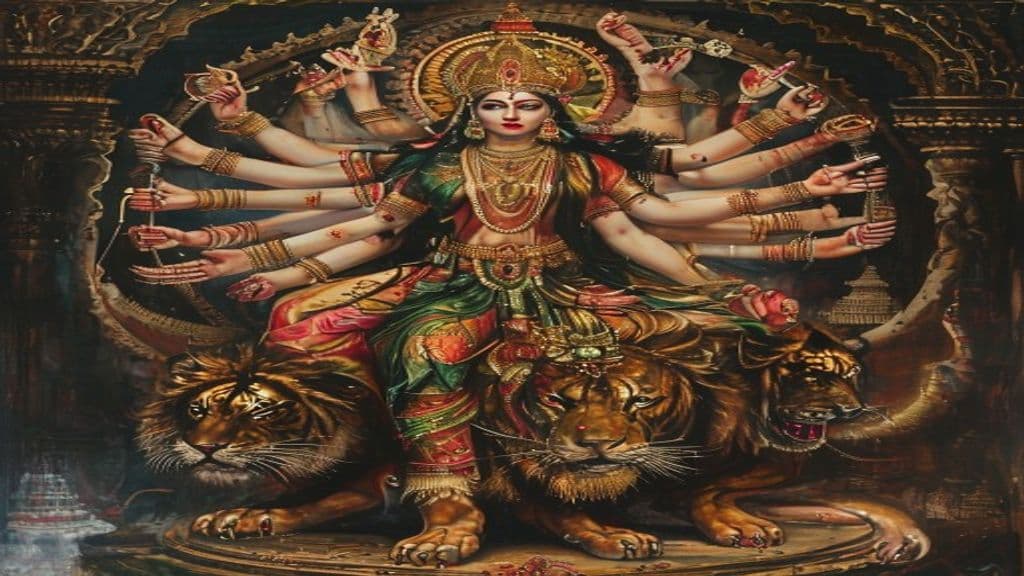
Durga
Durga is a major Hindu goddess, central to the Shakta tradition as an aspect of the Divine Feminine (Mahadevi). She is venerated as a protective, martial mother-goddess who combats demonic forces (notably Mahishasura) to uphold dharma, and is celebrated in major festival cycles such as Navaratri and Durga Puja.
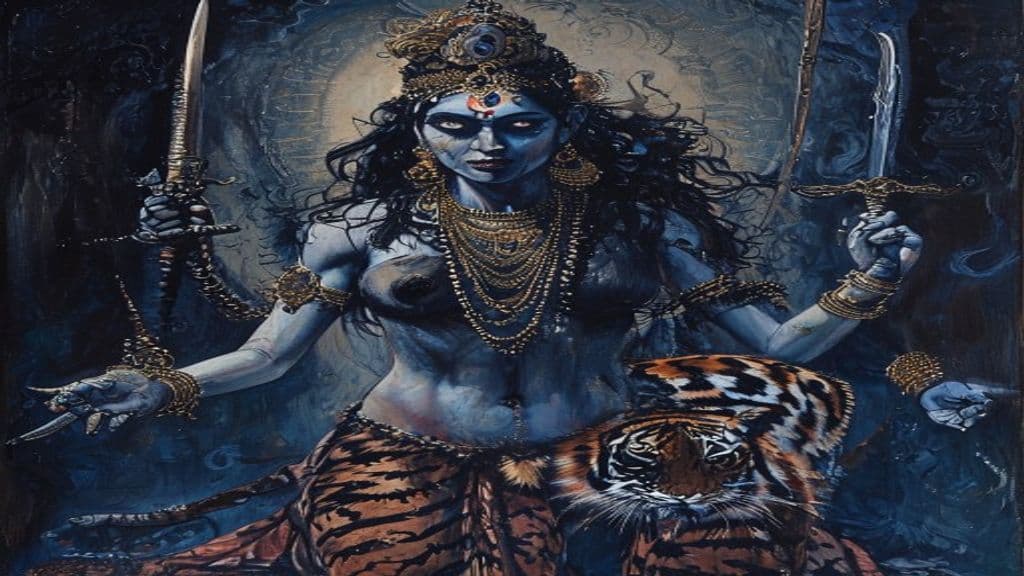
Kali
Kali is a major Hindu goddess associated with time (kāla), death, destruction, and also with liberating knowledge; she appears in Puranic and Tantric texts as a fierce battlefield power and as a protective Divine Mother (Kali Mātā).
Adi (asura)
Adi is attested in modern reference works as the name of an Asura who 'appears in the Matsya Purāṇa.' Beyond this single-line citation in secondary sources, no descriptive material about the figure is provided in the supplied research notes.
Adi Shakti
Adi Shakti (also Adi Parashakti, Mahadevi, Adya Shakti) is the primordial feminine power in Hindu/Shakta theology, regarded as the ultimate reality (Para Brahman) and the source from which all goddesses and gods manifest. She is both an impersonal cosmic principle (Mulaprakriti) and a focus of devotional invocation in temples, mantras, and pilgrimage sites such as Shakti Peethas.
Adi Vinayaka
Adi Vinayaka (Ādi Vināyaka; also called Nara Mukha Vinayaka) is a named iconographic and devotional form of the Hindu god Ganesha portraying the deity with a human head, described in sources as the form before the episode of decapitation by Shiva. It is rarely worshipped and appears in a small number of South Indian shrines and in devotional/musical repertoires.
Aditi
Aditi is a major Vedic goddess in Hindu tradition who personifies the boundless, infinite cosmic principle and functions as the maternal matrix from which many celestial deities (the Ādityas and other groups) are born. In the Vedic hymns she is invoked as a protective liberator who guards petitioners, provides wealth and safety, and frees devotees from hindrances such as sin and sickness.
Agni
Agni is the Vedic personification of fire in Hindu tradition: a sacred, mediating principle that manifests as terrestrial fire, atmospheric lightning, and celestial sun, and that receives and conveys sacrificial offerings. Prominent in the Rigvedic corpus, Agni functions as sanctifier, witness of rites of passage, and a transformational inner principle in later Upanishadic literature.
Ahalya
Ahalya is a mytho-legendary woman of South Asian (primarily Hindu) narrative tradition, described as created by the god Brahma, married to the sage Gautama, seduced (or tricked) by Indra, cursed by her husband, and ultimately redeemed by Rama. Her tale is a locus for themes of creation, desire, curse/penance, and redemption and she is counted among the ritual-mnemonic panchakanya.
Aindri (Indrani / Shachi / Paulomi)
Aindri (commonly rendered in sources as Indrani, also called Shachi or Paulomi) is a Hindu goddess presented as the queen-consort of Indra. She is depicted in the available material as a courtly queen associated with beauty, pride and kindness who also appears in at least one account as an active martial participant in the devas' battles with asuras.
Akhilandeswari
Akhilandeswari (Akhilandeshwari) is a major South Indian manifestation of the Hindu Goddess Adi Parashakti/Parvati, venerated as the presiding goddess of the Jambukeswarar Temple in Thiruvanaikaval. In temple tradition she is portrayed as a penitent/student of Shiva and figures in local legends, ritual schedules, and festivals that emphasize both maternal and fierce aspects.
Akshayavata
In Hindu mythology, Akshayavata is a sacred banyan tree and/or lake that symbolizes eternal life. It is mentioned in both Hindu and Jain traditions and associated with the Puranas. (Note: - The power tier should be "Greater" or at least "Ancient", as it is associated with the Puranas, which are considered ancient texts. - No specific physical description is provided, but that doesn't m)
Alakshmi
Alakshmi is an inauspicious female supernatural figure in Hindu tradition, presented as the negation or shadow-counterpart of the prosperity-goddess Lakshmi. She personifies poverty, grief, jealousy and social discord and is managed in domestic ritual and festival practice.
Alamelu
Alamelu (also Alamelu Manga / Alarmel Mangai) is a South Indian devotional name for the goddess Padmavati, identified in sources as an avatar of Lakshmi and the consort of Venkateswara; the name is also used widely as a female personal name and in titles of cultural works in Tamil and Telugu contexts.
Amrita (Buddhist tradition)
In the context of Indian religions, particularly within Hinduism and Buddhism, Amrita is a divine elixir that grants immortality and eternal life. (Note: - Power tier should be Ancient (deity-level), not Primordial. - Origin story appears accurate but lacks specificity on when Amrita was first mentioned in the Rigveda; add more detail. - Abilities are )
Community Record
- [1]Bhavani - Wikipedia. Wikipedia, 'Bhavani' entry (quoted and summarized passages as provided in research notes)wiki
- [2]Bhavānī - Wikidata. Wikidata entry for Bhavānī (as forms of Parvati listed in provided notes)other
- [3]Bhavani, Tamil Nadu - Wikipedia. Wikipedia entry on Bhavani, Tamil Nadu (referenced in research notes for regional presence)wiki