
The film's opening legend describes Vadhusur as a being who had once been granted immortality by Lord Shiva. According to that narrated legend, after betrayal and death at a wedding (an apsara is implicated in the film's backstory), Vadhusur continued to exist as a vengeful spirit wandering the world and haunting a particular ancestral palace.
Summaries do not give a sustained corporeal description. In the film’s plot Vadhusur most clearly manifests through possession — Madhav becomes partially possessed and functions as Vadhusur’s physical vessel — rather than via a consistently described visible form in the available plot summaries.
Described in the film as granted immortality by Lord Shiva in the narrated legend, Vadhusur is depicted as a persistent, revenge-driven presence that feeds on newly married women and haunts the Acharya Palace. He can possess or partially possess a living person (Madhav serves as his physical vessel in the story). The film presents his dormancy as dependent on continuous sacred mantra playback from an automated device and shows that sabotage or reversal of that device awakens or strengthens him. The plot centers on a ritual scheme in which a thirteenth sacrifice is required to fully resurrect him, and the legend states he could only be killed by his own hand or bloodline; in the climax a bloodline descendant uses a lightning-charged branch from an apsara’s sacred tree to destroy the ritual and the possessed vessel.
Weaknesses
- ritualcan only be killed by his own hand or bloodline
- conditiondormant while sacred mantras are continuously played
- othervulnerable to destruction when the resurrection ritual is undone by a bloodline act combined with a consecrated object (apsara's sacred tree branch, lightning-charged)
Wards
- mantracontinuous sacred mantra playback via an automated device
- conditionhold wedding in daylight and cross the Ganges before sunset (priestly counsel)
- ritualsealing in a prayer room and restarting sacred mantra playback to weaken the spirit during an encounter
- otheruse of consecrated objects (e.g., branch from an apsara's sacred tree) as a counter-agent
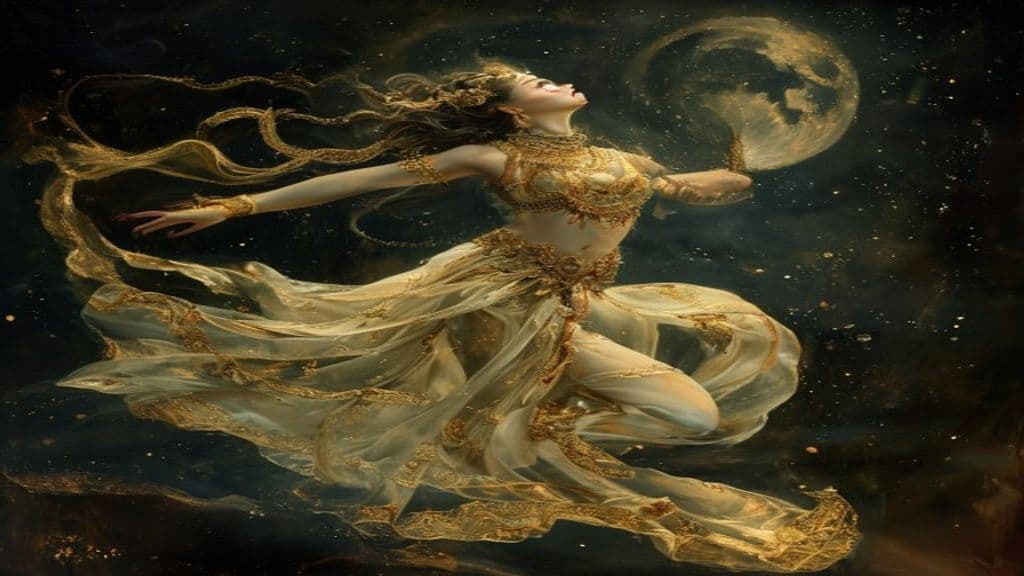
Apsara
Celestial dancers and water nymphs of Hindu cosmology — beautiful semi-divine beings who dance at the court of Indra and, by his command, descend to earth to distract sages from excessive asceticism.
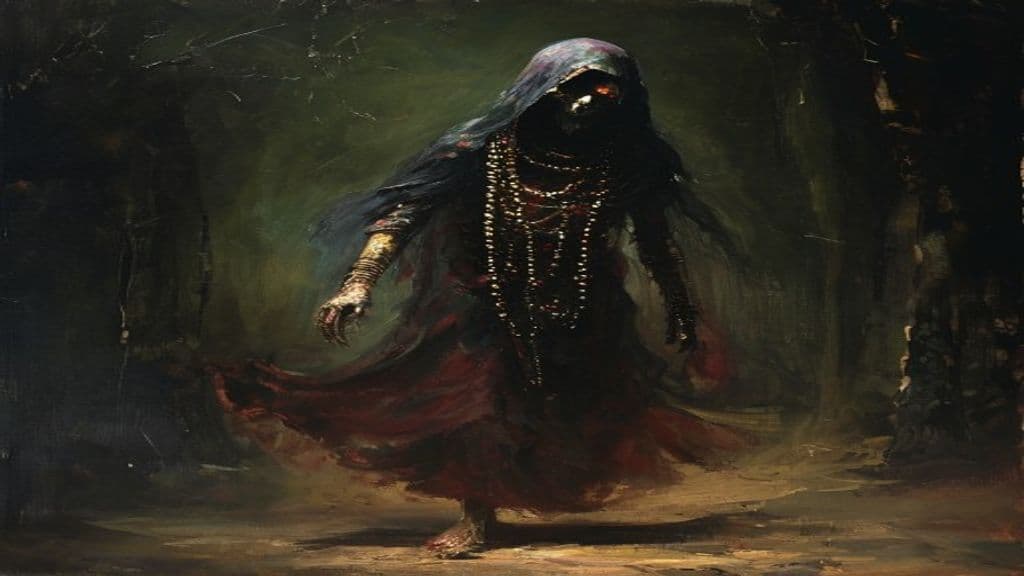
Bhoot (bhoota)
A bhoot (also bhoota, bhoot, bhut) is the culturally specific term across parts of the Indian subcontinent for a perturbed, restless spirit generally understood to be the ghost of a deceased person. Sources describe bhoots as arising when a person's death or post-death circumstances prevent them from moving on — for example violent death, unresolved affairs, or failures in funerary rites — and the term appears frequently in modern South Asian media and discussions.
Utu (Shamash)
Utu, known in Akkadian as Shamash, is the ancient Mesopotamian sun deity who functions as the personified sun, divine judge, protector of travelers, and a god associated with divination; he was especially venerated at Sippar and Larsa and figures in a family of major gods.
Utukku (Utukku Lemnu)
Utukku (Sumerian udug; Akkadian utukku) is an ambiguous class of underworld-born malignant spirits in ancient Mesopotamian tradition. Treated in ritual literature as agents of disease and affliction, they are distinct from the dingir (gods) and primarily addressed through exorcistic texts collectively known as the Udug Hul.
Uumarnituq and Aakulujjuusi
Uumarnituq and Aakulujjuusi are the pair of first human parents in a corpus of Inuit unipkaaqtuat (origin tales). In overlapping Netsilik, Iglulingmiut, Natsilingmiut, Cumberland Sound and Greenlandic variants they re‑populate the earth after a pre‑historical destruction and act as progenitors whose actions (including performance of magic songs called irinaliuti) explain childbirth, gender transformation in specific tellings, and certain social conditions in particular variants.
Uwan
A Japanese yōkai primarily attested in Edo-period illustrated compendia as a grotesque, teeth-blackened humanoid associated with a loud, startling cry rendered as "uwan." Primary evidence is visual; later folkloric accounts add speculative behaviors such as selective audibility and a mimicry-based countermeasure.
Ušum (Ushum)
Ušum (also written Ushum) is a named dragon‑ or serpent‑like monster in Sumerian/Akkadian mythic cycles. In the surviving summaries it appears as one of several monstrous 'warriors' slain by the warrior‑god Ninurta; its corpse is reported as being hung on the seat of his chariot as a demonstration of victory and restored order.
Vadavagni
A supernatural being embodying a submarine fire with the head of a mare in Hindu mythology, associated with destruction. (Note: - Power tier: Greater seems too high given the description as a "submarine fire" and its embodiment by a mare's head; Primordial would be more plausible. - Abilities: The text should clarify that ther)
Vafþrúðnir
Vafþrúðnir is a jötunn (giant) in Old Norse tradition best known from the Poetic Edda poem Vafþrúðnismál as a supremely wise and 'mighty' figure who engages Óðinn in a formal contest of cosmological questions and answers. His name, often glossed "mighty weaver" or "mighty in riddles," evokes skill in entangling speech and lore.
Vagina dentata
A widespread folkloric motif in which a woman's sexual organ is described as containing teeth; narratives frame it as a potential danger during sexual intercourse that can injure, emasculate, castrate, or kill men. The motif functions symbolically across cultures as a cautionary narrative about sex, power, and boundary transgression rather than as a single named supernatural creature.
Vairocana
A principal cosmic Buddha in Mahayana and Vajrayana Buddhism identified with the Dharmakāya (Dharma-body) of all Buddhas; portrayed in sutric literature as an all-pervasive, illuminating principle whose body contains innumerable world-systems and who functions as the source or universal principle from which other buddhas emanate.
Vajranga
Asura and vengeful being in Hindu mythology, born to grant his mother Diti revenge against the devas. (Note: - Power tier: Should be Ancient (deity-level) since Vajranga is said to have a physical form similar to Indra's powerful weapon. - Abilities: "to slay the devas" is mentioned, but no other abilities a)
Vajrapāṇi
Vajrapāṇi is a bodhisattva in Buddhist textual and iconographic traditions who personifies and protects the Buddha’s power. Appearing in early Mahāyāna and some Theravāda texts and in wide-ranging artistic forms (including Greco-Buddhist Gandhāran renderings), he functions as a Dharmapāla, a companion to the historical Buddha, and a tantric yidam associated with the vajra and the seed syllable hūṃ.
Valar
In J. R. R. Tolkien's legendarium the Valar are the greatest of the Ainur who entered the created world (Arda) to shape, govern, and protect it. They are described as the 'Powers of the World'—personified, supreme spiritual beings who implement and elaborate the creator Eru Ilúvatar's themes and who stand above Maiar and the peoples of Arda.
Community Record
- [1]Bhooth Bangla (Wikipedia: plot). Wikipedia: Bhooth Bangla — plot summary describing Vadhusur, his immortality granted by Lord Shiva, feeding on newly married women, automated mantra device, possession of Madhav, thirteenth sacrifice, and bloodline vulnerability.wiki
- [2]Full Bhooth Bangla Article (Archive). Archive: Full Bhooth Bangla Article — compiled plot and production notes referenced in research materials.other
- [3]Bhooth Bangla (YTS synopsis). YTS synopsis summarizing film plot elements including haunting of Acharya Palace and possession incidents.other