
In the Sumerian myth Inanna and Bilulu (extant in a fragmentary form dated to approximately the second millennium BCE), Bilulu and her son Girgire raid Dumuzi's dwelling and are held responsible for Dumuzi's death. Inanna pursues Bilulu, pronounces a curse that results in Bilulu's transformation into a waterskin, and thereafter Bilulu and her son are assigned the role of tutelaries of the desert, charged with informing the deceased Dumuzi whenever libations are poured for him. Scholarly literature treats Bilulu as a personification of rain-cloud/precipitation phenomena; the relationship of Bilulu to the Early Dynastic Ninbilulu and the irrigation deity Enbilulu is debated and subject to sign- and gender-shifts in theonymy.
The literary record supplies no sustained iconographic description. In the preserved myth Bilulu is referred to by the epithet um-ma ("old woman"), and the narrative states that Inanna's curse transforms Bilulu into a waterskin, indicating at least one non-anthropomorphic transformed state. No standardized cult image or detailed anthropomorphic rendering is attested in the supplied sources.
In the mythic episode Bilulu functions as an agent capable of violent action: she and her son Girgire carry out a raid that results in Dumuzi's death. Girgire is interpreted by at least one scholar as a name meaning "lightning bolt," which supports an association with storm/lightning within a precipitation semantic field. After Inanna's punishment Bilulu's assigned behavior is liminal and communicative: as a desert tutelary she is charged to inform the deceased Dumuzi when libations are poured for him. Beyond these narrative roles, later attributions linking Bilulu to water/irrigation theonyms (Ninbilulu/Enbilulu) suggest conceptual overlap with river, canal, and irrigation deities in Mesopotamian textual contexts, though specific cultic functions remain uncertain.
Weaknesses
- othervulnerable to punitive action by higher deity (mythic precedent: Inanna's curse and transformation into a waterskin)
Wards
- othermythic precedent of appeal to a more powerful deity (Inanna) for punishment/restraint

Dumuzi
Dumuzi (Dumuzid; Tammuz/Adon/Adonis in Levantine reception) is an ancient Mesopotamian pastoral and fertility deity, shepherd and consort of the goddess Inanna/Ishtar, whose death/abduction and seasonal absence are tied to vegetation cycles and annual cultic mourning and renewal.
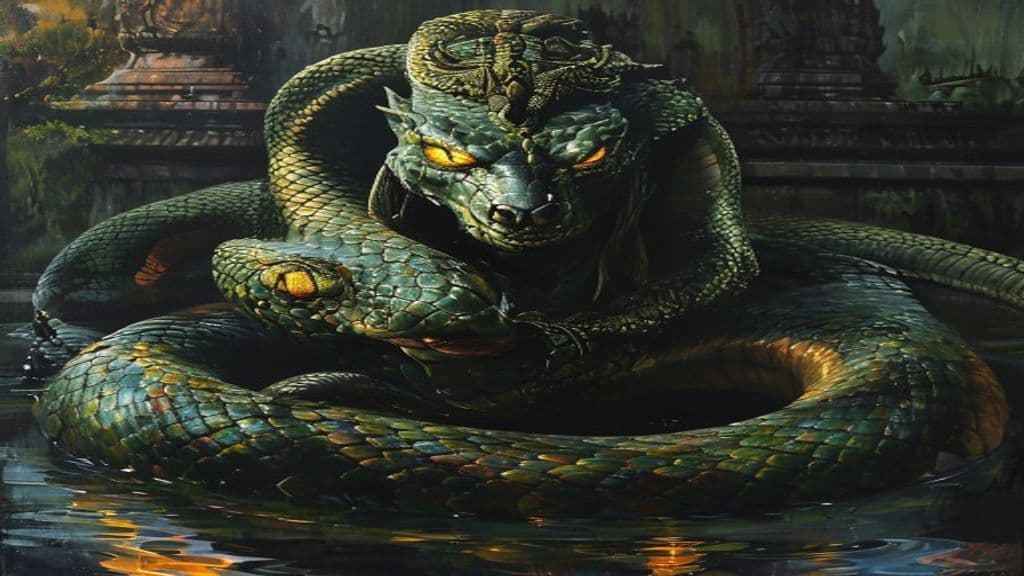
Naga
Divine serpent beings of Hindu, Buddhist, and Jain cosmology — powerful guardians of water, earth, and underground treasures. Revered as deities in South and Southeast Asia.

Enbilulu
Mesopotamian deity responsible for the regulation and distribution of freshwater for irrigation, canals, and rivers. Attested both as an originally independent agricultural specialist (Enbilulu/Bilulu/Ninbilulu forms) and later assimilated as one of the names/aspects of Marduk in Babylonian syncretic theology.
Adapa
Adapa is a mythic figure from ancient Mesopotamian (Sumerian and Akkadian) literature: a mortal fisherman and temple sage of Ea at Eridu endowed with exceptional wisdom. He appears in a fragmentary tale in which he breaks the wings of the south wind and is summoned to the divine court; his name was later invoked in exorcistic and ritual contexts as an authoritative identity.
Aga of Kish
Aga of Kish (Aga, Agga, Akka) is an Early Dynastic Mesopotamian king recorded in the Sumerian King List, the Tummal Inscription, epigraphic objects, and the Sumerian poem "Gilgamesh and Aga." He functions in texts as a historical/legendary political actor who attempted hegemonic demands on Uruk and was ultimately captured and released by Gilgamesh.
Alulim
Alulim is the legendary antediluvian 'first king' of Eridu in Mesopotamian tradition, presented in king lists and mythic compositions as the initial ruler appointed by the gods. He functions etiologically to explain the origin of kingship and, in late ritual texts, is invoked in agricultural incantations associated with driving off field pests.
Alû (Alu)
A named lemma attested in modern reference lists as 'ALU / Alu', but for which the supplied research corpus contains no substantive primary- or secondary-source information about nature, appearance, powers, or rituals in Mesopotamian tradition.
Amurru (Martu)
Amurru, Sumerian Martu, is a Mesopotamian deity who functions as the divine personification of the Amorites. Originating in Mesopotamian textual practice, he is associated with the steppe and mountains, depicted with a crooked staff, portrayed in hymnography as warlike and lightning-armed, and from the Old Babylonian period acquires a prominent exorcistic cultic role.
Ancestors of Enlil (Enki-Ninki deities)
A sequence of Sumerian divine pairs (en-/nin- names) conceived as the primordial ancestors culminating in Enlil; chiefly attested in god lists and invoked as authoritative primordial names in ritual, especially in incantations and exorcisms.
Anshar
Anshar is a Mesopotamian primordial deity whose name (Cuneiform AN.ŠÁR) literally means "whole sky" or "the whole heaven." He functions as an abstract ancestral figure in theogonic genealogies (not actively worshiped as a regular cult deity) and appears in literary contexts—most notably the Enūma Eliš—and in god lists where he legitimizes later supreme gods.
Anu
Anu (Sumerian An; Akkadian Anu/Anum) is the divine personification of the sky in ancient Mesopotamian religion, traditionally ranked at the top of god‑lists as the source of heavenly authority (anûtu/anuti) and the fount of legitimate rule for gods and kings. Though supreme in genealogies and astronomical schema, many periods portray him as a relatively passive or figurehead deity whose active cultic role is limited until a late Seleucid reinvention in Uruk.
Anunnaki
A variable collective of major deities in ancient Sumerian, Akkadian, Assyrian and Babylonian religious literature, described as offspring or descendants linked to the sky god An (Anu) and an earth/mother figure (Ki/Ninhursag). Texts portray them as participants in the divine assembly, decreers of human fate, and in some traditions a group of seven underworld judges; their number, membership, and functions vary across sources.
Anzû (Imdugud)
Anzû, also called dZû or Imdugud, is a large storm-associated bird-figure in Sumerian/Akkadian/Babylonian myth. Portrayed as a hybrid (commonly a massive bird with a lion's head or as a half-human storm-bird), Anzû is credited in mythic narratives with seizing the Tablet of Destinies and thereby challenging the authority of chief gods such as Enlil.
Apkallu (Abgal)
Apkallu (Akkadian; Sumerian: Abgal) are polyvalent Mesopotamian wisdom figures attested as mythic/semi-divine sages (notably a group of seven), as professional human experts (ummânu), and as apotropaic images used in household and cultic ritual. They are closely associated with the god Ea (Nudimmud) as transmitters of secret knowledge and are represented in diverse iconography including fish-man and bird-headed types.
Ara
Ara (Sumerian: A) is a minor Mesopotamian goddess attested as a servant or attendant of the god Enki. Earlier scholarship sometimes conflated her theonym with the attendant deity Isimud, but modern treatments distinguish Ara as a separate divine household figure.
Community Record
- [1]Bilulu (Wikipedia). Wikipedia, entry "Bilulu"wiki
- [2]Inanna and Bilulu (GatewaysToBabylon). GatewaysToBabylon, text: Inanna and Bilulu (excerpt/transcription)literary
- [3]Enbilulu (Wikipedia). Wikipedia, entry "Enbilulu" (discussion used for comparative theonymy)wiki
- [4]Comparative scholarship on dying-god motifs (selected anthologies referenced). Comparative treatments and anthologies cited in the supplied research notes (see bibliography in original materials)academic