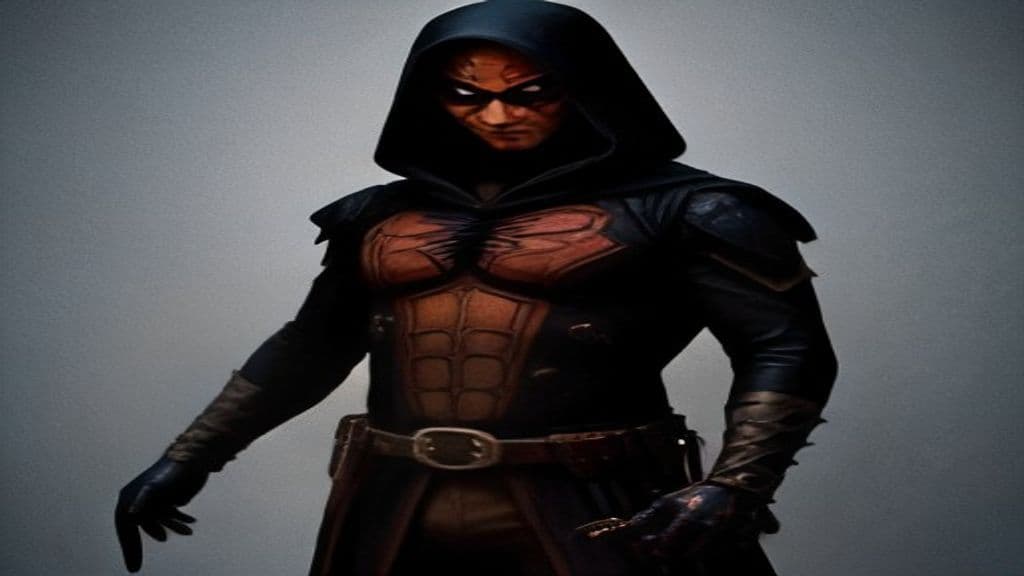
Comic: In DC Comics continuity the Black Spider is principally the costumed identity of Eric Needham, a small‑time criminal and former drug addict whose personal tragedy and hatred of drug dealers lead him to adopt a lethal vigilante role; the character debuted in Detective Comics #463 (September 1976) and has appeared in multiple continuities and reboots (including New 52), sometimes recruited by Amanda Waller into Task Force X / Suicide Squad. Novella: In Jeremias Gotthelf's The Black Spider (published 1842) the spider functions as the consequence of a Faustian pact and communal transgression; summaries indicate that after an individual repeatedly fails to uphold a pact with the Devil and the community engages in morally culpable acts (including unchecked forest clearance), the Black Spider manifests as a plague‑bringing, punitive agent upon the hamlet.
Comic: The Black Spider is presented as a costumed human vigilante/assassin (no supernatural physiology), identified primarily by his costumed persona and armed, trained combatant behavior. Novella: Gotthelf's Black Spider is described in summary accounts as a frightening, supernatural spider‑figure associated with plague and calamity; provided sources give no detailed, consistent physical description of the apparition beyond its menacing/spidery symbolism.
Comic: No supernatural powers are ascribed in source summaries; abilities consist of trained human combat skills, use of weapons, and tactics of a lethal vigilante/assassin, placing him in conflict with nonlethal heroes such as Batman and sometimes bringing him under governmental control (Task Force X). Novella: The Black Spider functions as a supernatural or moral agent that brings pestilence and calamity upon a community as the narrative consequence of a broken Faustian pact and communal sin; sources link it to plague and punitive occurrences but do not enumerate discrete magical powers or mechanics in the summaries provided.
Weaknesses
- conditionhuman nature and law enforcement (comic)
- othermoral/ritual compliance of community (novella)
Wards
- conditioncontainment, law enforcement, and detention (comic narratives)
- otherkeeping covenants / avoiding Faustian bargains (novella tradition)
Black Marvel
The Black Marvel is a Marvel Comics superhero identity first published in 1941. Primarily associated with the civilian Daniel Lyons, the Black Marvel is a Golden Age costumed adventurer whose origin involves tests administered by a dying Blackfeet chief (Man-to) and his medicine man (Running Elk); the character later appears in modern Marvel continuity in storylines involving wartime team-ups, murder and resurrection plots, and a Faustian bargain with the demonic Mephisto.
Black Númenóreans
A human political and cultural faction originating in Númenor in J. R. R. Tolkien's legendarium. They are a villainous offshoot of Númenóreans who abandoned worship of Eru Ilúvatar, rebelled against the Valar, and whose actions led to the Downfall of Númenor; remnants or ideological heirs later acted as tyrants in Middle-earth.
Black Owl
A Golden Age American comic-book costumed hero identity first appearing in Prize Comics #2 (April 1940). The mantle was used by more than one human character (notably Doug Danville and Walt Walters) and also appears as an unrelated modern lexical label for artists, companies, and groups in contemporary sources.
Black Pirate (Jon Valor)
In the DC Comics / Starman continuity, the Black Pirate is the ghost of Jon Valor, a 16th‑century English privateer whose posthumous curse bound the dead of the port that became Opal City until his name was cleared. The label "Black Pirate" also appears outside this fiction as a film title and in various modern cultural references, but those uses are unrelated to the comic-book ghost figure.
Black Shuck
A spectral black dog of East Anglian legend, with glowing red or green eyes. Its appearance is an omen of death. Its howl has been heard on clifftops during storms for centuries.
Black Spectre
Black Spectre is a fictional villain identity used by multiple human antagonists in Marvel Comics, primarily as an adversarial persona opposing the vigilante Moon Knight. The mantle has been adopted by different individuals (not a supernatural being) to carry out criminal, political, and terroristic schemes within contemporary urban narratives.
Black Terror
A Golden Age American comic-book costumed hero identity originating in 1941 as pharmacist Bob Benton who gained powers from a chemical called "formic ethers." Across decades and publishers the identity has been reinterpreted as a powered crimefighter, a vengeful vigilante, an impersonated costume used by agents, and a consciousness housed in a computer program called Terror 2000.
Black Tom Cassidy
Black Tom Cassidy (Thomas Samuel Eamon Cassidy) is a fictional mutant supervillain from Marvel Comics who first appeared in Uncanny X-Men #99 (1976). He is an Irish-born criminal boss and recurring X-Men adversary whose powers center on projection of force through wooden media and, after a medical graft, become plantlike in nature; in later stories he forms a physiological union with the mutant island Krakoa and serves in a security role.
Black Turtle‑Snake (Xuánwǔ / Genbu)
A composite cosmological guardian from East Asian tradition (Chinese: 玄武, Xuánwǔ; Japanese: Genbu) that functions as the northern member of the Four Symbols. Represented iconographically as a tortoise intertwined with a snake, it orders sky and landscape (north, winter, seven lunar mansions) and is venerated in temples, palace gates, and funerary contexts as a protective presence.
Black Volga
A modern urban-legend motif embodied in a black Volga automobile (originally GAZ models) reported across parts of Europe and Eurasia from the 1960s–1970s onward. The vehicle is said in various tellings to abduct and sometimes kill people (often children in some summaries), with motives ranging from political abduction to blood- or organ‑theft; a single verbal formula is recorded in some variants as a way to make the car vanish.
Black Vulcan
Black Vulcan is a fictional African-American superhero created by Hanna-Barbera for the Super Friends animated series (debuting 1977). Presented as an electricity-manipulating costumed hero in the show and later reinterpreted satirically in Harvey Birdman, Attorney at Law, he was created as a replacement for DC's Black Lightning due to rights disputes.
Black Widow (Natasha Romanova / Natasha Romanoff)
A modern popular-culture fictional character originating in Marvel Comics (1964) and later adapted into the Marvel Cinematic Universe; a highly trained human spy and operative whose codename 'Black Widow' denotes a role in espionage and covert operations rather than a supernatural being.
Community Record
- [1]Black Spider. Wikipedia: Black Spiderwiki
- [2]Who's Black Spider?. Who's Black Spider? (blog overview of comic variations)other
- [3]The Black Spider. Wikipedia: The Black Spider (Gotthelf)wiki
- [4]The Black Spider - Alma Books. Alma Books product summary for The Black Spiderliterary
- [5]The forest of the Black Spider – Swiss National Museum. Swiss National Museum blog: discussion of Gotthelf's themesliterary
- [6]Black Spiders. Wikipedia: Black Spiders (band)wiki
- [7]The Bold Black Spider - IndyPlanet. IndyPlanet entry on Golden Age character The Bold Black Spiderother
- [8]Evil Always Awaits: The Black Spider - David J. Goodwin. Critical commentary on Gotthelf's taleother
- [9]BLACK SPIDER | St. John's College. St. John's College bookstore blurb for The Black Spiderliterary