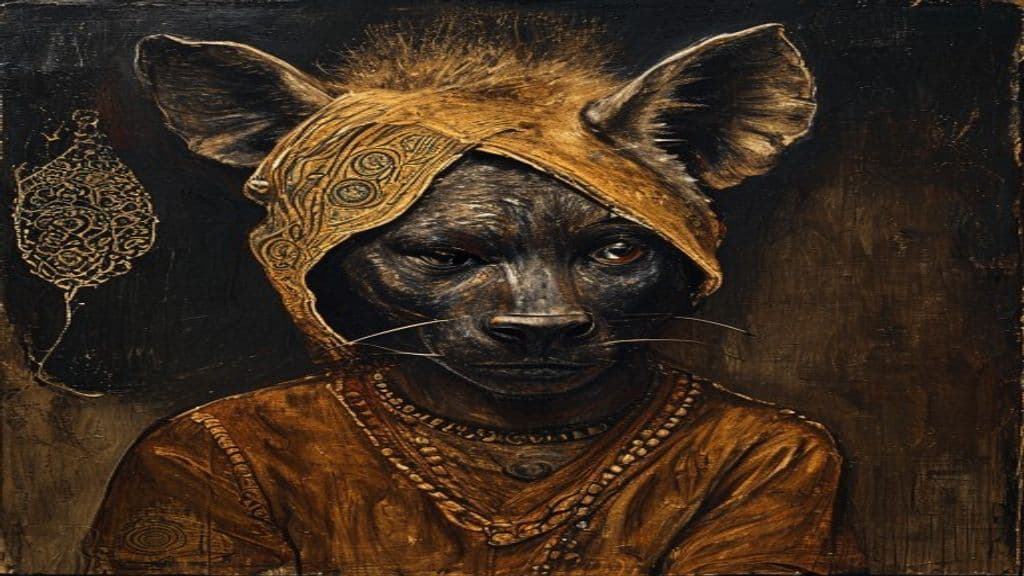
Buda is not presented as a single mythic founder figure but as a transmissible, socially-located power: a named capacity tied to envy and to particular social groups and occupations. Sources describe buda as a power held and wielded by those in a different social group (for example Beta Israel or metalworkers) and link its acquisition to lineage and artisan knowledge in folkloric interpretation; scholarly commentary frames this as a cultural diagnosis whereby specialized craft skill or social marginality is construed as deriving from an ambiguous or malign source. Geographically the concept is centred in Ethiopia and Eritrea and is also reported in related regional contexts (Sudan, Tanzania, and among Berber groups in Morocco).
The primary physical manifestation described in the sources is transformation into a hyena; buda-bearers are said to change into hyenas and to attack while concealing their human identity. The sources do not provide a standardized visual description of the human form of a buda-bearer beyond social and occupational markers—accusations commonly target members of Beta Israel or certain artisan/caste groups such as metalworkers (sometimes labelled with terms like tabib in related contexts).
Buda is credited with two linked harmful capacities: to inflict the effects commonly called the 'evil eye'—causing illness, misfortune, or other harm through envious gaze or magical influence—and to shapeshift into a hyena to attack victims covertly. Sources report that bearers are sometimes described as 'empowered by evil spirit' and that folkloric explanations connect the power's transmission to paternal lineage or artisanal origins; the literature treats buda as a real force that can be countered by religious and magical measures.
Weaknesses
- ritualExorcism invoked in the name of Jesus by an ordained Ethiopian Orthodox priest
- ritualProtective amulets/talismans (kitab) prepared by a debtera
- mantraInvocation of God's name (Christian context)
Wards
- otherKitab (amulet or talisman made by a debtera)
- mantraInvoking God's name
- ritualSeeking ordained priest intervention and exorcism in church settings
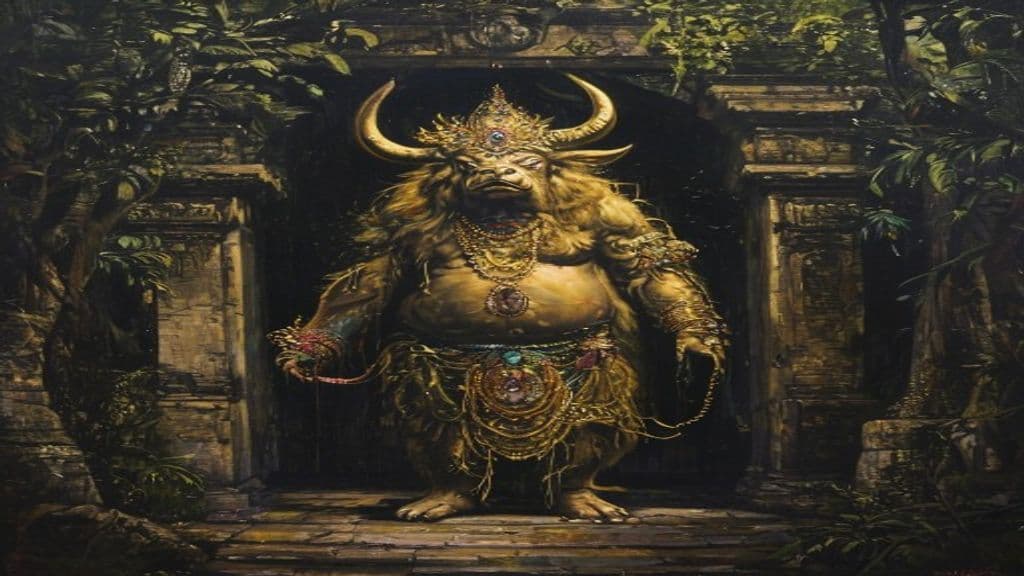
Yaksha
Nature spirits of Hindu, Buddhist, and Jain cosmology — guardians of forests, treasures, and wilderness. Ambivalent beings, capable of great benevolence to the respectful and terrible harm to the greedy.
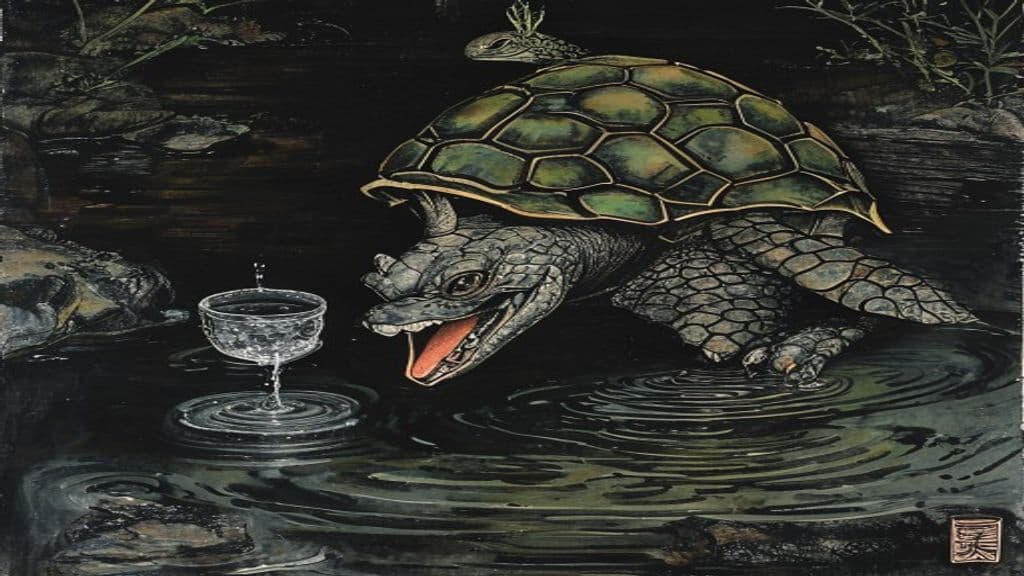
Kappa
A water-dwelling imp of Japanese folklore with a bowl of water on its head. Mischievous but bound by strict codes of politeness; dangerous near rivers.

Ghoul
A ghoul is a demon-like or monstrous humanoid originating in pre-Islamic Arabian religion, traditionally associated with graveyards and the consumption of human flesh. The concept later entered broader folklore and has been widely reused and transformed in modern fiction and popular culture.
Brân the Blessed
Brân the Blessed (Welsh: Bendigeidfran / Brân Fendigaidd, 'Blessed Crow') is a giant-king in the Second Branch of the Mabinogi who functions as a mythic sovereign of Britain. He is depicted as a colossal royal figure associated with the sea and with poetry/bards; after being mortally wounded his severed head remains animate and is used as an apotropaic guardian of the island.
Bubota
Bubota is attested in a small, heterogeneous set of Catalan-language and English-language sources as a feminine ghost or spectral figure invoked in contemporary artistic works and occasional popular references. Available materials classify it as a female-associated spirit and use the term both as a folkloric label and as a cultural/metaphorical signifier; however, primary folkloric narratives, standardized iconography, and ritual practice are not documented in the provided sources.
Bucca
A class of place‑bound supernatural beings attested in Cornish folklore, associated in surviving sources with coastal and mining landscapes and with local occupational culture; the surviving packet of sources is fragmentary and primarily cites an anthology excerpt (Mabel Quiller Couch).
Buchis
The deification of the kꜣ (ka) of the war god Montu, incarnated as a sacred bull in Egyptian mythology. (Note: - Remove "Greater" power tier; no information in source material supports this level of power. - Add sensory cues (e.g., distinctive markings, specific sounds) related to sacred bulls' selection and w)
Buckriders
A South-Eastern Dutch and North-Eastern Belgian tradition describing groups—treated variously as alleged witches and criminal bands—said to have entered pacts with an infernal master and to have 'ridden' bucks/goats by night to commit raids. The motif appears in 18th-century trials and in local folklore linking goat-riding and diabolic Sabbath imagery.
Bucky Barnes
James Buchanan "Bucky" Barnes is a fictional human character created for American comic books published by Marvel Comics (originally Timely Comics). Introduced in 1941 as the youthful sidekick of Captain America, he was later retconned and reinvented in modern comics as the brainwashed cyborg assassin the Winter Soldier before regaining memories and seeking redemption.
Budai (Qieci)
Budai is the nickname of the historical Chinese monk Qieci (契此), a jovial, sack-carrying mendicant whose persona was incorporated into Chan (Zen) Buddhist popular practice and often identified with the future Buddha Maitreya. He functions in tradition as a folkloric saint-monk and pedagogical symbol of abundance, contentment, and accessible awakening rather than as an abstract hostile spirit.
Buddha (Siddhartha Gautama)
Siddhartha Gautama, most commonly called the Buddha, is presented in the provided sources as a historical wandering ascetic and religious teacher of the 6th–5th century BCE who attained nirvana, taught Dharma, and founded the monastic community (sangha) that became Buddhism.
Buddhas of the Ten Directions (Shífāng Fó)
A doctrinal and devotional designation for the manifold buddhas present throughout the Buddhist cosmological field (the 'ten directions'), invoked as fully awakened presences and used as objects of contemplation and repentance in devotional practice.
Budeia
Budeia is a lexical/onomastic term attested in two distinct registers: (1) an ancient Greek mytho-genealogical figure and an epithet of Athena meaning 'oxen-yoker', and (2) a modern Norwegian occupational noun (budeia) denoting the woman who tends the summer farm dairy. The term consistently occupies an agricultural/labor semantic field in both traditions rather than functioning as a singular supernatural entity.
Budha
Budha (Sanskrit: बुध) is the personification of the planet Mercury in Indian astronomical and astrological tradition. He functions both as the observed planetary body whose motions are recorded in classical Sanskrit astronomical texts and as a navagraha deity associated with intelligence, memory, and the weekday Budhavara (Wednesday).
Budini
The Budini (Ancient Greek Βουδῖνοι) are recorded in Graeco-Roman ethnographic sources as a human tribal people of the forest‑steppe north of the Black Sea, associated with the Vorskla river valley and the multiethnic city of Gelonus in the first millennium BC. Classical accounts portray them as a hunting-dependent, linguistically distinct group noted for red hair and blue eyes; some archaeological interpretations tentatively link them to anomalous mortuary deposits.
Community Record
- [1]Buda (folklore) — Wikipedia. Wikipedia, 'Buda (folklore)'wiki
- [2]Wikidata entry for Buda. Wikidata: Q2905079other
- [3]Summary of exorcism practices (Amsalu Geleta, as cited). Quoted summary of Amsalu Geleta on Ethiopian Orthodox exorcism practices as reported in the Wikipedia articlewiki