
In the local folkloric and judicial corpus of the 18th century, the buckriders are presented as people who entered into an oath-bound alliance with an infernal master (referred to in sources as 'the Devil'). Tradition and trial testimony report that the Devil provided them with bucks/goats which they rode through the night; this motif is compounded with earlier European witchcraft imagery of nocturnal goat-riding and attendance at diabolic sabbaths. Historically, the label was also claimed or adopted by criminal bands active in Limburg and neighbouring districts and first appears in surviving records by name in the 1774 'trial of Wellen.'
Accounts emphasize collective imagery of riders astride large bucks/goats and moving through the night sky rather than distinctive individual dress. The goat/buck motif is explicit and ties the buckriders to wider witches' Sabbath iconography (goat-riding and diabolic attendance), while trial confessions describe mounting and flying on such animals.
Sources report that accused buckriders claimed nocturnal aerial travel on bucks/goats and vast, rapid mobility that enabled raids across large distances and return before dawn. Judicial records and later historiography treat these claims as part of confessions—many extracted under torture—and as a folkloric motif that was sometimes appropriated by criminal gangs to intimidate victims. Behavior attributed to them in sources includes organized robbery, extortion, and occasional violence against farms, churches, and isolated households, together with oath-taking and annual meetings with their infernal master (for example, a traditional rendezvous on the Mook Heath).
Weaknesses
- otherCommunity architectural defenses (moats, closed farmyard layouts)
- conditionJudicial prosecution and punishment (arrest, torture, execution) as historical countermeasure
Wards
- otherPhysical community defenses (town moats, closed square farm buildings)
- otherLegal and religious prosecution (investigation of 'ungodly oaths' by authorities)
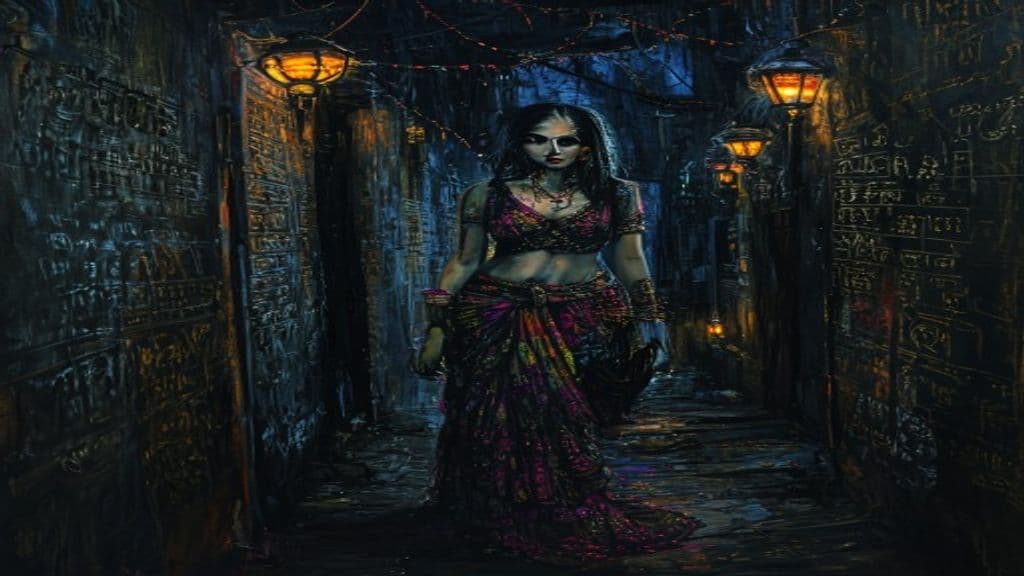
Stree
A vengeful female spirit from Chanderi who abducts men during festival nights. Warded off by the inscription 'O Stree, kal aana' — her legend, still practised on walls across Madhya Pradesh, inspired the 2018 Bollywood horror-comedy.
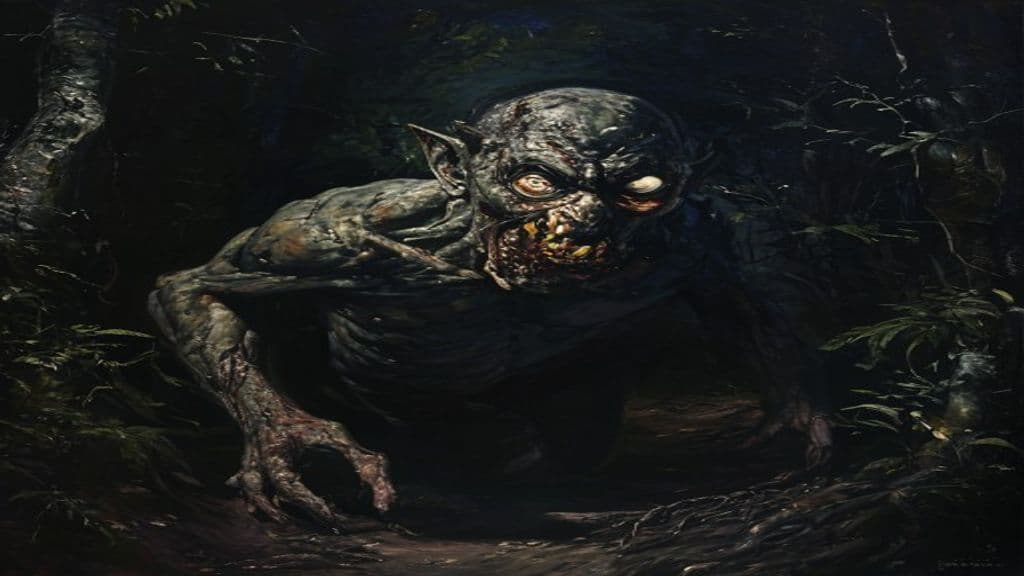
Pishacha
Flesh-eating spirits of Hindu mythology that haunt cremation grounds and are associated with disease, madness, and possession. The lowest class of demon in the Vedic hierarchy.

Rakshasa (Himalayan variants)
A Himalayan reception of the pan-Indian rakshasa motif: hostile or disruptive non‑human beings known from Sanskrit epic and Puranic literature, here noted where Himalayan sources and discussions intersect with the broader epic tradition. The supplied sources do not document distinct, well‑attested Himalayan folklore variants; the entry therefore presents primarily the epic/legendary profile as transmitted into Himalayan contexts in general references.

Dayan (Daayan, Ḍāin, Ḍāini)
A North and East Indian folkloric figure: a malevolent female revenant or vengeful spirit commonly associated with women who died in traumatic or unresolved circumstances. Dayans are described in popular sources as powerful life-draining entities with distinctive physical markers and as a label that also functions in social witch‑hunt practices.
Brutus of Troy
Brutus of Troy is a legendary ancestral founder-king in medieval British pseudo-history, presented as the eponymous progenitor of the Britons and first ruler/founder of Britain in narratives that link Britain to Trojan and, in some recensions, biblical genealogies. Best known from Geoffrey of Monmouth’s Historia Regum Britanniae and earlier mentions in the Historia Brittonum, the figure functions as a culture-ancestor and legitimizing founder rather than a supernatural being.
Brynhildr (Brunhild / Brunhilda)
Brynhildr (Old Norse) — also known as Brunhild or Brunhilda in Germanic tradition — is a named valkyrie and tragic heroine of the Sigurd/Brunhild cycle in Old Norse-Icelandic heroic poetry. She appears in the Poetic Edda and related heroic lays as a fateful, martial woman associated with the valkyrie class and the narrative of Sigurðr (Sigurd) and Guðrún.
Brân the Blessed
Brân the Blessed (Welsh: Bendigeidfran / Brân Fendigaidd, 'Blessed Crow') is a giant-king in the Second Branch of the Mabinogi who functions as a mythic sovereign of Britain. He is depicted as a colossal royal figure associated with the sea and with poetry/bards; after being mortally wounded his severed head remains animate and is used as an apotropaic guardian of the island.
Bubota
Bubota is attested in a small, heterogeneous set of Catalan-language and English-language sources as a feminine ghost or spectral figure invoked in contemporary artistic works and occasional popular references. Available materials classify it as a female-associated spirit and use the term both as a folkloric label and as a cultural/metaphorical signifier; however, primary folkloric narratives, standardized iconography, and ritual practice are not documented in the provided sources.
Bucca
A class of place‑bound supernatural beings attested in Cornish folklore, associated in surviving sources with coastal and mining landscapes and with local occupational culture; the surviving packet of sources is fragmentary and primarily cites an anthology excerpt (Mabel Quiller Couch).
Buchis
The deification of the kꜣ (ka) of the war god Montu, incarnated as a sacred bull in Egyptian mythology. (Note: - Remove "Greater" power tier; no information in source material supports this level of power. - Add sensory cues (e.g., distinctive markings, specific sounds) related to sacred bulls' selection and w)
Bucky Barnes
James Buchanan "Bucky" Barnes is a fictional human character created for American comic books published by Marvel Comics (originally Timely Comics). Introduced in 1941 as the youthful sidekick of Captain America, he was later retconned and reinvented in modern comics as the brainwashed cyborg assassin the Winter Soldier before regaining memories and seeking redemption.
Buda
In Ethiopian and Eritrean popular religion, buda (Ge'ez: ቡዳ) is a socially-located hostile power associated with the evil eye and the ability of its bearer to change into a hyena. It is attributed to particular social groups (for example Beta Israel and metalworking castes) and is countered by amulets, debtera-made protections, and Christian exorcism.
Budai (Qieci)
Budai is the nickname of the historical Chinese monk Qieci (契此), a jovial, sack-carrying mendicant whose persona was incorporated into Chan (Zen) Buddhist popular practice and often identified with the future Buddha Maitreya. He functions in tradition as a folkloric saint-monk and pedagogical symbol of abundance, contentment, and accessible awakening rather than as an abstract hostile spirit.
Buddha (Siddhartha Gautama)
Siddhartha Gautama, most commonly called the Buddha, is presented in the provided sources as a historical wandering ascetic and religious teacher of the 6th–5th century BCE who attained nirvana, taught Dharma, and founded the monastic community (sangha) that became Buddhism.
Buddhas of the Ten Directions (Shífāng Fó)
A doctrinal and devotional designation for the manifold buddhas present throughout the Buddhist cosmological field (the 'ten directions'), invoked as fully awakened presences and used as objects of contemplation and repentance in devotional practice.
Budeia
Budeia is a lexical/onomastic term attested in two distinct registers: (1) an ancient Greek mytho-genealogical figure and an epithet of Athena meaning 'oxen-yoker', and (2) a modern Norwegian occupational noun (budeia) denoting the woman who tends the summer farm dairy. The term consistently occupies an agricultural/labor semantic field in both traditions rather than functioning as a singular supernatural entity.
Community Record
- [1]Buckriders (Wikipedia). Wikipedia, 'Buckriders' entry — summary of folkloric motif and historical prosecutionswiki
- [2]Wikidata: Q539273. Wikidata item for 'Buckriders' (labels/descriptions)other
- [3]RHOB EP 54 The Buck Riders (archival podcast summary). Random History of Belgium episode summary referencing historical buckrider trials and contextother
- [4]Land Of Legends / Son Electronique (archival documentary notes mentioning Buckriders). Archive notes referencing the buckrider tradition in regional legend compilationsother
- [5]Sittard archival mention of Buckriders. Local archival material referencing buckrider accounts in the Sittard regionother
- [6]S.J.P. Sleinada (1779) — quoted travel-spell. As summarized in modern sources: S.J.P. Sleinada quoted travel-spell 'Over huis, over tuin, over staak, en dat tot Keulen in de wijnkelder!' (quoted in secondary summaries)folk
- [7]Contemporary archival and historiographical remarks (trial of Wellen, 1774; Attorney General Gaspard de Limpens). Discussion of the 1774 'trial of Wellen', use of the term 'Bokkenrijders', and Gaspard de Limpens' critique of confessions extracted under torturewiki