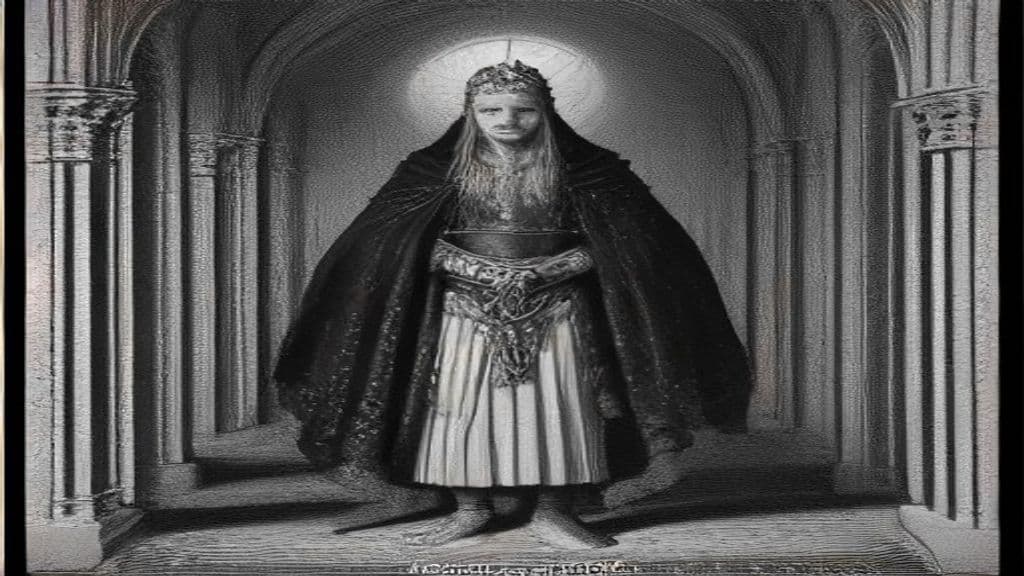
The supplied sources do not record a mythic birth or supernatural origin for Budli. He is presented in saga and ballad materials as a named royal ancestor: a king whose primary narrative function is genealogical—most notably as father of Brynhild/Brynhildr in the Saga of the Volsungs and related ballad tradition. His name also appears in Eddaic name-lists and genealogical lists that place him within the network of Volsung/Burgundian-cycle lineages.
The sources treat Budli as a human king and provide only situational descriptions rather than physical detail. Ballad fragments place him in a hall (e.g., “In midmost hall stands Budli, leans against the board”) and refer to him as a ruling chieftain (e.g., “the king rules over a long grove, they called him Budli the bright”), but no distinctive corporeal or supernatural features are recorded in the supplied materials.
No supernatural abilities are attributed to Budli in the cited saga, Eddaic, or ballad sources. His role is narrative and relational: a ruling king and father-figure whose chief function within the traditions is to establish the lineage and social status of other legendary characters (notably Brynhild).
Sigurd
Sigurd (Old Norse Sigurðr; continental Siegfried) is a legendary human hero of the Germanic heroic tradition—famed as the slayer of the dragon Fáfnir and the possessor of the Nibelung/Nibelungen hoard—whose life and death are told across Norse sagas, the Nibelungenlied, Eddic poetry, and medieval ballads.
Budai (Qieci)
Budai is the nickname of the historical Chinese monk Qieci (契此), a jovial, sack-carrying mendicant whose persona was incorporated into Chan (Zen) Buddhist popular practice and often identified with the future Buddha Maitreya. He functions in tradition as a folkloric saint-monk and pedagogical symbol of abundance, contentment, and accessible awakening rather than as an abstract hostile spirit.
Buddha (Siddhartha Gautama)
Siddhartha Gautama, most commonly called the Buddha, is presented in the provided sources as a historical wandering ascetic and religious teacher of the 6th–5th century BCE who attained nirvana, taught Dharma, and founded the monastic community (sangha) that became Buddhism.
Buddhas of the Ten Directions (Shífāng Fó)
A doctrinal and devotional designation for the manifold buddhas present throughout the Buddhist cosmological field (the 'ten directions'), invoked as fully awakened presences and used as objects of contemplation and repentance in devotional practice.
Budeia
Budeia is a lexical/onomastic term attested in two distinct registers: (1) an ancient Greek mytho-genealogical figure and an epithet of Athena meaning 'oxen-yoker', and (2) a modern Norwegian occupational noun (budeia) denoting the woman who tends the summer farm dairy. The term consistently occupies an agricultural/labor semantic field in both traditions rather than functioning as a singular supernatural entity.
Budha
Budha (Sanskrit: बुध) is the personification of the planet Mercury in Indian astronomical and astrological tradition. He functions both as the observed planetary body whose motions are recorded in classical Sanskrit astronomical texts and as a navagraha deity associated with intelligence, memory, and the weekday Budhavara (Wednesday).
Budini
The Budini (Ancient Greek Βουδῖνοι) are recorded in Graeco-Roman ethnographic sources as a human tribal people of the forest‑steppe north of the Black Sea, associated with the Vorskla river valley and the multiethnic city of Gelonus in the first millennium BC. Classical accounts portray them as a hunting-dependent, linguistically distinct group noted for red hair and blue eyes; some archaeological interpretations tentatively link them to anomalous mortuary deposits.
Buer
Buer is a named spirit recorded in Renaissance grimoire tradition (notably the 16th-century Pseudomonarchia Daemonum) described there as a Great President of Hell who commands fifty legions of demons. Modern occult, gaming, and fan sources have elaborated visual and ritual details not attested in the supplied historical extracts.
Bug-Eyed Bandit
A nom-de-crime used by two DC Comics supervillains and later media adaptations for insect-themed criminal inventors who employ robotic or biologically inspired insect devices to commit theft, extortion, and assaults on technology-rich targets. The identity has appeared as Bertram Larvan (original comics), an unnamed son (later comics), and as a female reinterpretation Brie Larvan in Arrowverse television.
Bug-eyed monster (BEM)
A stock figure and visual trope of early- to mid-20th-century speculative fiction and related fan cultures, characterised by oversized, bulging or compound eyes and used as a conventionalised nonhuman antagonist signalling sexualized danger, abduction or general menace.
Buga
Buga (BUGA) is identified in the consulted sources as an Evenki (Evenk) sky or heaven god, rendered in brief tertiary references as the Evenki 'god of the heaven' and labelled by one popular summary as the 'Evenki Supreme God.' Available documentation in the provided set is fragmentary and supplies no detailed myths, rituals, or iconography for Buga.
Bugbear
A folkloric scare-figure historically invoked to frighten disobedient children, classed among boogeyman-type beings. Medieval descriptions in English sources portray it as a creepy, bear-like lurker in woods; modern popular culture and gaming have reimagined it as a large goblinoid monster.
Community Record
- [1]The Saga of the Volsungs : the Norse epic of Sigurd the Dragon Slayer. The Saga of the Volsungs (chapter heading: “Sigurd Rides through the Wavering Flames of Brynhild, the Daughter of Budli”).literary
- [2]Ballad fragments referencing Budli / Brynhild. Scandinavian ballad fragments (e.g., “In midmost hall stands Budli…” and “In ancient times there was a king Budli was his name…”), preserving Brynhild as ‘Budli's daughter’.folk
- [3]Eddaic name-lists (fragmentary reference including Budli). Eddaic/genealogical lists containing the name Buðli in sequences connected to Volsung/Burgundian-cycle figures (fragmentary context).literary
- [4]Wikipedia: Buðli. Summary entry for Buðli / Budli in public reference works summarizing saga and ballad attestations.wiki
- [5]Nordic Names: Buðli. Name‑list entry noting the Old Norse form Buðli and attestations in saga material.other