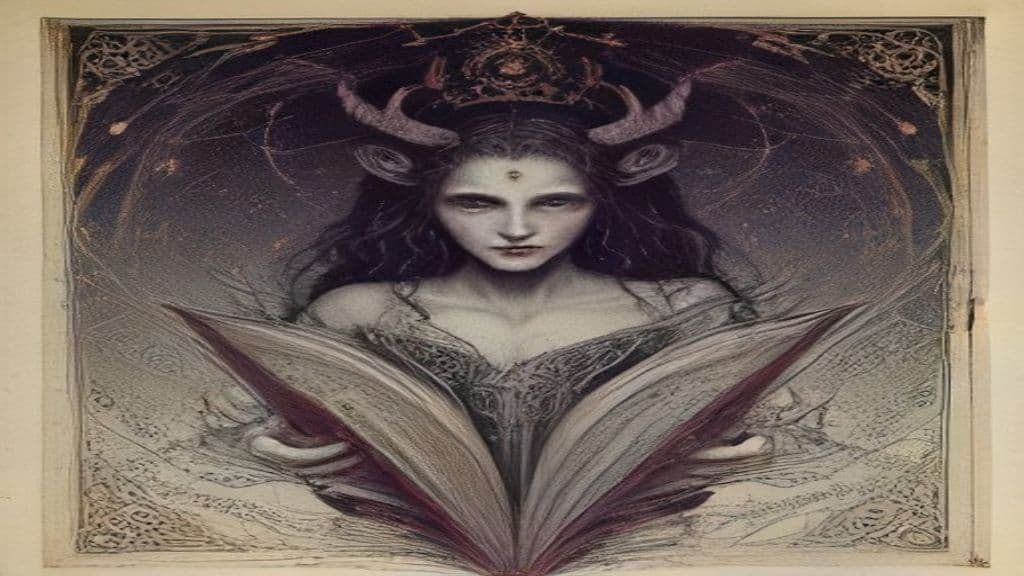
Buer appears in the corpus of Renaissance/early modern European demonological catalogues, most directly in the 16th-century grimoire tradition exemplified by the Pseudomonarchia Daemonum. In those listings compilers arranged named spirits into hierarchical offices and military formations; Buer is recorded within that literary-infernal bureaucracy as holding the title of Great President of Hell. The supplied source material does not provide any earlier folkloric origin or pre-grimoire antecedents for the name.
The historical extracts supplied offer only a brief, partial comparison—an interrupted phrase referencing Chiron, the chief centaur of Greek myth—without a full canonical physical description from the primary grimoire text in these sources. Contemporary occult, fan, and gaming pages frequently portray Buer as a multi-legged leonine/goatlike hybrid (for example, informal internet depictions describe a five‑legged creature), but such vivid visualizations derive from modern secondary and derivative materials rather than from the quoted 16th‑century extract and should be treated as later iconography.
Within the provided sources the principal attested attribute is Buer's office and command: he is described as a 'Great President of Hell' who commands fifty legions of demons, indicating a role as a ranked commander within grimoire hierarchies. The supplied extracts do not reliably record specific taught arts, magical specializations, or other powers from the Pseudomonarchia Daemonum; modern pages attribute seasonal strengths and ritual correspondences, but those attributions are modern reconstructions and are not verified in the historical extracts given.
Buddha (Siddhartha Gautama)
Siddhartha Gautama, most commonly called the Buddha, is presented in the provided sources as a historical wandering ascetic and religious teacher of the 6th–5th century BCE who attained nirvana, taught Dharma, and founded the monastic community (sangha) that became Buddhism.
Buddhas of the Ten Directions (Shífāng Fó)
A doctrinal and devotional designation for the manifold buddhas present throughout the Buddhist cosmological field (the 'ten directions'), invoked as fully awakened presences and used as objects of contemplation and repentance in devotional practice.
Budeia
Budeia is a lexical/onomastic term attested in two distinct registers: (1) an ancient Greek mytho-genealogical figure and an epithet of Athena meaning 'oxen-yoker', and (2) a modern Norwegian occupational noun (budeia) denoting the woman who tends the summer farm dairy. The term consistently occupies an agricultural/labor semantic field in both traditions rather than functioning as a singular supernatural entity.
Budha
Budha (Sanskrit: बुध) is the personification of the planet Mercury in Indian astronomical and astrological tradition. He functions both as the observed planetary body whose motions are recorded in classical Sanskrit astronomical texts and as a navagraha deity associated with intelligence, memory, and the weekday Budhavara (Wednesday).
Budini
The Budini (Ancient Greek Βουδῖνοι) are recorded in Graeco-Roman ethnographic sources as a human tribal people of the forest‑steppe north of the Black Sea, associated with the Vorskla river valley and the multiethnic city of Gelonus in the first millennium BC. Classical accounts portray them as a hunting-dependent, linguistically distinct group noted for red hair and blue eyes; some archaeological interpretations tentatively link them to anomalous mortuary deposits.
Budli (Buðli)
Budli (Old Norse Buðli) is a legendary king attested in Norse saga and ballad material. He appears as a mortal royal figure, chiefly known as the father of Brynhild/Brynhildr in the Volsung-related tradition and in later Scandinavian ballads and name-lists.
Bug-Eyed Bandit
A nom-de-crime used by two DC Comics supervillains and later media adaptations for insect-themed criminal inventors who employ robotic or biologically inspired insect devices to commit theft, extortion, and assaults on technology-rich targets. The identity has appeared as Bertram Larvan (original comics), an unnamed son (later comics), and as a female reinterpretation Brie Larvan in Arrowverse television.
Bug-eyed monster (BEM)
A stock figure and visual trope of early- to mid-20th-century speculative fiction and related fan cultures, characterised by oversized, bulging or compound eyes and used as a conventionalised nonhuman antagonist signalling sexualized danger, abduction or general menace.
Buga
Buga (BUGA) is identified in the consulted sources as an Evenki (Evenk) sky or heaven god, rendered in brief tertiary references as the Evenki 'god of the heaven' and labelled by one popular summary as the 'Evenki Supreme God.' Available documentation in the provided set is fragmentary and supplies no detailed myths, rituals, or iconography for Buga.
Bugbear
A folkloric scare-figure historically invoked to frighten disobedient children, classed among boogeyman-type beings. Medieval descriptions in English sources portray it as a creepy, bear-like lurker in woods; modern popular culture and gaming have reimagined it as a large goblinoid monster.
Buggane
A large, malevolent supernatural being from Isle of Man folklore, described in tales as ogre- or giant-like and sometimes a shapeshifter. Buggane stories depict it damaging buildings and livestock, attacking people, and appearing in coastal and farm contexts; some tales limit it by sacred or liminal boundaries such as water and hallowed ground.
Bugul Noz
A nocturnal spirit of Breton folklore (particularly Morbihan) whose name is glossed as 'Night Shepherd' or 'child of the night.' Accounts vary: some present the Bugul Noz as a small goblin-like nocturnal being that menaces shepherds and people who linger outdoors after dark; other informants describe a tall, foreboding twilight figure. It functions in local culture as a cautionary night-being that enforces avoidance of unsafe nighttime activity.
Community Record
- [1]Buer (demon) - Wikipedia. "Buer is a spirit that appears in the 16th-century grimoire Pseudomonarchia Daemonum and its derivatives, where he is described as a Great President of Hell, having fifty legions of demons under his command."wiki
- [2]List of demons in the Ars Goetia - Wikipedia (related cataloguing tradition). Related cataloguing tradition and comparable roster of named spirits with ranks and legions.wiki
- [3]FUCK OFF BUER (Unlawful Games blog). Contemporary informal depiction describing a modern multi‑legged leonine/goatlike image: "IF YOU ACCIDENTALLY ROLL A DEMONIC 5 GOAT LEGGED LION..." (blog, modern/derivative).other
- [4]Buer Demon Dictionary - Male Demon Names List & Demonology (hellhorror.com). Modern occult/demon-name compilation that supplies secondary visual and ritual attributions (treated in the present document as modern/uncertain).other
- [5]Greyhawk Online — Project: Demons and Devils of the Flanaess — Buer. Example of modern gaming/fictional adaptation of the grimoire figure into contemporary fantasy settings (derivative use).other