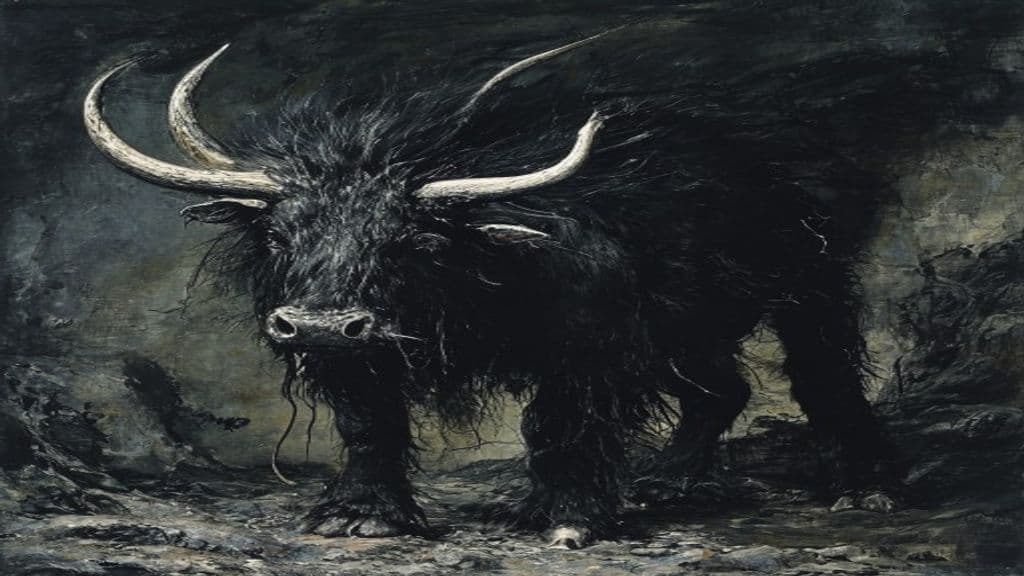
There is no single canonical origin myth in the supplied sources. Tales place particular bugganes in named localities (for example, the Buggan ny Hushtey living in a large coastal cave) and relate individual episodes—conflicts with saints (St. Trinian), contests with legendary heroes (Fionn mac Cumhaill), and punitive visits on households—that integrate them into the island's narrative landscape. Sources do not provide an etymology or an original creation story for the term.
Accounts vary across tales rather than presenting a single fixed form. Attested variants include a large black calf; a humanlike figure with equine features (ears or hooves); a creature 'covered with a mane of coarse, black hair' with eyes like torches and glittering tusks; and a huge man with bull's horns, glowing eyes and large teeth. Some stories emphasize great size and strength (for example, tearing the roof off a chapel) and also describe shapeshifting in certain retellings.
Narrative episodes attribute considerable physical strength and destructive behavior to bugganes: ripping thatch and roofs from buildings, throwing or tossing sheep over cliffs or steep banks, and puffing smoke down chimneys. In individual tales a buggane is said to have caused a storm and steered a ship back toward the island in an attempt to return; in other tales bugganes are deployed occasionally by fairies to punish people who offended them. They are portrayed as hostile to humans and as enforcers of social norms (for example stories punishing laziness). Sources also record that bugganes were said to be unable to cross water or stand on hallowed ground, a limitation that recurs in the narratives.
Weaknesses
- conditionunable to cross water
- conditionunable to stand on hallowed ground
Wards
- conditiontaking refuge on hallowed ground (consecrated chapels, churches)
- ritualinvoking a saint (e.g., St. Trinian) and establishing/repairing a chapel

Arkan Sonney
A Manx folkloric 'fairy animal' whose name is also the everyday Manx word for hedgehog; in tradition it appears as a white pig that brings good fortune to those who see or catch it but causes misfortune if held too long.
Moddey Dhoo
A place‑bound phantom black dog from Manx tradition, chiefly associated with Peel Castle (St Patrick’s Isle). Recorded in an 18th‑century account by George Waldron and later collected and expanded by folklorists, the Moddey Dhoo appears at dusk in the castle guardroom and returns to a secret passage at dawn; later local reports extend the motif across the Isle of Man with variant descriptions.
Buer
Buer is a named spirit recorded in Renaissance grimoire tradition (notably the 16th-century Pseudomonarchia Daemonum) described there as a Great President of Hell who commands fifty legions of demons. Modern occult, gaming, and fan sources have elaborated visual and ritual details not attested in the supplied historical extracts.
Bug-Eyed Bandit
A nom-de-crime used by two DC Comics supervillains and later media adaptations for insect-themed criminal inventors who employ robotic or biologically inspired insect devices to commit theft, extortion, and assaults on technology-rich targets. The identity has appeared as Bertram Larvan (original comics), an unnamed son (later comics), and as a female reinterpretation Brie Larvan in Arrowverse television.
Bug-eyed monster (BEM)
A stock figure and visual trope of early- to mid-20th-century speculative fiction and related fan cultures, characterised by oversized, bulging or compound eyes and used as a conventionalised nonhuman antagonist signalling sexualized danger, abduction or general menace.
Buga
Buga (BUGA) is identified in the consulted sources as an Evenki (Evenk) sky or heaven god, rendered in brief tertiary references as the Evenki 'god of the heaven' and labelled by one popular summary as the 'Evenki Supreme God.' Available documentation in the provided set is fragmentary and supplies no detailed myths, rituals, or iconography for Buga.
Bugbear
A folkloric scare-figure historically invoked to frighten disobedient children, classed among boogeyman-type beings. Medieval descriptions in English sources portray it as a creepy, bear-like lurker in woods; modern popular culture and gaming have reimagined it as a large goblinoid monster.
Bugul Noz
A nocturnal spirit of Breton folklore (particularly Morbihan) whose name is glossed as 'Night Shepherd' or 'child of the night.' Accounts vary: some present the Bugul Noz as a small goblin-like nocturnal being that menaces shepherds and people who linger outdoors after dark; other informants describe a tall, foreboding twilight figure. It functions in local culture as a cautionary night-being that enforces avoidance of unsafe nighttime activity.
Bukavac
Bukavac is a demonic mythical creature from Slavic (Serbian) popular belief, attested chiefly in Syrmia. Described as an aquatic, nocturnal menace, it was said to emerge from lakes and pools to make loud noises and to jump onto people and animals, strangling them.
Bukki
Bukki (Hebrew: בֻּקִּי, Buqqī) is attested in biblical and related traditions as a personal name borne by at least two distinct human figures: a Danite prince named in Numbers 34:22 and a member of the Aaronid priestly genealogy recorded in 1 Chronicles (and echoed in Ezra-related lists). The name appears in variant forms across textual traditions (e.g., Boccas, Borith) and in modern secular usages unrelated to the ancient individuals.
Bulgae (Korean Fire Dog)
A mythical Korean fire dog said to cause eclipses by biting the Sun and Moon. (Note: * The power tier is incorrect; according to the source, Bulgae cause eclipses by biting both the Sun and Moon, but there's no indication that they're on a primordial level. It should be at least Ancie)
Bulgasari (iron-eating monster)
Bulgasari (불가사리, also romanized Bulgasali) is a kaiju-style iron-eating monster originating in mid-20th-century Korean cinema. The creature is best known from the lost 1962 South Korean film Bulgasari, in which a martial artist (Nam Hyeong) is resurrected as the iron-eating monster to enact revenge on his murderers; a distinct later North Korean film titled Pulgasari (1985) is related in film-history discussions but is a separate production.
Community Record
- [1]Buggane (Wikipedia). Wikipedia: 'Buggane' (Manx folklore) entry, various tale summaries and motifswiki
- [2]Ghosts and Bogles (collection). Collected tales including Manx ghost and bogles material referenced in summaries of buggane storiesfolk
- [3]Chillers for Christmas (collection). Anthology containing retellings of Manx buggane episodes as cited in secondary summariesfolk
- [4]Otherworld: The Isle of Mist (novel). Modern fictional work referencing Manx supernatural beings; cited in summaries but not used for traditional practice claimsliterary
- [5]Buggane (Wikidata). Wikidata entry for Bugganeother