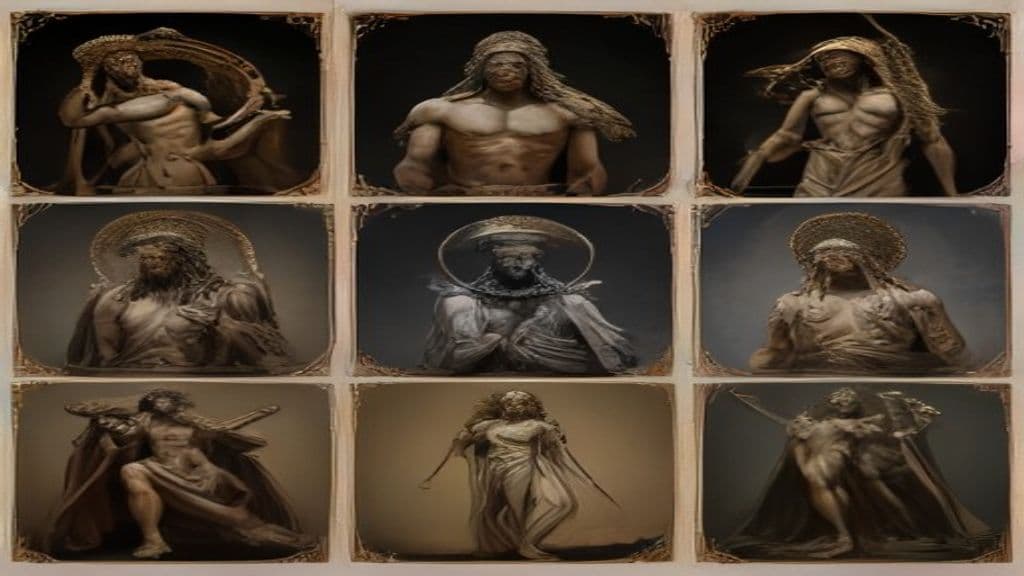
The name Butes designates multiple mythic personages in Greek tradition. Prominently: an Athenian prince, son of King Pandion I and the naiad Zeuxippe, who served as a priest of Poseidon and Athena and was worshipped as a hero by the Athenians; an Argonaut, son of Teleon (with variant parentage in some accounts), who alone yielded to the Sirens' song and was carried by Aphrodite to Lilybaeum in Sicily to become her lover (fathering Eryx in some versions); and a Thracian son of Boreas who settled on Strongyle (Naxos), preyed on sailors, raped a Maenad (Coronis), and was driven mad by Dionysus and died by throwing himself down a well. Additional minor bearers of the name appear in various epic episodes (possible father of Hippodamia, a companion of Cephalus, an Amycus-clan member killed in boxing, a warrior among the Seven against Thebes, a servant of Anchises, and a warrior under Aeneas), showing the name's reuse across genealogical and narrative contexts.
Classical sources summarized treat the various Butes figures as ordinary human/heroic personages rather than as a distinct morphological type; no sustained or consistent physical description is provided. Individual accounts emphasize genealogy, social role (prince, Argonaut, pirate, priest), and narrative episode rather than corporeal traits.
No consistent innate supernatural powers are attributed to the name as a class. Individual narratives emphasize roles and consequences of divine interaction: the Athenian Butes functions as priest and posthumous hero within civic cult; the Argonaut Butes is uniquely susceptible to the Sirens' song and is thereafter transported and favored by Aphrodite (becoming her lover and, in some accounts, fathering Eryx); the Thracian Butes engages in violent raiding and is subject to Dionysian punishment (madness) leading to self-destruction. Thus, capacities are ordinary human/heroic activities supplemented by vulnerability to or favor from gods rather than intrinsic supernatural abilities.
Weaknesses
- othersubject to direct divine influence or punishment
Wards
None recorded.

Aphrodite
Aphrodite is a major ancient Greek goddess associated with love, lust, beauty, pleasure, passion, procreation, and related social and cosmic forces. She is counted among the principal Olympian deities with major cult-centers (Cythera, Cyprus, Corinth, Athens), celebrated annually at the Aphrodisia, and syncretized with the Roman Venus.

Dionysus
Dionysus (Ancient Greek: Διόνυσος) is a major ancient Greek deity associated with wine and winemaking, vegetation and fertility, festivity and theatre, ritual ecstasy and possession, and liminal links with death and the underworld. He is an epiphany-god who travels between worlds, whose cult includes ecstatic rites and mystery initiation.
Agreus
Agreus (also spelled Argeus) is attested in modern compilations as one of the Pans — a class of rustic, pan-like rural deities in classical Greek mythology. In modern database records he is additionally listed as a son of Apollo; beyond classificatory notes, surviving citations provide no detailed cultic or narrative material for him.
Alkyonides
In classical Greek mythology the Alkyonides (Alcyonides) are the seven daughters of the giant Alcyoneus. Classical summaries record that, in grief at their father's death, the daughters threw themselves into the sea; the mythic name survives in modern Greek toponymy as the Alkyonides Gulf.
Alseid
An Alseid (Ancient Greek: Ἀλσηΐδες, Alsēïdes) is a class of nymph in classical Greek mythology specifically associated with groves and glens. The term functions as a locality-category within the broader Greek taxonomy of nymphs; later modern sources reuse the label for varied fantasy and game creations.
Amphinome
Amphinome is an ancient Greek proper name attested for multiple distinct female figures in myth — chiefly a Nereid (sea-nymph) and several mortal women (including a wife of Aeson and one of the Peliades). The name is also reused in modern taxonomic and creative contexts (annelid genus, butterfly species, and contemporary fantasy), but these are later reuses rather than continuations of a single mythic being.
Androgeos
Androgeos (Greek Ἀνδρόγεως, Latin Androgeus) is a personal name borne by mortal figures in classical Greek and Roman literary tradition, most notably a son of Minos and Pasiphaë whose death in mythic narratives precipitates Athenian tribute to Crete. A separate, less-detailed bearer of the name is listed as a Greek soldier present at the sack of Troy in some sources.
Arge
Arge (Ancient Greek: Ἄργη, Árgē) is a name applied to several distinct female personages in Greek mythic traditions — a boastful huntress transformed by a god, one of the Hyperborean maidens honored at Delos, and a Cretan nymph attested in a rare variant of Dionysus’ birth. The name functions as an individuated personal name across local narratives rather than as a coherent supernatural taxon.
Cilix
Cilix is a figure from Greek myth presented as a Phoenician prince and eponymous founder whose settlement in Asia Minor explains the place-name Cilicia. In modern usage the name is also applied to a genus of insects and to an impact structure on Jupiter's moon Europa, but those are scientific reuses of the name.
Cleite (Clite / Κλείτη)
Cleite (Ancient Greek: Κλείτη) is a personal name borne by several mortal women in Greek myth rather than a single supernatural class. Figures called Cleite appear in different epic cycles—Argonautica, the Danaid traditions, the Trojan cycle, and Nonnus' Dionysiaca—typically as wives, mourners, maenads, or mothers whose narrative fates include grief, filial ties, and in one tradition metamorphosis into a spring.
Eileithyia
Eileithyia is a Greek divine figure principally associated with childbirth and midwifery. Invoked to ease labour pains and ensure successful delivery, she appears in classical poetry, mythic episodes, and in long-lived local cults (notably cave-sanctuaries in Crete and sanctuaries in Aigion and other locales).
Lacedaemon
Lacedaemon (Lakedaimon, Lacaedemon) is a mythic eponymous king in classical Greek tradition: the legendary founder whose name is given to the region and polis of Lacedaemon/Sparta. He is presented genealogically as a son of Zeus and the Pleiad Taygete and as husband of Sparta, serving an etiological function linking the city to divine ancestry.
Manto (daughter of Teiresias)
Manto is a named figure in classical mythological lists identified in the supplied sources as a daughter of the seer Teiresias. The provided materials record her genealogical identity but do not supply narratives, descriptions, or ritual material concerning her.
Meganeira
Meganeira (Μεγάνειρα, Megáneira) is a personal name borne by mortal women in Greek mythic genealogies and narratives. The name, glossed as 'great lady' or 'woman of high status,' appears attached to several human figures who function as daughters, wives, or mothers within Arcadian, Eleusinian, and local Parnassian stories.
Community Record
- [1]Butes. Wikipedia contributors. 'Butes.' Wikipedia, The Free Encyclopedia.wiki