
Meganeira is not presented as a supernatural origin being but as a personal name in Greek myth. Different traditions attach the name to distinct mortal women: one account makes her daughter of Crocon and Saesara and mother of Apheidas and Elatus by Arcas (thus situating her in Arcadian genealogy); another names her mother, by Diomus, of Alcyoneus of Crisa at the foot of Parnassus (a lineage appearing in a local sacrificial legend); a variant tradition identifies Meganeira with Metanira, wife of King Celeus of Eleusis. Across accounts she functions to link familial lines and local narratives to broader mythic cycles.
No physical description is provided in the cited sources. The references are genealogical and narrative, and make no claim about Meganeira's looks or distinctive physical traits.
The sources attribute no supernatural abilities to Meganeira. Her role in the traditions is familial and narrative—mother, daughter, or wife—serving to connect other named figures (e.g., Arcas, Apheidas, Elatus, Alcyoneus) within mythic genealogies and local stories rather than performing feats or exerting magical influence.
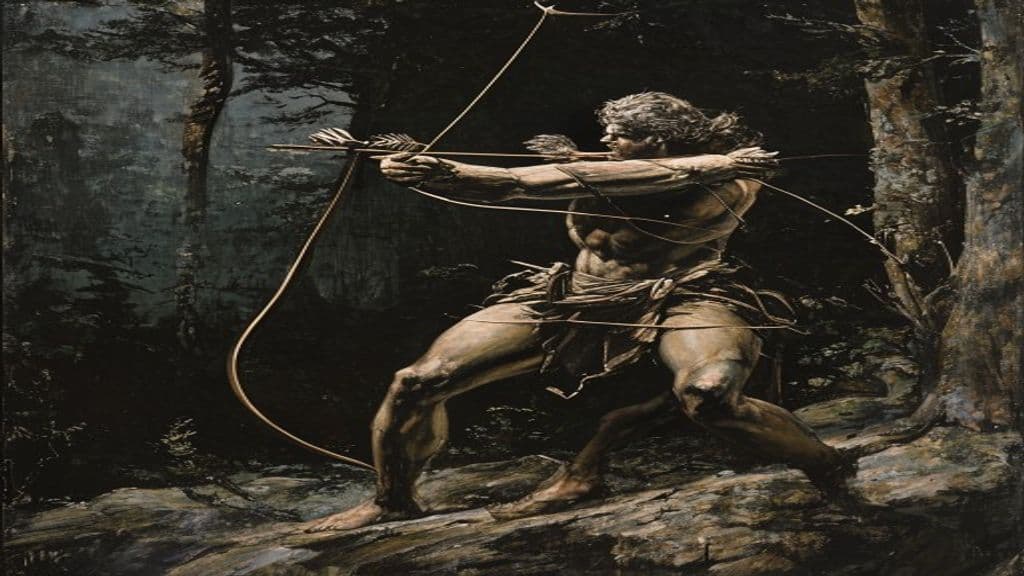
Arcas
Arcas (Ancient Greek Ἀρκάς) is a mythic Greek culture-hero and eponymous founder of Arcadia: a hunter who becomes king, credited with teaching weaving, baking, and agriculture, and whose narrative involves Zeus, Callisto, Lycaon, and apotheosis among the stars.

Apheidas
Apheidas is a personal name attested in ancient Greek mythic genealogies and narratives that refers to multiple distinct figures — including an Arcadian son of Arcas, a centaur at the wedding of Pirithous and Hippodamia, one of Odysseus’ companions slain by the Cyclops Polyphemus, a short-reigning legendary king of Athens, and an eponymous ancestor of a Molossian subgroup. The name appears across epic, genealogical, and local-regional traditions rather than as a single, consistent supernatural class.

Elatus
Elatus (Ancient Greek: Ἔλατος) is a personal name borne by multiple distinct figures in ancient Greek mythic tradition — including an Arcadian founder-eponym, a Lapith prince, a centaur slain in combat with Heracles, and several minor epic personae (charioteer, Trojan ally, suitor). The name functions as an onomastic label across genealogical, foundation, and heroic-age narratives rather than designating a single recurring supernatural class.

Alcyoneus
Alcyoneus (Ancient Greek Alkyoneús, Ἀλκυονεύς) is a colossal monstrous figure in Greek myth, variably presented as one of the Gigantes (Giants) born of Gaia and as a singular enormous hostile herdsman/warrior opposed to Heracles. Noted for prodigious strength and for a peculiar invulnerability tied to his native land, he is defeated when Heracles drags him out of his homeland at Athena's counsel in one influential tradition.

Metanira
Metanira is the mortal queen of Eleusis in Greek myth, wife of King Celeus, who figures in the episode where Demeter, disguised as a nurse, attempts a secret rite to make a royal child immortal. Metanira’s discovery and frightened cry interrupt the goddess’s ritual and thereby alter the outcome, after which Demeter gives the household the gift of agricultural knowledge instead.
Celeus
Celeus (Greek Κελεός, Keleós) is a mythic king of Eleusis in Attica who, as a hospitable mortal, becomes an early recipient of Demeter's favors and teachings; his household events (the attempted immortalization of his son Demophon and the instruction of Triptolemus in agriculture) are foundational to the Eleusinian origin-myths.
Community Record
- [1]Meganeira — Wikipedia. Wikipedia contributors. "Meganeira." Wikipedia, The Free Encyclopedia. https://en.wikipedia.org/wiki/Meganeirawiki
- [2]Meganeira — Wikidata. Wikidata entry Q3853936: Meganeira. http://www.wikidata.org/entity/Q3853936wiki