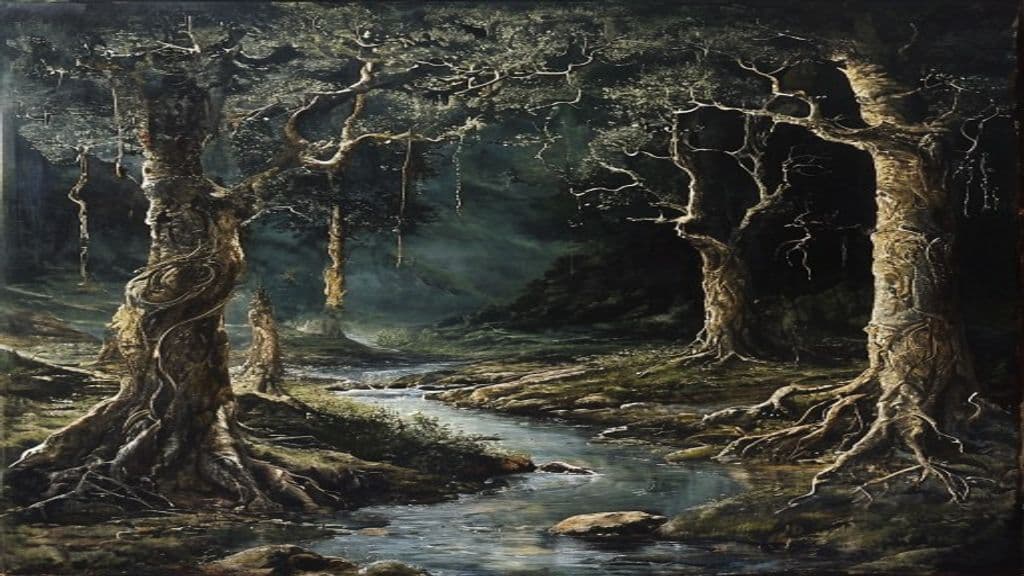
Physical descriptions of individual sacred trees are not provided in the source material, but certain types are referred to as 'fairy trees' on the Isle of Man.
Sacred trees possess symbolic significance and serve as conduits for medicinal properties or abodes for nature spirits.
Weaknesses
- Disrespect
Wards
- Respect
Aengus
Aengus (Óengus, Aonghus) is a member of the Tuatha Dé Danann in Irish myth, portrayed as a youthful, attractive figure associated with love, youth, poetic inspiration and seasonal/solar symbolism; he is linked to Brú na Bóinne (Newgrange) and appears as fosterer, protector, enchanter and avenger in multiple tales.
Anguish of Ireland
A mythological character in King Arthur's stories, described as a king and enemy of Arthur. (Note: - Power tier should be Greater (Anguish is a regional power in the context of King Arthur's stories, not a deity-level Ancient being) - Abilities description is partially accurate; Anguish does acknow)
Arevakhach’
The Armenian eternity sign is an ancient national symbol representing the Armenians' spiritual and celestial connection. It appears as a geometric figure on khachkars and church walls, embodying the significance of faith and symbolism in Armenian tradition. (Note: - Power tier: Primordial (as it's described as an "ancient" national symbol, but there's no indication that it's deity-level) - Appearance: Not enough detail is provided; the source material only ment)
Baltic Mythology
A complex pantheon of gods, spirits, and supernatural beings in ancient Baltic cultures. (Note: 1. Power tier: Change to "Ancient" as Primordial implies a cosmic entity, which is not supported by the source material. 2. Origin story: Specify that the connection with nature and inspiration from t)
Bedivere
One-handed knight and marshal of King Arthur's Round Table, known for returning Excalibur to the Lady of the Lake. (Note: - Power tier should be Greater (powerful regional), as Bedivere is a human character with significant roles within the Arthurian court, but not necessarily on a cosmic or deity-level. - Appearance: Th)
Blue Stone (Russia)
A type of sacred stone in Slavic tradition, held significant spiritual significance and venerated through simple rituals. (Note: - Power tier should be Lesser (since they don't have major hallows and are venerated in a simpler way). - Abilities: "Venerated through simple rituals" is vague; clarify that these rituals include pou)
Broichan
A 6th century Celtic wizard documented by Adomnán of Iona, with magical abilities and connections to spiritual or supernatural forces. (Note: 1. Power tier should be Ancient, as a wizard serving a king and having connections to a saint is more deity-level than primordial. 2. Add sensory cues based on the fact that Adomnán wrote about Broich)
Bullaun
A natural feature in Celtic tradition, often imbued with spiritual significance. (Note: - Power tier should be Primordial=cosmic, given its association with natural features and spiritual significance. - Origin story missing entirely; add from source material (if available) or consult ex)
Celtic Calendar
A system used by ancient Celts to organize their timekeeping and festivals, tracking the cycles of nature and marking important events on the lunar and solar calendars. (Note: 1. Power tier: Should be Primordial (since it's an entire system and not directly tied to a specific entity with abilities). 2. Abilities: Add "Organization" or a similar ability that reflects its pra)
Clootie Well
A Celtic tradition where individuals leave offerings of cloth or ribbons at holy wells, believed to possess healing properties. (Note: 1. Remove "Power tier: Ancient" as it contradicts the description of abilities (no classical powers) and origin story (not deity-level). 2. Add "Origin story: Based on ancient custom of leaving votive)
Gormshuil Mhòr na Maighe
A powerful, Gaelic Scottish woman of supernatural reputation associated with witchcraft and mysterious sea events. (Note: - Power tier: Should be Primordial (cosmic) rather than Ancient (deity-level), given her association with "mysterious sea events" and control over a significant historical event. - Weaknesses: Not men)
Leprechaun
A diminutive, solitary supernatural being from Irish folklore, commonly depicted as a shoemaker who delights in mischief and is associated with hidden or buried treasure. Prominent in later folkloric collections and the 19th‑century literary revival rather than central early mythic cycles.
Community Record
- [1]